



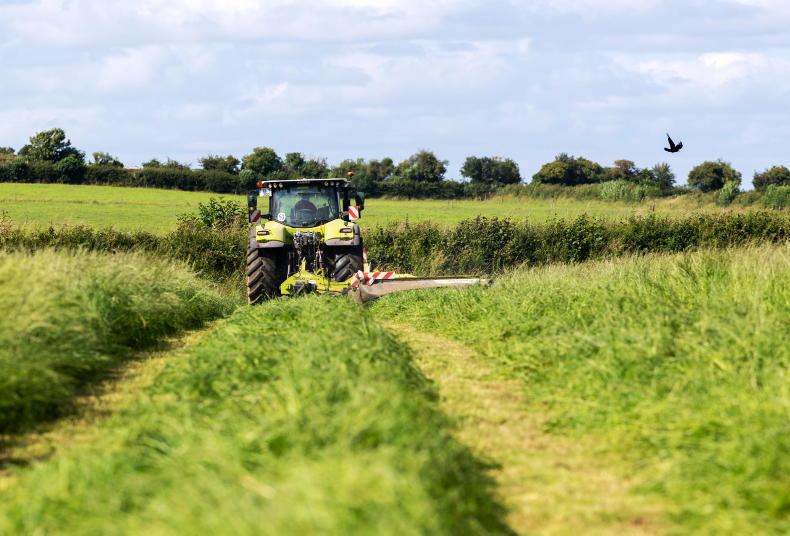
The Oireachtas Joint Committee on Agriculture and Food has urged caution against the "excessive" use of grass as a feedstock for anaerobic digestion plants, warning that it could reduce feed availability for livestock and undermine Ireland's food security.
The warning is one of 12 recommendations contained in the committee's new report on anaerobic digestion, launched this week.
However, when questioned on what constitutes excessive use of grass, the committee did not provide any figures.
Under EU regulations, the use of crops such as grass is already limited, with most AD plants expected to source around 30% of their feedstock from crops.
The report also contains a number of recommendations aimed at supporting the sector, including the implementation of the Renewable Heat Obligation, the transposition of RENURE legislation and further research into reverse compression for biomethane injection.
Legal obligation
The State's chosen method of developing an AD industry differs significantly from that of most other European countries.
Rather than introducing a support scheme for AD plants, Ireland plans to implement a legal obligation on fuel suppliers and consumers to purchase renewable heating fuels.
For the natural gas network, biomethane is currently the only renewable alternative.
This approach largely favours large-scale developments, which is why most AD projects currently in the pipeline are utility-scale plants.
However, the National Biomethane Strategy states that one of its key objectives is to make farm-scale AD plants economically viable, something that will require a different policy approach.
While the committee's report acknowledges that a grant scheme should be introduced for farm-scale plants, it provides little detail on how these projects will be made commercially viable.
Unlike many other European countries, Ireland has yet to outline a dedicated support mechanism that would enable farmers to invest in and operate small-scale AD plants.
Community concerns
The committee's recommendations were heavily influenced by concerns expressed by the National Biogas Concerns Group, with six of the 12 recommendations reflecting issues raised by the organisation.
While the group states that it is not opposed to AD, it called for the development of national planning guidelines, monitoring of gas emissions from plants and statutory guidance on community engagement.
The group also called for greater regulation of AD plants, although the report notes that the industry maintains it is already highly regulated.
'You can't eat gas'
Independent TD Danny Healy-Rae, who attended the report's launch, also expressed concerns about the sector and questioned if planning permission is required for AD plants.
He also raised concerns about agricultural land being diverted from food to energy production, telling the committee: "You can't eat gas."



SHARING OPTIONS