


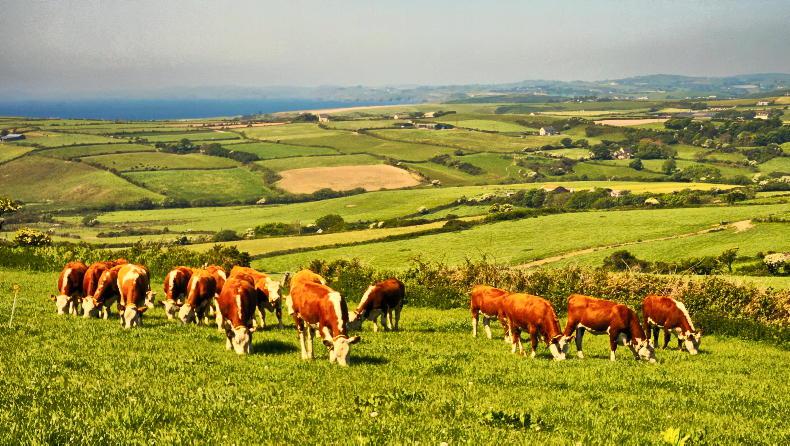
A tale of two halves is emerging on the grass growth front, with a massive variation developing across the country.
The north and west are enjoying a vintage year from a grazing perspective, but large swathes of the south and southeast are battling a deepening drought.
However, these generalisations hide the detail of the story, with the impact of the drought exacerbated from one area to the next by the localised nature of recent heavy rainfall. Grass growth in the northwest is averaging close to 70kg DM/ha/day, but a lot of farms in the region have recorded over 90kg DM/ha/day, according to John Maher, head of Teagasc’s Grass 10 programme.
In contrast, growth rates have dropped back to 30kg DM/ha/day on a growing number of highly-stocked dairy and beef farms in the south and southeast.
“This is just half the normal growth rate for this time of the year,” Maher explained.
The area facing the greatest drought challenge stretches from east Cork, across south Tipperary and Waterford, and into south Leinster. However, Maher stressed that grass growth problems are not uniform across this region. He pointed out that grass growth levels across east Cork, Waterford and Wexford averaged around 50-53kg/ha/day, but ranged from 32kg/ha/day to 70kg/ha/day.
“We have farms in Cork that are going really well, but others that are struggling,” he said.
Southeast
Ger Shortle, Wexford-based Teagasc regional manager, estimated that 20-25% of intensive farms in the county were supplementing grass with silage and meal, and had been for the last three or four weeks.
He agreed that the difficulties were localised and influenced by rainfall patterns.
Cork
Similarly, Gráinne Hurley of Teagasc in west Cork said the region could be divided in two.
“Grass growth is flying in the west [of Cork], but a lot of farmers in the east of west Cork are under pressure,” she said.
Massive variations in rainfall levels have contributed to the sharp differences in grass growth, Maher explained.
While Moorepark got just 116mm of rain over the last three months, and Johnstown Castle 160mm, Grange got 250mm and Athenry 376mm.
Soil moisture deficits have now hit 50mm in many parts of the south and southeast, which has significantly reduced grass growth, Maher maintained.
Leitrim
Despite the heavier rainfall in the west, Leitrim-based adviser Tom Coll said he had never seen ground conditions or grass growth as good as it has been in the region this year.
“It’s been a great year all round for farmers. I have never seen places as dry,” said Coll.
This has helped feed into national figures which show that grass growth levels are running around 1t/ha above the five-year average.
But the problems in the south are intensifying with each dry week.
“Current growth and predicted growth are half what is needed,” Maher pointed out.
“At this stage of the year farmers should be building grass covers, not going backwards and eating into winter feed,” he said.




SHARING OPTIONS