


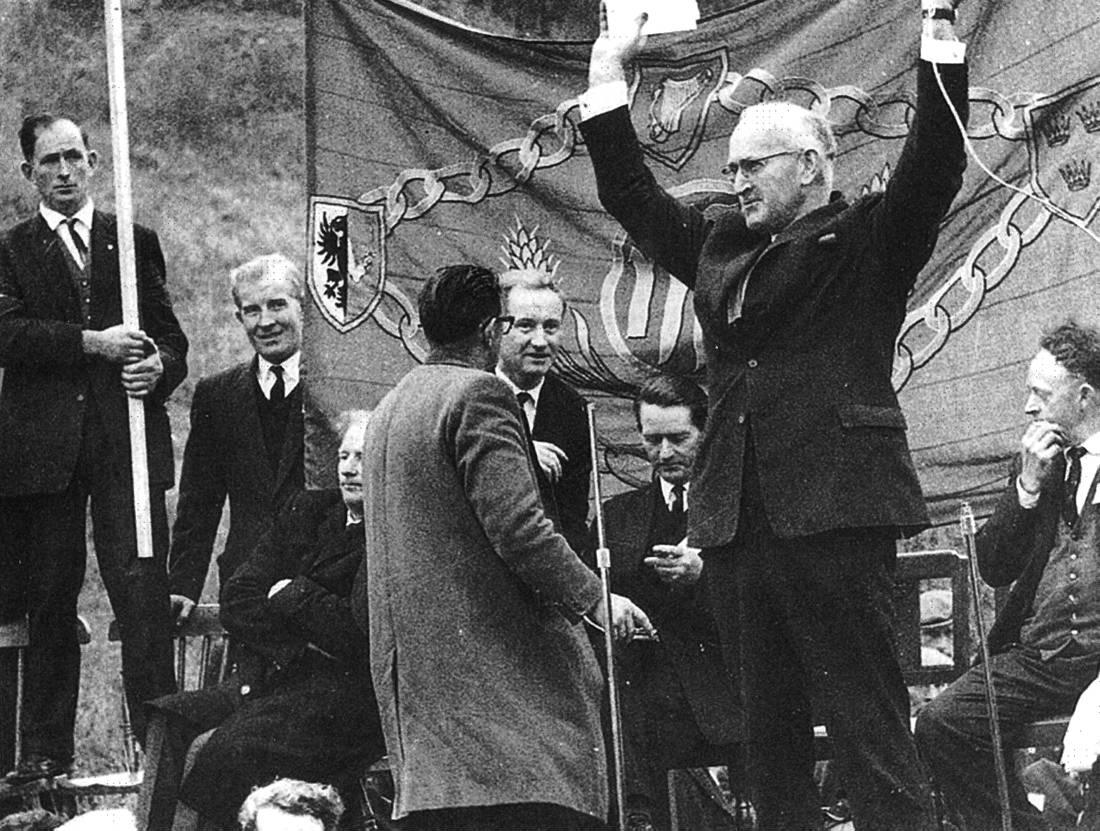
The definitive history of the IFA has been a long time in gestation. I was honoured to be asked, on my retirement as editor of the Irish Farmers Journal, to pull it together into a publishable volume.
But beneath the mechanical editing, there was a discernible, long-term theme and it can be easily summed up: farmers get what’s leftover. By the nature of the sector, the suppliers of inputs become more concentrated and in the absence of effective regulation, more powerful. Similarly, those buying farmers’ output become more concentrated, with huge buying power and ever-reducing regulatory oversight.
These are the classic problems facing farmers. The need for strong organisations to fight their corner is self-evident.
Left by themselves, individual farmers are almost powerless in the face of not just commercial pressures, but in dealing with governments over tax and the implementation of ever more complex regulations.
By themselves, they have little influence in how major infrastructural companies such as the ESB and local authorities deal with access to land and compensation.
Before the NFA, later IFA, came into existence, governments legitimately complained that they had as many as 63 different organisations to consult when considering how farmers and agriculture should be dealt with.
Reading through the 60 years of the IFA’s existence, the tenacity and capacity of the voluntary members and staff shines through. While many outside of the sector will mostly remember the march to Dublin from all over the country in 1966 and the huge tractorcade in 2003, these were just the visible outpourings of a huge frustration with diminishing incomes and a recognition of how other sectors were leaving farmers behind in terms of income and access to services.
Nobody pretends that these are easy dilemmas for governments. All over the world, governments face the same problems in framing an agricultural and food policy that guarantees food supplies to increasingly urbanised populations while at the same time gives, despite the normal operation of market forces, an income for farmers that ensures a fair standard of living and some return on their investment.
Many reading the book will get the impression that protests occupied a large proportion of the association’s energy. To labour under such an impression would be wrong. What is fascinating is to track how the urbane first President of the Association, Dr Juan Greene from Kildare, began by assuming that reasoned analysis and cogent argument would be enough to win government support and policy changes. Towards the end of his term, he had come to grips with the need for this reasoned analysis to be accompanied by the visible possibility of more direct action. He and his successor, Rickard Deasy, had watched in the late 1950s and 1960s incomes in the rest of the community continuously outpace those of farmers, on whom so much employment and national wealth generation depended.
The late 1960s shines through the book as a period of intense activity for the young organisation; the huge marches and imprisonments effectively made the Association. It demonstrated that it genuinely spoke and acted on behalf of the vast bulk of Irish farmers and that it had to be listened to seriously. Its strength had been demonstrated by destroying Agriculture Minister Neil Blaney’s National Agricultural Council, established to demolish the fledgling NFA. And when its candidates swept the board in the beet elections, it turned its attention as to how farmers’ interests could be protected and enhanced. There were two key areas. The pursuit of the principle that farmers should go directly into business themselves and that a continuous dialogue should take place with government and other Irish organisations on the desirability of joining the “common market” or, as it was called at the time, the European Economic Community.
The two areas targeted for direct business involvement were meat processing and financial services. Both fundraising drives were spearheaded by the NFA. An enormous £3m was gathered to buy the two big international meat packer plants at Grand Canal Street in Dublin and at Leixlip in Co Kildare with a commitment to build a new facility at Midleton in Co Cork.
The takeover vehicle was Cork Marts. The establishment of the marts had been the earliest demonstration of the business muscle of the new organisation and it was the first demonstration of farmers in pursuit of their own business since the foundation of the co-op creameries at the end of the 1800s and in the early years of the 1900s. The establishment of the marts had been a resounding success and so was the drive by Cork Marts to acquire the IMP plants. The fact that the venture eventually failed was no fault in the original concept.
The second venture, in the form of FBD, was much more successful, if smaller in scale. The original concept was to start off in insurance and then to develop into life assurance and perhaps, agri-banking. In the event, the latter two were not pursued but the insurance company has become the largest domestically owned Irish insurance business.
The referendum held in 1972 on whether or not Ireland should join the EEC demonstrated the capacity of the organisation to reach its now huge membership base and to persuade them, by force of logical argument, to vote as a cohesive block.
After those heady advances, the organisation settled into looking after and developing the interests of its members. It had early been recognised as the legitimate Irish member of COPA, the EU-wide farmers’ body. It opened an office in Brussels where many of the price and policy decisions affecting agriculture were now being made. EEC membership brought new challenges – there were annual price review discussions, currency convulsions as sterling, to which the Irish currency was totally linked, gyrated and 1974 saw a catastrophic collapse in the price of cattle. In many senses, the Irish Government and Department of Agriculture was now on the same side as the IFA in the pursuit of national farming and agri-business well-being, but that did not prevent bitter disputes as well as ongoing cooperation. One of the disputes resulted in the system of rates on agricultural land being abolished but in a foolish move to capture the EEC gains of the 1970s, attempts were made to impose both a sales tax and a land tax. The IFA strongly opposed both.
The organisation’s campaigns over the milk quota and GATT/WTO proposals all demonstrated clearly how necessary a coherent agricultural voice was on important national issues. In the various reform proposals affecting the Common Agricultural Policy, the Government and Department consulted intensively with the organisation before setting out its national position and before agreeing to the final document. The credibility attaching to the organisation’s position was helped enormously by the widespread respect in which its Brussels representatives have been held, with its long-serving Michael Treacy being reckoned as one of the most influential and best-informed of all national and international representatives.
In the day-to-day commercial cut and thrust, the IFA has played a critical role in protecting farmers’ interests as inevitably, the occasional purchaser of grain, beef or vegetables runs into difficulties. Again, inevitably farmers are at the back of the queue in getting paid as unsecured creditors. At times, unorthodox action has been taken to ensure that farmers got paid for stock or produce supplied. Single farmers operating on their own would have had no chance.
The IFA has come a long way in 60 years – from when it was up for consideration as to whether it should be banned as an illegal organisation to where it is now an integral part of the national consultative and negotiating structure with a highly respected Brussels presence.
Its role is as valid as ever and as the percentage of population in farming shrinks, the need for a coherent and cohesive voice on behalf of the sector is more important than ever.


SHARING OPTIONS