



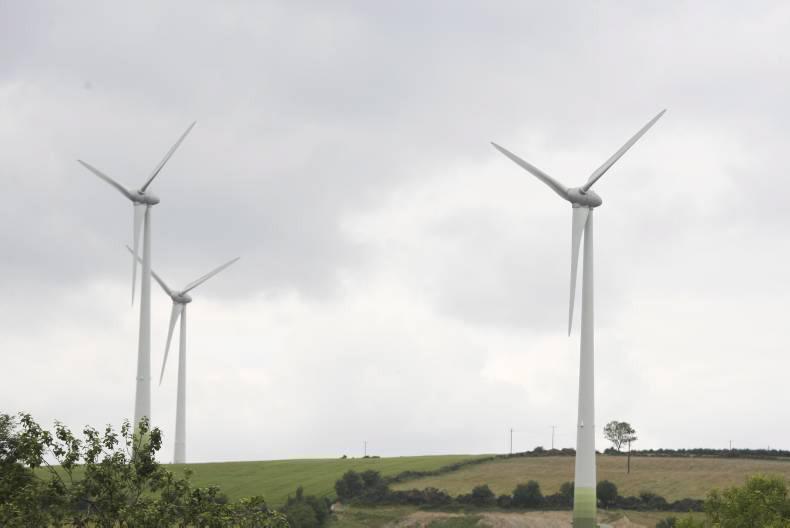
Due to a combination of the deep recession and policy errors, Ireland now has a very large surplus of electricity generating capacity. Several modern gas stations have been constructed since demand reached its peak and the Government has persisted with a policy of subsidising the construction of additional windfarms.
The result is serious over-capacity, heavy subsidies and high electricity costs for business and households.
There are pressures to extend the subsidy regime to solar power and a decision has apparently already been taken to subsidise a new plant in Killala, Co Mayo, which will generate power from wood chips imported from the United States.
Meanwhile, modern gas plants with relatively low carbon emissions lie idle while high-emission coal and peat plants, the latter also enjoying subsidy, are running flat out. Eagle-eyed readers will have noted that storm Barney last week required windfarms to switch off, because the wind speeds were too high. They must also switch off when winds are too low, so the typical windfarm will be available, at best, about one hour in three.
Solar plants are not always on either, and cannot add to secure capacity. There is in any event no shortage of secure capacity.
Ireland has the same obligation to make a contribution to the global reduction of carbon emissions as every other country but appears to have chosen a uniquely expensive way to go about it. In the UK, the government has already pulled back on subsidies to wind and solar plants and has just announced that coal-fired generation capacity is to be phased out, to be replaced with modern gas plants.
Gas plants
Gas plants emit no more than half the carbon produced, per electricity unit, of coal plants, so the proposed shift will cut emissions sharply.
The UK does not have these gas plants in place but has to incur the capital costs of construction. In Ireland the plants, some of which belong to the Government, have already been built but are in danger of being mothballed as more and more intermittent wind capacity is subsidised into existence.
A cottage industry has grown up devoted to the production of reports showing that corporate welfare is the golden path to job creation, emission reduction and all things bright and beautiful. This cottage industry is lavishly financed since the subsidies are so substantial.
The failure to provide a coherent public debate on energy and climate policy, and to illuminate the available policy choices above the clamour of the vested interests, is a Government failure. Energy policy is complex and the concerns about carbon emissions add additional layers of complexity, as does the EU dimension to policy.
This complexity is fertile ground for the corporate welfare lobbyists facing, as they do, an under-resourced print and broadcast media.
The Government is apparently planning to release a white paper on energy policy before the election.
There are many facets to energy policy and the electricity sector is just one of them, albeit a pretty important one.
The white paper needs to explain why electricity in Ireland is so expensive relative to other European countries and what role the subsidisation of wind power has played in bringing this situation about.
There is a need for clarity about the future, if any, of subsidies to generators given the huge excess capacity and about the chopping and changing of plans for transmission investment. Specifically, if the Grid Link line through the southeast of the country is no longer needed, why was it proposed in the first place?
The white paper also needs to explain why, regardless of the excess generating capacity already in place, further expansion is being contemplated at all. Since older high-emission capacity is in place, the retirement of that capacity in favour of reliable and existing gas capacity with lower emissions is clearly an option the UK government would like to have. Ireland has this option but apparently is choosing not to take it.





SHARING OPTIONS