



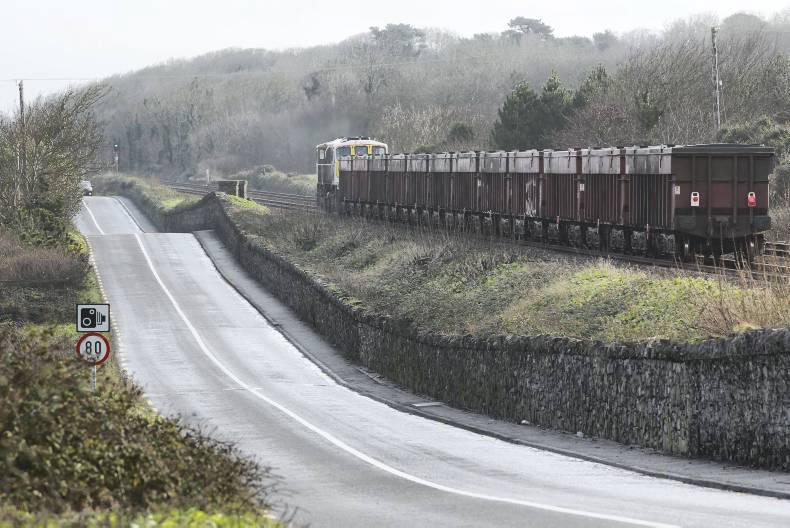
The bubble in bank credit in the decade prior to the collapse in 2008 was accompanied by a bubble in public spending, including capital spending.
One of the worst projects was the construction of a single-track railway line in east Clare connecting Ennis to the Dublin-Galway line at Athenry. The purpose was to create a rail link between Limerick and Galway, already served by numerous cheap, unsubsidised and frequent bus services, offering a journey time of 90 minutes. The rail line cost €110m and offers no better frequency than the bus alternative but a journey time of two hours.
Not surprisingly, the public have failed to support the service and the Ennis-Athenry section has an average of 13 passengers per train. A minibus operation would struggle at this level of patronage and the service loses several million a year on top of the heavy capital cost.
The persistent lobbying which resulted in this mistake envisioned the Ennis-Athenry section as the first leg in a line which would head further north to Claremorris and possibly onwards to Sligo. The failure to attract passengers has persuaded the Government to abandon further commitments. Unlike some dubious rail investments which had been planned in the east of the country, this one has been abandoned rather than deferred.
But the lobbying continues and proponents, perhaps embarrassed by the dismal passenger numbers on Ennis to Athenry, argue that further rail investment in Connacht could be justified by the prospects for carrying freight. The Irish market for rail freight has declined to the extent that Irish Rail no longer publishes the detailed figures. The notion that new rail construction anywhere in Ireland, never mind in the west, could be justified by rail freight is improbable. To be fair, Irish Rail, never shy about seeking costless funds from the capital programme, has been conspicuously silent about further extensions north of Athenry.
One of the factors limiting the prospects for rail freight in Ireland is the development of the primary road network. Most of the main regional centres are now connected to Dublin by modern roadways and their construction is widely seen as one of the few worthwhile bequests of the bubble. No sane person would truck a container to a rail depot in Dublin for onward carriage to a depot in Cork or Galway, where it would need to be collected by yet another truck for delivery. The first truck would have reached the destination before the container was even loaded on the train in Dublin. Ireland does not have the distances or the bulk volumes to make sense of rail freight and this is doubly the case in western regions.
The unavoidable correction to the public finances from 2008 on has seen sharp cuts in Exchequer capital spending, accompanied by lower demands on infrastructure as the economy contracted. With reasonable prospects of renewed expansion, it is timely to consider a gradual restoration of a larger capital budget. But the finances remain over-stretched and projects cannot be selected on the basis of lobby group efforts, nor can unwise projects anywhere in the country be restored to the active list if they should never have been there in the first place.
Some necessary road improvement projects have fallen victim to the capital programme cutbacks of recent years. The biggest regret must be the deferral of the M20 connecting Cork to Limerick, a route that attracts heavy traffic and features severe bottlenecks disrupting market towns. Other casualties have included the extension of the M3 route from Dublin through Cavan into the northwest and the improvements planned for the N5 from Longford through to Mayo. The extension of the M18 from Gort through to Tuam is under construction and due to open two years hence. This is an important non-radial route and its completion will reduce further the bus journey times along the western corridor.
There are numerous other road investment priorities already identified in studies by the National Roads Authority in the west and northwest on both primary and secondary routes. Devoting scarce funds to rail projects means the sacrifice of these overdue improvements. The €110m already squandered on the Ennis-Athenry link, not to mention the ongoing annual losses, would have helped finance road projects in the same region to facilitate proven traffic demand.
As for the abandoned rail corridors, the development of greenway routes for cyclists and hikers elsewhere in the west appears to have generated a far greater response than the misbegotten Ennis-Athenry line. Further greenways can be provided costing a fraction of the bill for yet another unwanted and unpatronised ghost railway.


SHARING OPTIONS