


The outcome of the general election has been greeted with claims that there has been a right/left ideological realignment and that Irish politics is becoming more European. Whatever about the ideology, there is one sense in which the second assertion is untrue: the fragmentation of the legislature into small parties and a large cohort of independent deputies simply could not happen under the voting systems employed in many European countries.
This is the case in Britain, where the first-past-the-post system saw the UK Independence Party win just one seat (out of 650) for its 12.7% of the vote. But it is also true in European countries which employ variants of proportional representation very different from ours. In one way or another these systems exclude independents and mini-parties whose national vote falls below a threshold.
In France, the two most popular candidates from the first round face off in a second election a week later, unless one gets 50% support first time out. In Germany, unless your party gets 5% of the national vote you get no seats at all. The result in all three countries is that a parliament with a large number of seats in the hands of independents and mini-parties cannot really happen.
At the recent election in Ireland, the electorate had no less than eight national parties to choose from (Fine Gael, Fianna Fáil, Sinn Féin, Labour, AAA-PBP, Social Democrats, the Green Party and Renua) plus multiple independents, as many as seven in some constituencies.
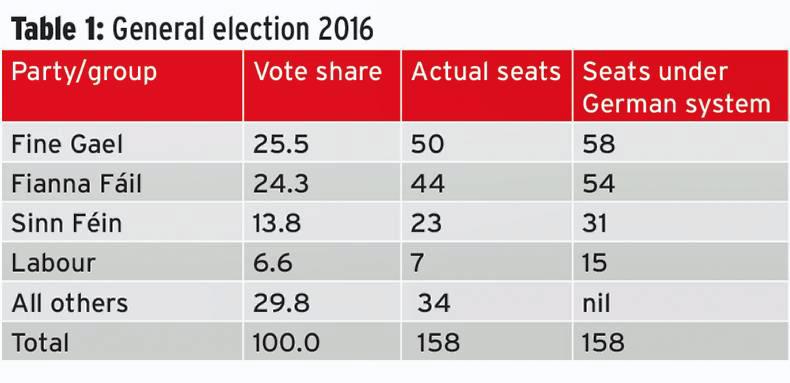
The total vote for all small parties (those polling below 5%), plus independents, was almost 30% and they won 34 seats between them. In Germany, none of these candidates would have been elected and the four parties winning above 5% would have taken all the seats. The actual outcome in Ireland and the hypothetical outcome under the German system are shown in Table 1.
Of course with a German-style system the lineup of parties and candidates would have been different. People with ambitions to public office join one of the parties with a chance of making the 5% threshold. There are several smallish parties in Germany and new parties occasionally break through the threshold, and established parties drop out, as happened to the centrist Free Democrats last time round.
Germany
A German-style list system here would not have produced a renewed mandate for the outgoing government but it would have produced a very different parliament and, quite likely, a very different election debate. Many of the candidates who stood as independents would quite likely have stood for one of the main parties: indeed numerous candidates who got elected as independents, or for smaller parties, were formerly attached to one of them. The multi-seat system in Ireland makes it attractive for candidates to swap their party label for the freedom to campaign on popular issues, a temptation to which several Fine Gael and Labour deputies succumbed through the last Dáil.
Ireland’s multi-member proportional representation system is used hardly anywhere else in the world. It has always produced deputies focused on local rather than national issues and the abolition of the dual mandate, where Dáil deputies could sit on local councils, has changed little. The success of candidates committed solely to local representation is not a new feature of Ireland’s unique version of proportional representation but it now seems to be accelerating the fracturing of the larger political parties and inhibiting the formation of governments.
There are lots of alternative formulae for devising an election system that represents public opinion and there have been two attempts, in 1959 and 1968, to change the Irish voting system, which is enshrined in the constitution. Both were defeated, as was the recent effort to scrap the Seanad. The electorate regularly expresses dissatisfaction with the political system in opinion polls but seems reluctant to make changes when asked.
Demands
There have been some spirited demands for Dáil reform these last few weeks and it would be too cynical to dismiss them all as a distraction from government formation. But the ultimate source of public unhappiness with Irish politics may not be the day-to-day conduct of parliament but the manner in which the membership is selected.




SHARING OPTIONS