



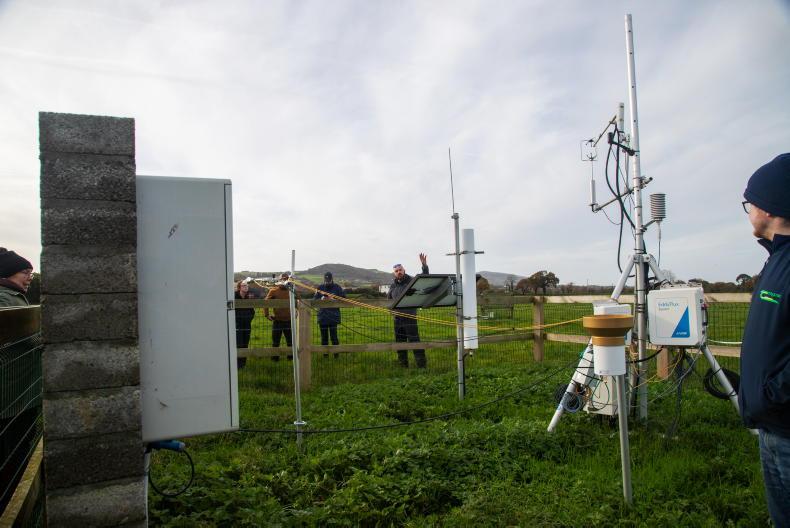
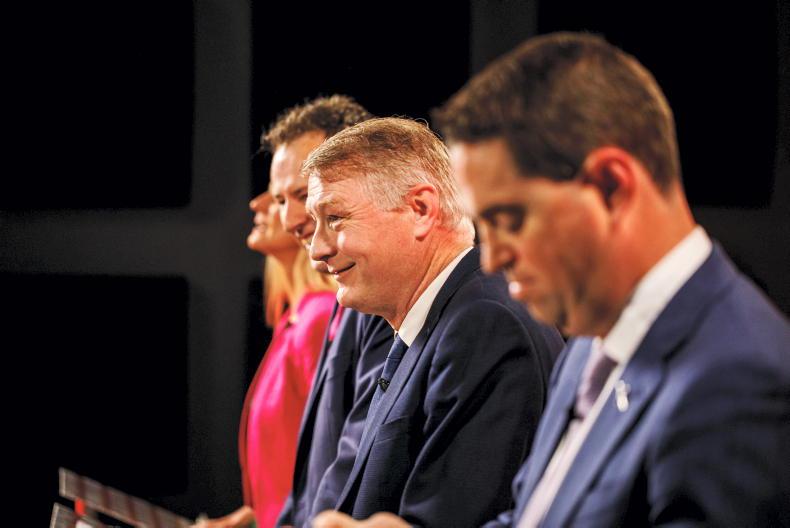
I was at a conference in Kilkenny last weekend. Not Kilkenomics, which got loads of media attention. The other event, which got little attention, was a conference on the future of farming in Europe.
It was organised by the European Conservative and Reform Party (ECR) , which is the fifth-largest political grouping in the European Parliament.
Their very presence in Ireland was a subject of some controversy, with a (small, perhaps token) protest at the gates of Lyrath Hotel, the venue for the event.
Newspaper headlines focused on the involvement in the ECR of Italian Prime Minister Giorgia Meloni. She is ECR president and her Brothers of Italy (Fdl) party supplies nine of the ECR’s 66 MEPs. She has been criticised as being far-right, anti-immigration and an EU sceptic.
Principles
The ECR’s MEPs come from 16 of the 27 EU member states. There is no current Irish MEP within the ECR. Former MEP Brian Crowley joined the ECR is 2014, having recently been re-elected to the European Parliament.
He lost the Fianna Fáil whip for doing so, with the party stating that the ECR’s principles were incompatible with their own.
The largest national representation within the ECR at present is the 24 MEPs from Poland.
They are members of the Law and Justice Party, (PiS) which has been in government in Poland since 2015, although it seems likely to lose power following recent elections. Again, the PiS has been criticised for their views on social issues such as homosexuality.
I considered it my remit to attend such a conference irrespective of who organised it
So why would I accept an invitation to attend a conference organised by such a group? The answer is because the event was solely focused on agriculture and food. And I considered it my remit to attend such a conference irrespective of who organised it.
There is a broader point here around discourse and debate. How are we meant to change the opinion of those we disagree with if we don’t communicate with them.
Debating the finer points of agricultural policy - domestically or across Europe - with those we broadly agree with is relatively easy.
So what did I learn? Well, among the speakers across the four panels, there was a clear distinction between the political representatives present and those coming from a farmer or farmer advocacy background.
The political types made broad points around current EU policy and their opposition to the increasing level of environmental regulation.
Bread-and-butter issues
The farmer types spoke of bread-and-butter issues, whether that was Alice Doyle of the Irish Farmers Association (IFA) explaining the difficulties farmers are experiencing maintaining income with the pace of change being asked of them and instancing examples from nitrates to CAP reform.
Valter Zelcs provided a farmer voice from the far side of Europe. He is a member of the Farmers Parliament, the largest farmer organisation in a country nestled between Poland, Belarus and Latvia in the shadow of Putin’s Russia, which it also borders.
He spoke of the government’s incentivising tillage farmers such as himself to transition to min-till as a lower carbon system of crop production.
However, the increase in herbicide usage necessitated when soil is not being turned over as a weed control mechanism has now led to a policy U-turn, with the government now encouraging a return to the plough.
As a tillage farmer who has adopted min-till and is anxiously watching whether glyphosate is renewed or not, I could empathise closely with this.
On the margins
On Saturday, I was at the Sinn Féin Ard Fheis is Athlone. There was a time when they were a party on the margins, banned off the airwaves for their support of the IRA. Now, they are the joint-largest party in the Dáil and the largest party in the Northern Ireland Assembly.
And one of the turning points in this island’s history came 30 years ago. The conflict in Northern Ireland had seen yet another low point in October 1993, when the Shankhill Road bombing and the Greysteel mass shooting saw a combined 18 people dead.
There was intense criticism of then-Sinn Féin leader Gerry Adams' involvement in the funeral of an IRA member who had died while perpetrating the Shankhill Road bombing.
There was intense criticism of John Hume, the SDLP leader, for refusing to end his dialogue with Gerry Adams around bringing an end to the violence.
But Hume continued to talk to Adams and, in December that year, the British and Irish governments issued the Downing Street Declaration.
In August 1994, the IRA announced a ceasefire and before the end of that year, all the various paramilitary groups - both nationalist and loyalist - had announced ceasefires. The journey to a permanent end to the conflict had begun.
There is a breakdown in the dialogue on farming, on food production
What has of that got to do with farming, you might well ask? I think there is a lesson for all of us.
At present, there is a breakdown in the dialogue on farming, on food production, its carbon footprint and its impact on biodiversity. That breakdown is between farmers, their representatives and environmental activists and NGOs.
The dialogue has become increasingly partisan and bitter. Both sides frequently accuse the other of bad faith in terms of their genuine agenda.
Turn the page
And we have to turn the page and change the nature of that discourse, for all our sakes. But that will require political courage. It will require generosity and a recognition that people we disagree with are acting sincerely and honestly, just from a different perspective.
It will require talking to people we disagree with and, even more importantly, listening to them. Displaying the courage shown by people such as John Hume, David Ervine, John Major, Gerry Adams, Albert Reynolds and David Trimble in those dark days of 1993 and the slow dawn through 1994.
The awful current events in Israel and Palestine are a stark reminder of the alternative to dialogue and engagement, however slow and difficult it may be. This island is an example that can be followed elsewhere.
Catching up on catchments
It may seem trite to compare the dialogue around farming and its future with the peace process on this island. But food production is fundamental to the survival of humanity and it is facing a set of challenges that aren’t going to resolve themselves. In this regard, the event I attended in the middle of the week was a real beacon of hope.
The catchment science conference held in Wexford displayed the depth and intensity of the research Teagasc is spearheading into how we better understand the complex processes that dictate the effect of farming on water quality.
Across three days, scientists from all over Europe heard the findings from 15 years of work across the six catchments around the country in the programme.
I would have loved for some of Irish farming’s fiercest critics to have been there to hear just how seriously stakeholders take their responsibility to the wider environment.
That includes farmers - four of the 300 family farmers that live and work within the six catchments shared a forum on Thursday morning.
Answers
That doesn’t mean we have the answers; some of the results of the research are extremely challenging. It does at least mean that we are asking the questions and not in some form of lip service.
My hope is that the next catchments science conference brings people from 'across the divide' along.
It’s only by this wider engagement that we can ever come to what everybody surely wants - a future where farming continues to supply the planet with food, but with the smallest possible impact on the wider environment.


SHARING OPTIONS