


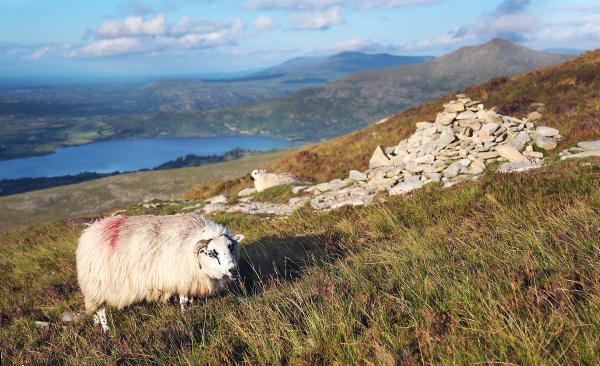
Commonages had the most to gain from CAP reforms. It also means they now have more to lose. With historically low payments per hectare, the anticipated move towards flat-rate payments would have seen millions flow to the 17,000 farmers that have a commonage share.
Those potential gains have been eroded through convergence and now it seems the low uptake of GLAS on commonages this year will limit the benefits from Pillar II. With a fixed pot of money, this means lowland farmers will benefit. The Department stated recently that it remains confident that 13,000 to 14,000 commonage farmers would access GLAS in the first tranche. On the ground, advisers predict the figure will be a lot less, closer to 7,000, or just half the Department’s estimate.
The letter of comfort received by the EU commission late last week will allow the Department to finally activate the submit button on the GLAS online system. Up until now, all applications were started and saved as drafts. This means the headline figures of the number of farmers with applications started for them on the Department online system have to be treated with caution.
An additional 2,000 farmers were added in the last week, bringing the total number to 17,739. With just four weeks left, it remains possible that the 30,000 target could be hit.
However, advisers must now refocus on existing applications and go through the process of actually submitting them, carefully making changes to maps, etc, which will undoubtedly take more time. Their efforts are not helped by the online system, which is still struggling to be fit for purpose. Advisers reported is was not working on Monday and many draft plans they had submitted were lost and had to be re-submitted.
Looking at the latest draft figures, the applications started to date are concentrated on the western seaboard, as expected. Mayo and Galway lead the way with 2,000 submitted. Donegal, Cork, Kerry and Clare make up the top six.
The biggest surprise is the low number (36%) of Tier 1 applications submitted to date. The majority of applications are Tier 3, although some of these could move into Tier 2 by selecting one of the four priority measures, such as 1ha of wild bird cover or low-emission slurry spreading.
The Department anticipated up to 50% of farmers would be Tier 1 farmers, most of whom would be commonage farmers.
You would expect commonage farmers to be the first in the queue to get into GLAS. With a higher payment of €120/ha, compared with €75/ha under AEOS, the maximum of €5,000 would be easier to achieve. This is not proving the case for a number of reasons.
Firstly, the delay by the Department in setting out the process for commonage management plans and how individual advisers were to be appointed. This was confirmed just last week, after which the first applications submitted for approval were made. The templates for commonage management plans are only expected next week.
As part of the process of identifying one master planner to submit a plan, the details are updated on the Department website. The submission for these is slow. The latest figures from the Department this week are that only 136 CMP appointment applications have been submitted out of a possible 4,500 commonages over 10ha. This is up just 36 from last week.
Looking at the 86 applications updated so far, they have been submitted by just 12 planners. That majority have one to five shareholders, with only a small number having over 10. While GLAS applications for commonage farmers can be submitted, the planners have one eye on the very limited window between 11 May and 3 July to get commonage management plans submitted.
The farmer submitting a GLAS plan by 22 May is doing so based on the intention to join a CMP. It is critical that the CMP plans are submitted by 3 July and there are calls by planners to extend this date.
It is also obvious that GLAS planners will focus on the easier commonages first. They are cherry-picking ones with fewer farmers, so that they can be sure of getting signatures and agreement. Why wouldn’t they?
After all, they can take their time to pick up the commonages with more farmers in later years. This is because of the concession forced through by the EU that commonage farmers joining in subsequent years must be guaranteed five years of payment. This means that commonage farmers do not have to rush in.
They will be guaranteed tier one priority access in future tranches, so commonage farmers currently in AEOS will be slow to jump as they know they will get more money overall by waiting until their AEOS contract finishes. It also allows them to focus on Tier 2 and Tier 3 farmers, who are all but guaranteed to get in on the first tranche. This strategy ensures they get more farmers into GLAS overall.
The other issue putting farmers off is the lack of clarity around land eligibility, inspections and penalties. The Department has not been able to give clarity on what happens if a commonage farmer outside of GLAS does harm to the commonage.
IFA Hill Committee chair Pat Dunne has insisted that the Department must issue the guidelines to planners to carry out the commonage plans. This must be simple and result in CMPs being done in a short timescale.
“The 3 July deadline to complete the CMPs may be tight, but the onus is on the Department and planners to step up to the mark,” said Dunne.
“Farmers who join GLAS now must get a significant payment this year and the longer deadlines are pushed out, this leads to payments being threatened this year,” he added.



SHARING OPTIONS