


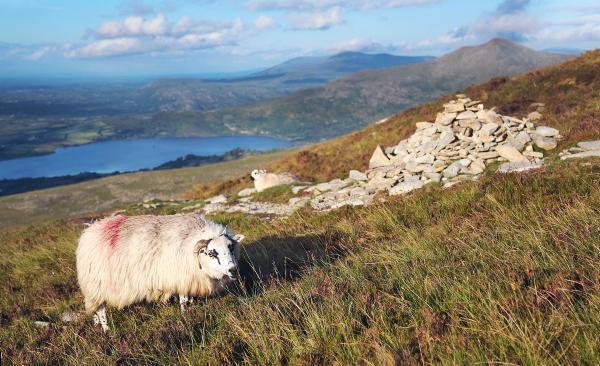
“The status quo is not an option. Widespread undergrazing on commonages means that large areas have become ineligible.”
Speaking at the Joint Oireachtas Committee, Dr Kevin Smyth, assistant secretary at the Department of Agriculture, said that if this continues, Ireland faces a massive fine not just on commonage farmers, but across all the €1.5bn in payments it receives from the EU.
“Scrub is not biodiversity and we need credible plans to bring land back to GAEC that will buy us time to avoid penalties,” he stressed.
Throughout the hearing, the Department’s focus was clearly to get more sheep and more activity on hills to address the problem.
“The massive undergrazing problem is not just down to previous Government policy. The age profile and profitability of the sector has added to the decline that must be addressed,” added Smyth.
He pointed to the first step – convergence already in place to encourage more activity on hills: “The 15,000 commonage farmers are set to gain €3,141 on average by 2019 due to the increase in direct payments per hectare.”
“However, to access these payments farmers applying for basic payment must be seen to have activity on all parcels they claim,” Paul Dillon, assistant secretary explained. “The Department has set this at the modest level of one ewe per 1.5ha to make farmers eligible, but this can be reduced for commonage or blanker bogs based on the farmer’s knowledge and best practice.”
Deputy Sean Kyle made the point that land being made ineligible by inspectors this year will reduce this flow of money to commonages, even if land is returned to eligibility by the commonage management plans in future years.
The requirement of each shareholder to have sheep on commonage was deemed as “crazy” by deputy Eamon Ó Cuív.
“If a commonage with 30 shareholders needs 300 sheep there is no benefit on forcing each farmer to have 10 sheep each. It would be more beneficial to allow farmers on commonage to agree to who puts up the sheep, allowing less farmers to have a larger flock worth looking after,” he added
On GLAS payments, Paul Dillon said that they can only be made if the scheme is designed to go beyond the baseline set by the basic scheme to keep land in GAEC.
The Department said this needs a common action by farmers reflected in a single plan drawn up by a single advisor.
“We have dropped back to having 50% of active farmers signed up, but no genuine application will be locked out of GLAS,” said Paul Dillon. However, he accepted that there are difficulties.
“There is a lot of work to be done. We might need to revisit the timeline to when commonage plans can be lodged. The fact is that a large chunk of the €120/ha for GLAS is for paying the advisor. To accept farmers into GLAS we have to have details of the plan and the commitments they are undertaking,” he added.


SHARING OPTIONS