


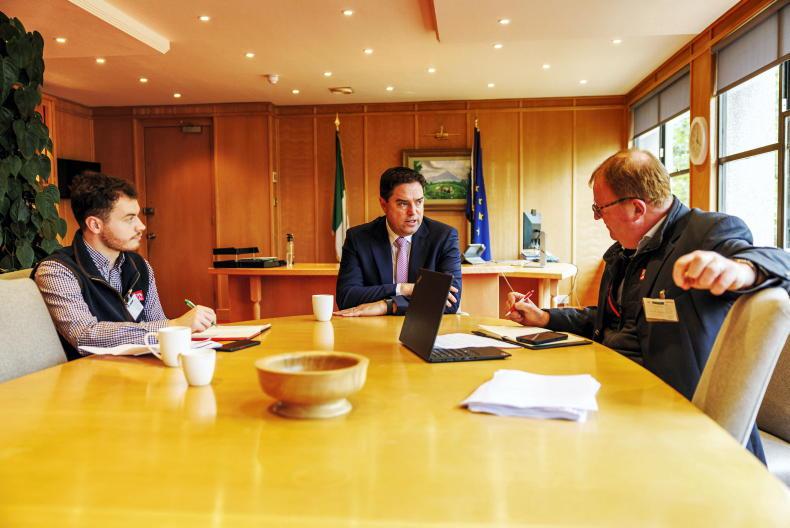
Imagine for a moment if the Minister for Education heralded the announcement of a proposed 22% cut in the budget for that department as “a decent starting point”.
He or she would be drummed out of office within days. The same would be true of a Minister for Health or Justice.
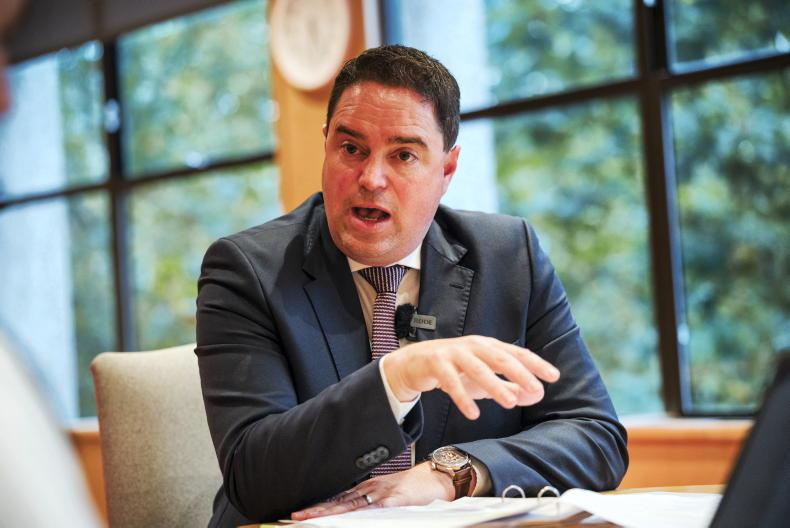
Yet, this was Martin Heydon’s exact reaction to the CAP budget proposal - he used those very words in this paper. Why did as canny a political operator as the Minister for Agriculture give such a neutral reaction?
The answer is probably multi-faceted. Firstly, Ireland needs leverage if it is to advance what it sees as national priorities in terms of adjustment to the CAP budget and to the policy proposals outlined by Christophe Hansen last week.
And kicking Hansen would be easy, but perhaps offering him understanding and support, which seems to be the Heydon strategy, will bear better fruit over time.
Problematic proposals
Make no mistake about it, the policy proposals are every bit as problematic as the budget proposal.
As I highlighted in last week’s Long Read, the proposals seek to defund older and part-time farmers and to cut payments to larger full-time farms.
This will exclude tens of thousands of farms from payments and slash payments to almost everyone else.
Only micro-farms with small current payments stand to gain. Good luck to them, no-one is arguing against that. I certainly am not, but the cuts will far outweigh any benefits.
There is another factor that may have coloured Martin Heydon’s thinking - CAP is far from the only issue where he must horse-trade with Brussels.
It’s fair to say the Commission are being exposed as deeply cynical and self-serving in the overall thrust of its multi-annual financial framework proposal.
As highlighted by all the panel discussing the proposals on Saturday morning’s 'Countrywide' programme on RTE radio, the Commission is abdicating accountability for inevitable consequences of the cut in the CAP and rural development funding provided.
Instead, member state governments will be in the firing line in 2028, when the full reality of the new CAP on farmers’ incomes becomes apparent.
Nitrates renewal
The renewal of the nitrates derogation is currently at a critical stage. With farmers reeling from the emergence of appropriate assessment as a proposed constituent of the next derogation, Heydon and his officials are working to minimise the impact of that element of the derogation, while delivering at least a 220kg/ha limit for farmers willing to accept the heightened conditions of derogation participation.
And, of course, this is not directly linked to CAP reform. We all know that derogation approval will be decided by the environment commissioner Jessika Roswell, not Christophe Hansen.
But there is also the reality that retention of the derogation is as much about politics as it is about scientific evidence. And it can’t hurt to be best in class when it comes to supporting the Commission in its proposals or at least not kicking the lard out of them.
By early 2026, the derogation will have been delivered (or not) and CAP and budget negotiations will still be at the stage of skirmish and 'phony war' with the decisive battles yet to come.
Good times make hard cases harder
It’s equally interesting that the farm organisations have made little response to Heydon’s statement. I doubt if the teachers unions, the nurses and consultants or indeed the gardaí would be as sanguine if the education, health or justice minister were to say what Heydon did in his interview with this paper.
Normally, farm leaders don’t shy from calling the minister of the day out and highlighting the negatives of any policy or budgetary proposal. And these are the worst budgetary cut proposals and the most consequential policy proposals of my lifetime.
Again, some context might be illuminating as to the paucity of condemnation for the minister. I think the answer might lie in the timing of the CAP announcements.
Firstly, the proposals are for the future, not for now. When your calendar is dominated by the weather for the next seven days, as is the case for farmers, it’s hard to feel the full impact of this drastic change in direction for farm supports when it’s 30 months away.
Farming runs in many different cycles. Tillage farmers currently harvesting will have planned whether to plant a cover crop and will have a plan for the 2026 crop, often in the broader context of a rotation that may be five to seven years in duration.
Dairy and suckler farmers have already made breeding decisions in relation to cows and those calves that will be born in 2026 won’t be breeding or slaughtered until 2028, when the new CAP comes into effect.
Price cycles are much more unpredictable and volatile. Currently, we are experiencing high prices for milk and meat. Beef prices are at their best levels since before the emergence of BSE, almost 30 years ago.
Lamb prices are just as good. With the drystock sector - the primary enterprise on the vast majority of Irish farms - booming, it’s an inopportune moment to be calling for no cut to the payments received by sheep and cattle farmers.
As I pointed out last week, these good prices don’t make drystock farming economically sustainable without supports. And current prices are definitely seeing resistance from consumers, who are reluctant to pay the prices required for prime beef and lamb cuts in particular.
They say the cure for high prices is high prices and, normally, you would expect that there is nowhere for beef and lamb prices to go except downwards.
I’m not wishing for that, but it seems unlikely that current prices will be sustained long term. That is particularly true if you consider that grain prices have not risen in line with meat and milk prices. Typically, feed prices are a dominant factor in determining global meat and milk prices; can this consistent trend be bucked much longer?
Being realistic, farm advocates will probably be in a much stronger position to argue in favour of the protection of farm supports for drystock farmers and dairy farmers in six or 12 months' time. Like the minister, they are possibly holding their fire for a more opportune moment to go in hard.
Will the Commission show strength in the face of a bully?
It was Teddy Roosevelt who said “speak softly, and carry a big stick”. Unfortunately, farmers don’t really have a big stick when it comes to dealing with the European Commission.
All the words of Ursula von der Leyen to farmers in the face of last year’s protest campaign ring hollow in the face of the budgetary proposals she has orchestrated.
As I write, we await the outcome of crunch discussions she is holding with Donald Trump in relation to a trade deal.
On Friday, the US president was typically aggressive and front-footed, calling on Europe to abandon wind turbines.
As is often the case, his words defied logic, science and economics. But has von der Leyen got the political courage to face Trump down?
Will there be a just deal done or will Europe appear craven? I expect that if it is the latter, that any deal done now will be regarded by Trump as little more than a starting point, to be reneged upon and renegotiated at the first opportunity.
We will see what Ursula von der Leyen is really made of over the next few days. Empty promises to farmers don’t inspire confidence.



SHARING OPTIONS