


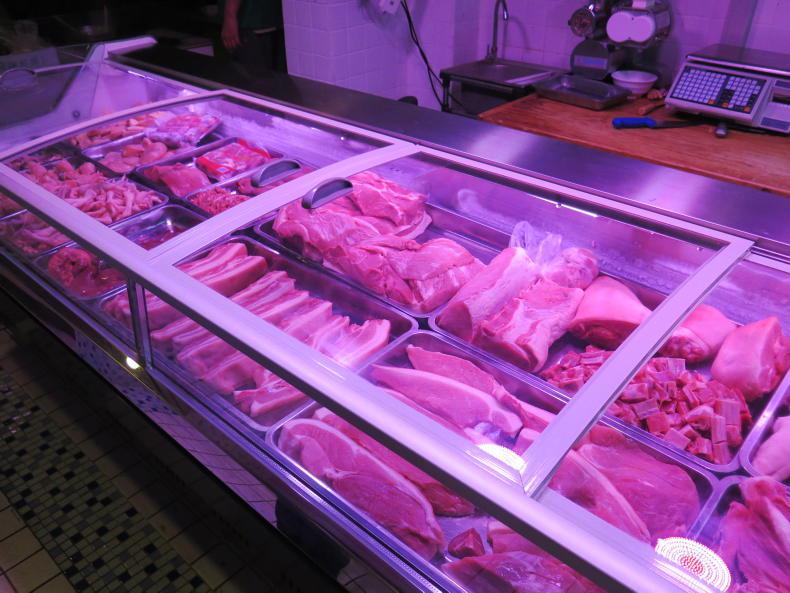
No sector of Irish agriculture has experienced as much change in recent decades as pig farming. Traditionally, pigs were part of the mix on most Irish farms – there were even plenty of people with very little land that kept a few pigs.
However, the combination of legislation and need for efficiency has meant that on-farm pig production has been transformed to large-scale, ultra-efficient production units.
As a result, the number of commercial pig producers has dwindled to just a handful, but they deliver the raw material that supports several thousand processing jobs, delivering €490.5m of exports in 2024.
As Figure 1 shows, farm gate pig prices have fluctuated over the past year. In September last year, prices for class S were a relatively healthy €2.19/kg, but they fell back over subsequent months to €2/kg in February this year.
There was a period of recovery over the spring months, reaching €2.17/kg in June, but since then it has been a downward trend – with last month’s price of €1.94/kg the lowest of the past year. Aside from labour, the major input costs in pig farming are feed and energy prices.
Tillage farmers have taken a hit this year with weak grain prices, but this also contributes to stable prices for the sectors of Irish farmers that are big users of animal feed. Energy costs have been relatively stable this year compared with previous years.
Valuable export category
Bord Bia reported that Irish pig meat production in 2024 was up 4% to approximately 310,000t – of which an estimated 200,000t were exported.
This generated revenue of €490m, making it the third most important primary agri food category after dairy and beef, and ahead of sheepmeat, which was worth €401m, and horticulture and cereals, that were worth €325m.
There were also 400,000 pigs exported live to Northern Ireland for processing in 2024.
Diversified markets
As Figure 2 shows, pigmeat exports are among the most diversified of any in Irish agriculture, competing with all comers across all significant global markets.
China is the largest market for volume for Irish pigmeat exports, taking almost 63,700t last year – and also by value at €102,477, if Britain and Northern Ireland are separated.
These are the second and third-most important markets by value and combined as a UK figure, they are worth €155,296 – despite being a much lower volume market than China, taking 45,073t.
This reflects the fact that China is a buyer of lower value cuts of pigmeat, while the UK buys some of the highest-value cuts.
The next most important market for Irish pigmeat exports is Australia – which may be a surprise to many people.
It was worth €32,864 last year, while no beef and sheepmeat were exported to that country.
The Asian markets of Japan, South Korea and Philippines were all in the top 10 export destinations by value for exports, as was South Africa. The European Union markets of Poland, Germany and Denmark make up the other top 10 export destinations.
Global production and trade
Irish pig meat production of around 300,000t is small when considered in a global context. USDA estimates that 116.680mt CWE of pig meat will be produced in the world this year, with the main producing countries shown in Figure 3.
Of this, around 10.2m tonnes will be traded between countries, with the main exporters shown in Figure 4.
While Ireland may be a small producer of pigmeat in global terms we are how a significant exporter. Mexico, which exports similar volumes to Ireland, is at seventh place in the table of top exporting countries.
USDA data groups all EU countries together, so Irish exports are counted alongside those of major exporters like Spain, Germany, Denmark and Netherlands as part of the 2.9m tonnes of EU pigmeat exports.
Exporters
The US are by far the world’s largest exporter of pigmeat, and forecast to ship 3,155t carcase weight equivalent (CWE) in 2025. Last year Mexico was the largest market for US pigmeat exports, taking 1.2m tonnes, followed by China/Hong Kong on 504,000t. Japan and South Korea between them account for over 500,000t while Canada takes 220,000t. The remainder is spread across Central and South American countries with Europe, Africa and Oceania minor markets.
After the EU countries combined, Brazil and Canada are the other major exporters of pigmeat, forecast by USDA to export 1.6m tonnes CWE and 1.375m tonnes CWE respectively this year.
After that there is a sharp fall off in volumes from the next group of exporting countries which include Chile, Russia, Mexico and the UK. This is the group that Ireland would fit into if our exports weren’t included as part of the EU figure.
Importers
China is expected to remain the world’s largest pigmeat importer in 2025 taking 1.565m tonnes CWE, but as Figure 5 shows, Japan and Mexico are close behind on 1.5m tonnes CWE and 1.460 tonnes CWE.
The UK is expected to be top of the second tier of importers on 760t CWE followed by South Korea (710,000t) Philippines (630,000t) and the US (501,000t). Canada and Australia are also significant importers, on 225,000t and 205,000t respectively.
The most interesting development in international pig trade in recent years has been the growing self-sufficiency in China. The country experienced a serious outbreak of African Swine Fever in 2018 which decimated its production and caused a surge in imports, which as recently as 2021 were at 4.3m tonnes CWE.
A major restructuring of pig production has taken place over recent years with production moving from a small back yard type based businesses to specialised production units. What happened in Ireland over a century happened in China over a few years.




SHARING OPTIONS