


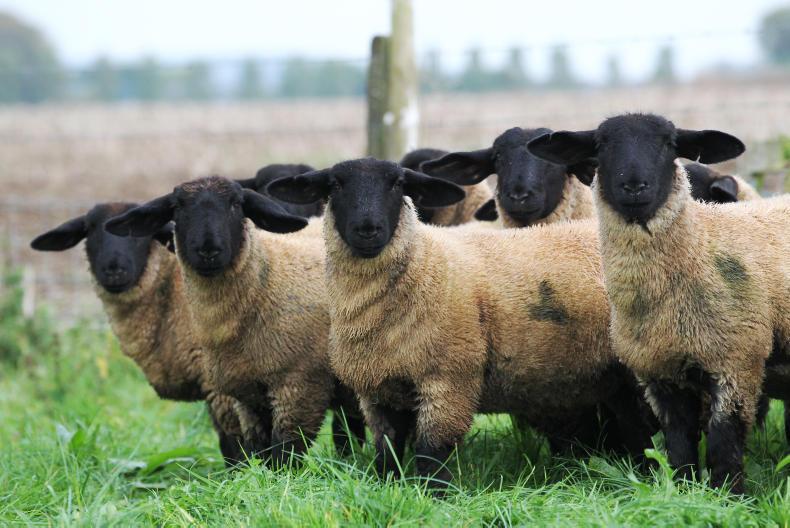
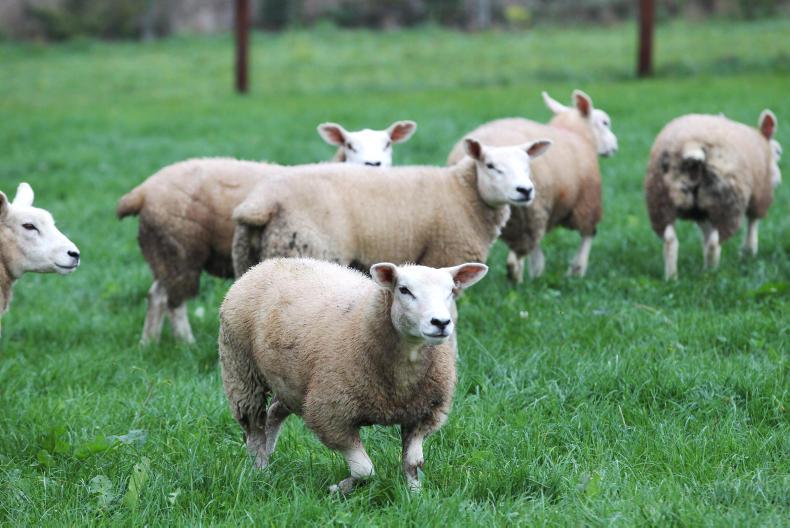
Analysis carried out by Teagasc and presented at last Wednesday’s Sheep Ireland industry meeting shows that farmers can significantly improve the profitability of their system by using five-star genetics.
A bio-economic model comparing a typical 100-ewe flock using either one-star or five-star genetics was conducted by Teagasc’s Alan Bohan and presented by Fiona McGovern in her presentation regarding the validation of genetic indices.
The model shows that five-star genetics achieved superior performance across a number of parameters. These included a lower lambing difficulty and associated reduction in labour, increase in lambs born and reduced morality, lighter ewes (ability to operate at higher stocking rate) and heavier weaning weights.

When combined, the model showed five-star genetics deliver the potential to generate €210/ha net profit compared with a €7/ha net profit contribution for the one-star flock.
Regarding validation of the €uro-Star indices, Fiona said this is being carried out on an ongoing basis to ensure that genetic evaluations are delivering on their predicted performance.
Fiona and Teagasc’s Noirin McHugh analysed data from Sheep Ireland’s central progeny test (CPT) flocks and the Irish and New Zealand Across Country (INZAC) flocks.
Table 1 details the performance of one- and five-star animals in CPT flocks on both the terminal and replacement indices.
As can be seen, five-star animals achieved higher performance in all traits, with the CPT flocks utilising all the main Irish breeds in commercial ewe flocks.
The performance to date of the INZAC flock is summarised in Table 2 for a number of key production parameters on the replacement index.
The INZAC flock is beneficial, in that it allows performance to be evaluated in a pure breeding production system, with high-genetic merit five-star and low-genetic merit one-star Suffolk and Texel animals used in the trial.
Results to date show that Sheep Ireland evaluations are working, with the five-star animals delivering superior performance. The INZAC flock is not evaluating the terminal index.
New economic values
The bio-economic model mentioned above was also used to calculate economic values for the terminal and replacement indices, which have recently been updated by Alan Bohan.
Alan told those attending the meeting that economic values had not been updated in close to 10 years and that the new values should lead to much more accurate financial projections used in genetic evaluations.
The economic values were calculated using a whole-farm bio-economic model and utilised information from a range of sources, including Teagasc research and CPT flocks.
The bio-economic model essentially takes a whole-farm setup and analyses performance over numerous variables, including farm size, stocking rate, level of production, mortality, variable and fixed costs and labour input.
Updates
Alan explains that having now set up the model, updates can be made much easier and on a continuous basis. This will allow any aspect, such as changes in feed costs or lamb prices, for example, to be taken account off.
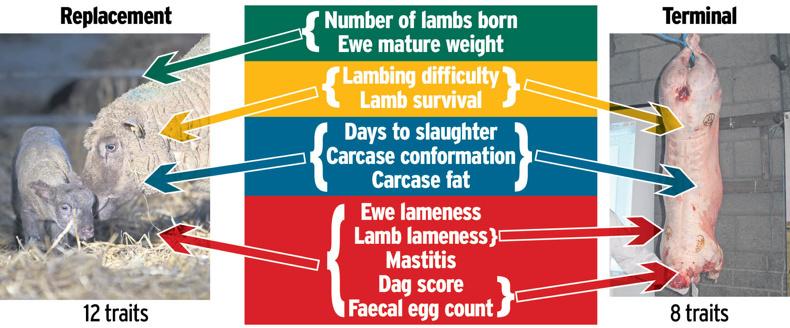
Alan also detailed the traits used from each of the groupings (maternal, lambing, production and health traits) in calculating the replacement and terminal index, along with their economic value. This is detailed in Table 3, while the graphic below shows which of these traits contribute to each index and their relative emphasis.
For example, if we look at the maternal index, each extra lamb that a ewe delivers is valued at €39.76. This is the value of a live lamb at birth and is not an overall value of the lamb, with other traits such as lamb survival and production traits having an influence on this.
Alan says that this trait will be monitored closely so that it does not lead to a situation where breeding programmes are geared solely towards greater prolificacy.
With regards to ewe mature weight, lighter ewes are viewed as more desirable due to lower maintenance costs and an ability to operate at a higher stocking rate.
Relative emphasis
As can be seen in the graphic, the replacement index is mainly driven by maternal and production traits, with lambing traits having less of an emphasis and health traits contributing negligibly.
The terminal index is driven primarily by production traits, with an emphasis nearly twice that of lambing traits, while health traits contribute more than on the replacement index, but are still relatively minor.
Sheep Ireland’s Thierry Pabiou followed Alan’s presentation and discussed how new farmer data added to the index in 2018 and new economic values may affect existing genetic evaluations, along with outlining new initiatives for 2018.
Thierry said that breeders are likely to see some fluctuation in indices, with the inclusion of farmer data predicted to change the replacement and terminal indices by 16% and 11% respectively, while the new economic values will change the indices by 6% and 8% respectively.
He said that some individual animals will gain in the value of their index, while some will stay the same and others will fall.
While fluctuation in individual animals as a result of more data being included in the index is likely to frustrate, longer term it will increase the accuracy of evaluations and the variation will allow potential for greater breeding decisions.
A new lambing module update has also taken place in 2018, with the last update completed in 2009.
Thierry says that the heritability of traits is influenced by the accuracy of records and, as such, more information and increased accuracy is having a positive effect on the lambing module.





SHARING OPTIONS