



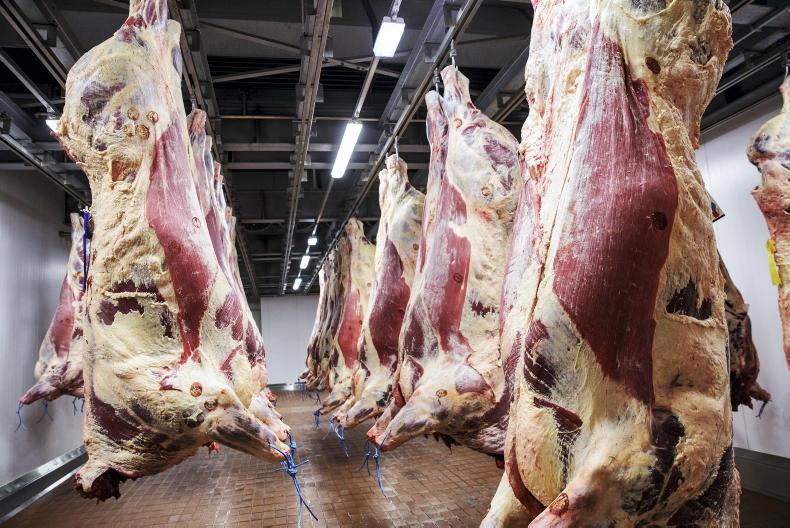
The beef trade remains under pressure this week, with factories dropping quotes by another 10c on Monday morning.
Some factories are trying to buy bullocks at €6.30/kg, but, as the official Department of Agriculture quoted figures in the Irish Farmers Journal shows, paid prices are not in line with quoted prices.
The average of base grades (ABG) for the week ended 19 April 2026 was 697.4c/kg compared with the ABG for the week ending 17 May 2026, one month later, which came in at 691.9c/kg. This represented a drop of 5.5c/kg during that four-week period.
This is in contrast with base quotes during that period falling by 20c/kg and even up to 30c/kg in some cases. This would indicate that while factories have been quick to drop quotes, what they are actually paying out hasn’t been dropping as quickly.
The other factor is that factories are currently working their way through a lot of contracted cattle from bigger finishers and these are contracted at a higher price to those of smaller finishers working off weekly quotes.
Procurement managers are also stretching out supplies, killing smaller numbers for some farmers on a weekly basis to get cattle into the factory over a number of weeks rather than all in one go.
Carcase weights have seen a big recovery for the first four months of 2026, with bullocks coming in 22.9kg heavier at 359kg from January to April.
Heifers are up 16kg, young bulls are up 15.5kg, while cows are up 9kg to 302kg. Better breeding and stock being kept longer due to high replacement costs are some of the reasons for the gains.
Carcase weights have dropped back a little in April, but the increase is offsetting some of the effects of lower numbers for the factories.
What the data shows is that factories are willing to pay more than quoted prices, so farmers should bargain hard when it comes to selling.
This week’s base quotes range from €6.30/kg to €6.40/kg for bullocks, with heifers working off a base range of €6.40/kg to €6.50/kg.
Flat prices for Aberdeen Angus cattle have also dropped 10c/kg in the last 10 days. Breed bonuses are still in the range of 10c to 20c/kg for in-spec Aberdeen Angus and Hereford bullocks and heifers.
Cows
R grading cows are being priced at €6.20/kg, with more going to those with numbers. U grading cows are generally now being bought at €6.30/kg to €6.40/kg, with higher prices going to regular cow sellers and specialist feeders.
O grading cows are being bought for around €6.00/kg. P+3 cows are coming in at €5.80/kg to €5.90/kg, with some factories quoting lower for very light cows.
R grading bulls are coming in at €6.50/kg to €6.60/kg, with U grading bulls being quoted at €6.60/kg to €6.70/kg. O grading bulls are working off an all-in price of €6.30/kg to €6.50/kg, while P grading bulls are being quoted at €6.20/kg to €6.40/kg, depending on weight and flesh cover.
Over-age bulls are generally working off a price of €6.30/kg to €6.50/kg, depending on grades and flesh cover. Under-16-month bulls are working off a €6.30/kg to €6.50/kg base price on the grid.
Last week’s kill came in at 31,420 head, almost exactly the same as the previous week.
The biggest change came in the cull cow kill, with an extra 782 cows killed last week.
The latest information from Bord Bia on animal numbers for the rest of 2026 would point to some recovery in numbers for the second half of the year.
This doesn’t mean big numbers coming down the track. This time last year, the kill had dropped to 28,000/week, so if the kill stays around 30,000 for a few weeks, this will have corrected the numbers to where Bord Bia thinks the kill will come in at for 2026.
That would be roughly the same amount of cattle that was killed in 2025.
The figures would also indicate that a lower number of suckler cows will be culled in 2026 along with a lack of replacement heifers on dairy farms and high replacement costs also contributing to a lower number of dairy cull cows being finished.



SHARING OPTIONS