



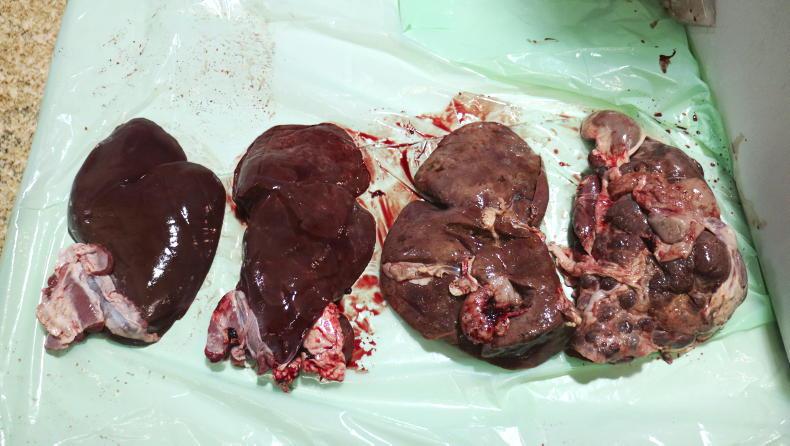
Many farmers may be of the opinion that there is a lower risk of liver fluke given the drought conditions during the summer months but this is not taking into account the higher volumes of rainfall in the first half of the year.
Some vets and factories are pointing to active fluke infestations in flocks that would traditionally face significant disease issues.
Flock owners should weigh up their own disease risk and make use of all available sources of information.
For example, where sheep are being sent for slaughter it is a good source of information, where possible, to see if the health status of livers can be assessed. Any sheep that die without explanation should also be sent for post-mortem.
Acute fluke is the threat at this stage of the year so there will not be the characteristic signs that are seen later in the year with chronic liver fluke. It is also important to select a product that will target at least immature stages of the liver-fluke parasite.
A common option adopted by many farmers at this stage of the year is using combination products that target fluke and worms. A significant number of these products only target mature stages of the liver fluke parasite and, as such, are of no real benefit in addressing the risk presenting in sheep.
FEC reduction test
This time of year is often a good time to carry out a faecal egg count (FEC) reduction test to check the efficacy of wormers with a medium-to-high worm burden required for the test to work effectively.
For an FEC reduction test, the 10 sheep from which the faecal samples are collected need to be clearly identifiable as faecal samples for the repeat FEC will be collected from these same lambs.
The repeat faecal egg count must take place seven days following treatment in the case of levamisole-based products and 14 days later in the case of benzimidazoles or macrocyclic lactones.
If the result is a >95% reduction in the worm count, it is considered that there is no problem with anthelmintic resistance while, if the result is <95%, it is likely that there is an issue with resistance, that is provided the recommended dosing guidelines were followed during treatment. If in doubt consult with your vet.
Sheep movement information
A few queries have cropped up lately regarding farmers accessing historic sheep movement information via MyAgfood.ie. This is not available at present via the new AIM services portal for sheep/equines but it can still be accessed via the AIM services portal for cattle. Click on ‘Access AIM’ under the cattle heading. This should then present flockowners with the option of selecting the ‘Sheep Keeper’ tab.
On the next webpage users will have the option to select movements at the top of the page and then enter the date range or search for particular dispatch documents. Note that to record any movements you will be redirected to the new sheep AIM services portal.
Organic sale
The Western Organic Producer Organisation are holding a second organic sheep sale on Friday 16 October at 4pm in Maam Cross Mart.
There are 900 store lambs, 350 ewe lambs, 80 hoggets, 40 ewes and 50 rams entered.



SHARING OPTIONS