There is a risk, particularly on higher ground, of animals getting trapped in snow drifts while good shelter and adequate nutrition remain critical for ewes and young lambs.
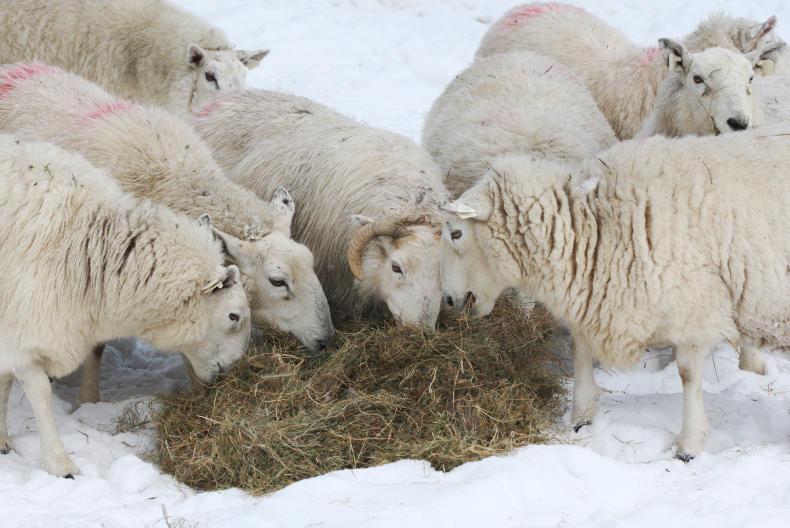
Ewes burying through the snow on high ground. Ewes in good condition will be able to withstand a level of underfeeding but where snow persists it is important to introduce supplementation.
Stronger lambs will be in a better position to withstand the cold as long as ewes have a good milk yield. / Brian Farrell
For hill sheep farmers in the east and south, snow drifts and wind chill remain the greatest concern. The worst damage from snow drifts is generally on high ground where animals get trapped under a heavy drift and weather prevents access for a period of time. At this stage, the advice is to put your safety first and refrain from travelling into dangerous terrain. Where animals are close to hand it is worth monitoring wind direction and ensuring animals have shelter from the prevailing wind.
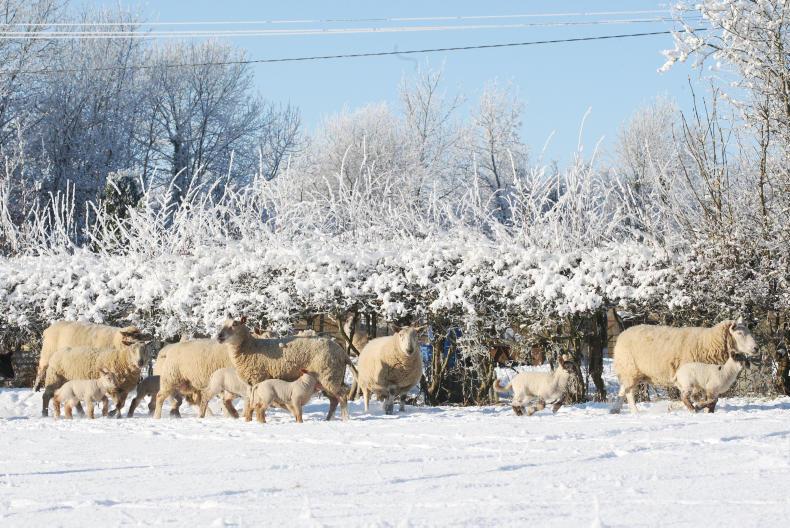
Shelter and nutrition are two vital components to consider during teh cold snap.
This is particularly the case for ewes with young lambs at foot, with nutrition and shelter two vital considerations. Increasing supplementation levels by 5% to 10% over the current offering will help to boost energy intake. Where spring grass has fulfilled the energy requirement of lactating ewes up to now, the need to supplement and the level required will depend on the volume of snowfall present and the length it lasts on the ground. At a minimum, lactating ewes with no access to grass should be supplemented with concentrates while taking care to target feeding levels so that acidosis is not a risk. Remember lactating ewes require up to 10l of water per day.
ADVERTISEMENT
Offering outwintered ewes forage, even for a short period, will help to overcome a nutritional deficit and avoid problems.
Ewes and lambs should be given access to fields with the best shelter, with feeding early in the day and in advance of nightfall allowing animals time to find shelter. Placing troughs in the position with the best shelter will also help. Pregnant ewes in good body condition will be able to withstand a level of underfeeding for a short period of time but this should not be pushed too far as it will increase the risk of twin lamb disease.
Feeding options are discussed in management notes on page 70. The notes also discuss dealing with hypothermia in lambs, which is high risk given the wind chill that is forecast.
This content is available to digital subscribers and loyalty code users only. Sign in to your account, use the code or subscribe to get unlimited access.
However, if you would like to share the information in this article, you may use the headline, summary and link below:
Title: Snow drifts and wind chill pose greatest risk
There is a risk, particularly on higher ground, of animals getting trapped in snow drifts while good shelter and adequate nutrition remain critical for ewes and young lambs.
The reader loyalty code gives you full access to the site from when you enter it until the following Wednesday at 9pm. Find your unique code on the back page of Irish Country Living every week.
CODE ACCEPTED
You have full access to the site until next Wednesday at 9pm.
CODE NOT VALID
Please try again or contact support.
For hill sheep farmers in the east and south, snow drifts and wind chill remain the greatest concern. The worst damage from snow drifts is generally on high ground where animals get trapped under a heavy drift and weather prevents access for a period of time. At this stage, the advice is to put your safety first and refrain from travelling into dangerous terrain. Where animals are close to hand it is worth monitoring wind direction and ensuring animals have shelter from the prevailing wind.
Shelter and nutrition are two vital components to consider during teh cold snap.
This is particularly the case for ewes with young lambs at foot, with nutrition and shelter two vital considerations. Increasing supplementation levels by 5% to 10% over the current offering will help to boost energy intake. Where spring grass has fulfilled the energy requirement of lactating ewes up to now, the need to supplement and the level required will depend on the volume of snowfall present and the length it lasts on the ground. At a minimum, lactating ewes with no access to grass should be supplemented with concentrates while taking care to target feeding levels so that acidosis is not a risk. Remember lactating ewes require up to 10l of water per day.
Offering outwintered ewes forage, even for a short period, will help to overcome a nutritional deficit and avoid problems.
Ewes and lambs should be given access to fields with the best shelter, with feeding early in the day and in advance of nightfall allowing animals time to find shelter. Placing troughs in the position with the best shelter will also help. Pregnant ewes in good body condition will be able to withstand a level of underfeeding for a short period of time but this should not be pushed too far as it will increase the risk of twin lamb disease.
Feeding options are discussed in management notes on page 70. The notes also discuss dealing with hypothermia in lambs, which is high risk given the wind chill that is forecast.
If you would like to speak to a member of our team, please call us on 01-4199525.
Link sent to your email address
We have sent an email to your address. Please click on the link in this email to reset your password. If you can't find it in your inbox, please check your spam folder. If you can't find the email, please call us on 01-4199525.
ENTER YOUR LOYALTY CODE:
The reader loyalty code gives you full access to the site from when you enter it until the following Wednesday at 9pm. Find your unique code on the back page of Irish Country Living every week.
SHARING OPTIONS