


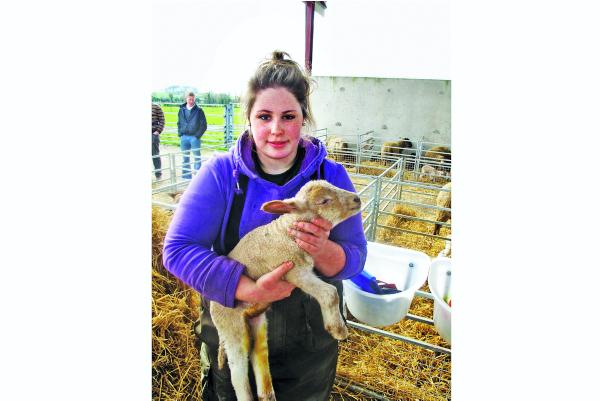
Entropion is not a selection criterion that is generally discussed. However, in this article, Jennifer Matthews explains the importance of monitoring sheep for the ailment and making breeding decisions to minimise its prevalence in future generations.
Entropion is a condition where one or both of the lower eyelids roll inwards. This causes the periocular hair and eyelashes to abrade the corneal surface of the eye, resulting in severe irritation and pain and making this condition a serious welfare issue. In some cases, entropion can recover spontaneously without treatment. However, in the majority of untreated cases, keratitis will develop, the cornea will become cloudy and ulcerated, and the lamb will become permanently blind.
The aim of the study was to identify any common denominators between the affected lambs (eg sire, sire breed, sex, birth weight etc) and to determine the welfare implications associated with the condition, and the effect of entropion on the future performance of the affected lambs.
Entropic lambs are known to be less inclined to perform natural behaviour, often failing to follow the ewe and suckle inefficiently which in turn lowers thrive in the first few days of life.
For my final year honours research project, I monitored entropion in new-born lambs on a large, commercial lowland flock in Co Offaly where 7.7% of the flock were affected with entropion.
The results of this study showed that entropion is associated with the breed of the sire, and the individual sire within breed.
It was also determined that lambs diagnosed with the condition were found to be heavier at birth than healthy lambs.
By 50 days old, entropic lambs were significantly lighter and were also found to have a lower daily live weight gain to 50 days than the unaffected lambs.
This indicates that the welfare of the affected lamb is compromised by this condition, and a lower daily liveweight gain will increase days to slaughter, therefore reducing the profit made by the farmer.
It is in the interest of both the animal and the farmer to employ prevention strategies and, most certainly, treat every affected lamb.
There are generally no clinical signs in adult sheep (with the possible exception of scar tissue in sutured eyes) to show that the animal has previously suffered from the condition.
Also, best practice selection decisions should hopefully limit the number of animals sold that have previously been affected.
Sires with any signs of the condition or producing lambs with the condition should be culled before the start of the breeding season, as too should replacement females.
*Jennifer Matthews recently completed a degree in Animal Health and Welfare at Harper Adams University College.



SHARING OPTIONS