



The Australian sheep industry is facing a crossroads, one which has crept in over the past two decades but is now picking up pace.
Farmers are flocking into shedding breeds, such as the Dorper ,or doubling down with the Merino, the latter of which is carried on in the hopes wool will have its day again.
The middle ground – a first cross Merino/Border Leicester ewe, once similarly popular to the speckled Borris ewe of Ireland, for example – is declining in numbers.
Farmers want either a shedding breed, to avoid rising shearing costs altogether, or the finer-wooled Merino, to pay the costs back. The strong wool of the first-cross ewe is doing neither.
The shedding race is throwing up all sorts of breeds, with the original Dorper, White Dorper, Sheepmaster and Australian White all having their moment.
These breeds are typically run in drier conditions in New South Wales and Queensland, but on some of the most efficient high-rainfall Victorian prime lamb operations, the composite Nudie shedding breed is gaining ground.
Originally developed by southwest Victorian farmer John Keiller, the breed has even made its way to the UK in recent years.
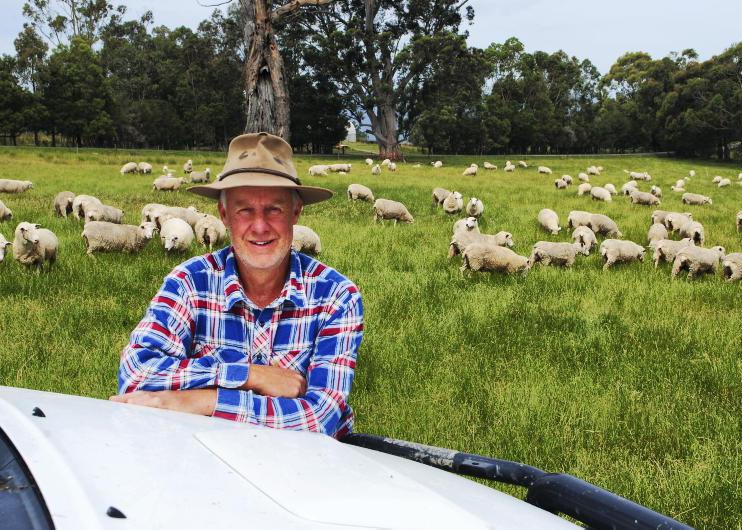
Keiller lambs 7,000 ewes and 3,000 ewe lambs in August and September each year on his 1,880ha Cashmore Park property at Portland.
The operation runs at the “pointy end” of genetic performance, according to the seasoned producer, who has been performance recording for 35 years.
His flock consists of 50% maternal woolled composites, a 10-way breed cross that started with Coopworths. The other 50% are what he has coined the Nudie breed – the maternal composites but without the wool, with Wiltshire Horn and Dorper genetics used to get them shedding.
Keiller aims to transition more to the Nudie breed, once their performance can go head to head with their wooled cousins.
He said the maternal composite is “just a fast-growing white wool sheep with two lambs and no parasites”.
“That’s what our simple aim is,” he said.
He explained the Nudie is bred with the same selection pressures, just with less wool and no need for shearing or dagging.
Key traits
So, what are the performance traits being chased with both types of ewe? Put simply, the sheep have to lamb themselves outdoors and rear two fast-growing, parasite-resistant lambs off grass.
Keiller’s 2025 lambing of 10,000 sheep went well, with favourable weather conditions.
Not as common as in Ireland, he has scanned all his ewes for the past 15 years, with mobs immediately split into empties, singles, twins, and triplets, and managed accordingly before lambing.
Singles are put in groups of 250 with 13-14 ewes per hectare on 1,200kg of dry matter.
Twins are run in smaller mobs of 35-60, at 7.5-8/ha and on 1,400kg of dry matter, and triplets are put in small paddocks close to the yards in mobs of 30.
The wooled composites usually scan at about 185%, with the Nudies at 165-170%, but this year, due to drier conditions, scanning was back around 15%.
“We were just a little bit down on the pregnancy test, but that’s about where our feed levels were, so we were about nicely matched,” Keiller said.
“The ewes were probably all about 5kg lighter than where we’d like them to be, about 0.2 or 0.3 of a condition score behind.”
Despite the ewes being in slightly poorer shape, he said he had a “cracking lambing”.
“You often find if sheep are run a little bit harder, you just have slightly lower birth weights,” he said.
Data game
Sheep farming has “without a doubt” become about data and genetics, according to Keiller.
“It doesn’t cost any more to run a good animal than it does a bad animal,” he said.
He said with strong global sheepmeat demand, producers are leaving $50(€30) behind per ewe for no extra cost, if they didn’t capitalise on the genetic gains available.
“From an animal breeding point of view, it’s so easy to have high quality animals these days,” he said.
Another farmer transitioning to shedding sheep is Rob Costin, who farms in Hordern Vale, Victoria.

Costin described the Nudie as a “game changer” and first got into the breed in 2020, with the sheep now almost half of his 6,000 ewe flock.
In 2025, he added 2,000 pure-bred Nudie ewe lambs to ramp up the change and aims to develop a shedding flock with as many of the wooled composite’s traits as possible.
“We decided that we wanted to be at the pointy end of it and really drive the type of animal that we could see was needed going forward,” he said.
“We’re trying to get all the production, the feet and the hardiness of the maternal composite, just getting rid of that one thing – wool.”
Costin insisted closing the gap on the performance of the Nudie to maternal composite ewes is crucial.
He explained how his Nudies scan at 170-180%, maybe 10% back on his wooled composites, with the gap “shrinking by the minute”.
“Going to a shedding composite is going to be the next big game changer for that prime lamb industry,” he said.
Sticking with wool
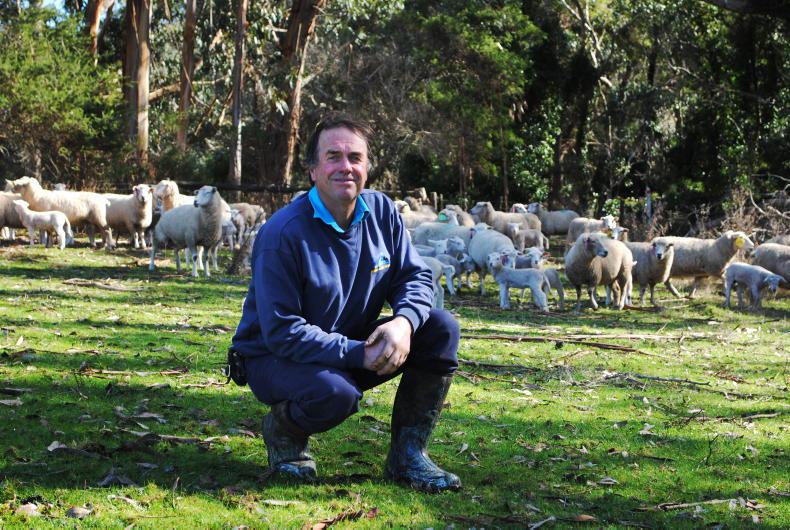
Another Victorian sheep farmer David de Pury, Yarra Valley, is sticking with wool, and is working to up the value of his sheep’s fleece.
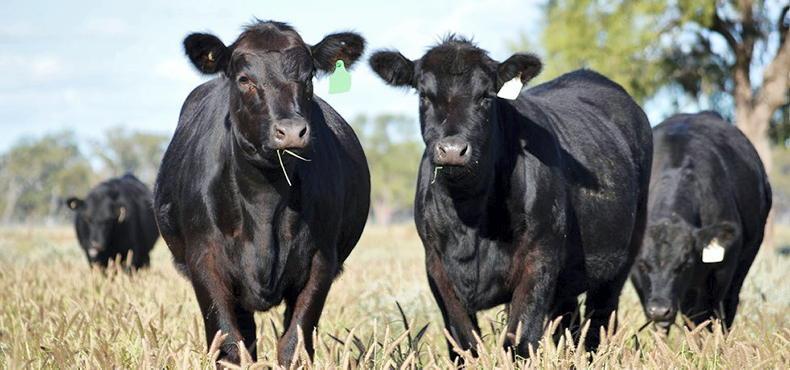
He runs 2,000 multi-meat and multi-meat/Merino ewes on 700ha, along with 400 suckler cows. The multi-meat breed originates from White Suffolk stock with the infusion of the ‘Booroola’ gene which pushes a ewe to release more eggs.
The breeding approach causes the number of triplets and quads in the flock to skyrocket, but De Pury said if managed correctly, this could be a good thing.

His basic principle is simple – the multi-meat sheep require less feeding to scan with twins, so he can stock densely and push the sheep hard.
He said in this way, he can achieve the same scanning percentages as regular flocks without the Booroola gene, but those sheep would have to be fed more.
In 2024, due to the ewes being over fat, they scanned at 230%, with a significant 55% being triplets.
In 2025, the ewes scanned at a more manageable 210%, with about 35% scanned with three foetuses or more, and a weaning rate of 180%.
“This system of using the multi-meats with their high [fertility] means it’s a much more efficient system,” De Pury said.

In recent years, he has used dual purpose, 18-19 micron (wool strength) Merino rams to up the multi-meat’s wool value. The lower a fleece’s micron level (finer wool), the higher its value will be.
Young multi-meat/Merino sheep have gone from having a 30 micron fleece to 23-24 microns, increasing the wool’s value from $2/kg to $8/kg (€1 to €4.50). The multi-meat/Merino breed mix is working well for De Pury, with Poll Dorset rams then put back over half the flock and the other half used to breed replacements.
Ewes go to the ram on 21 February each year and start lambing on 21 July, with lambs weaned in early November and sold to local abattoirs from the following January to May.
De Pury is adamant that lambing down lots of triplets outdoors is doable. Ewes carrying triplets and more are split in mobs of 40-50 across 5ha paddocks to ensure problems can be caught quickly at lambing.
He said his ewes were also little hungrier in 2025 and this actually helped lambing.
“It’s a fine line between having enough condition on them so that they lactate well but if they’re too fat, then they’ll have problems with the lambs getting too big and getting stuck and stuff like that.
“If they’re going well, then a lot of them will raise three lambs quite happily.
“It works well for us, it’s just a matter of fine tuning it.”




SHARING OPTIONS