



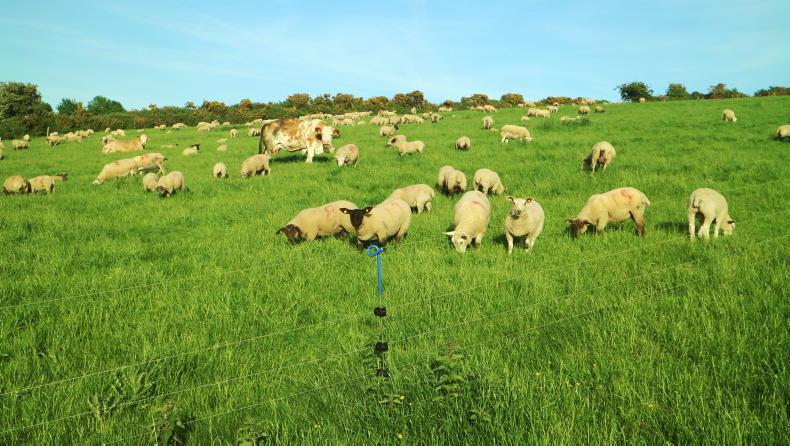
Weaning decisions: Flocks with a mean lambing date of 1 March are now approaching week 14 of lactation. Ewe milk yield at this stage will have reduced to a low level with lambs becoming increasingly reliant on grass intake.
Decisions on the optimum time to wean should take in to account grass quality and quantity available.
The increase in grass growth rates over the last two weeks has left more farms in a better position so there may be merit in delaying weaning where lambs are performing adequately and the aim is to get another draft of lambs away pre-weaning.
However, if grass supply or quality is under pressure then it make sense to wean so that the best grass available can be prioritised for lambs.
Lamb intake at this age is significant at 1.2kg dry matter per head daily and while ewe grass demand is declining it is still high at upwards of 2.2kg to 2.4kg dry matter per head. Weaning can almost halve this grass demand.
The other big benefit is that it provides the optimum timeframe to address body condition ahead of the next breeding season and allows used to be used as a grass management tool to graze down paddocks after lambs. Once ewes have been dried off there is no merit in overly restricting intake.
Where grass swards are at a higher than desirable level for lambs then lambs should be moved on to fresh pasture once the most digestible leaf component of the plant has been grazed.
NSWS body condition score action: I was at an event last week where there was some questions on the body condition score action in the National Sheep Welfare Scheme.
If there is no sheep falling below the target body condition score (BCS) then it is acceptable to record this in the scheme action booklet.
Where there is sheep at a BCS of one or two, which is likely to be the case, then the number of such sheep should be recorded along with what action has been taken.
This can be as simple as grouping these sheep together for access to the best-quality grass available.
Other practices can complement offering access to high-quality feed such as introducing creep feed to lambs to take the pressure of ewes or weaning these ewes early to allow a better opportunity to regain condition but there is no set requirement to implement any practices outside of offering access to high-quality feed.
The first BCS assessment must take place between 15 April and 15 July.
Date for diary: The Teagasc National Sheep Conference takes place on Thursday 18 June in Ballinasloe, Co Galway. The format for this year’s conference is changed with an indoor session in the Shearwater Hotel, Ballinasloe from 3pm to 5pm.
Topics discussed in this session include bluetongue virus and other exotic diseases, lameness in sheep flocks, labour practices and an outlook on markets, sheep schemes and the next CAP.
The conference then moves outdoors to the farm of John Galvin, Taughmaconnell, Co Roscommon and from 5.30pm to 6.30pm will showcase the latest sheep research updates before the second session begins at 7pm with interactive workshops on grassland management, lameness control, internal parasite control and breeding. The event is free to attend.



SHARING OPTIONS