



Strategies for the sustainable management of upland areas must be developed around farming systems.
This was one of the key messages from the joint CAFRE and Teagasc Uplands Symposium 2025 which took place on Tuesday in Ballymena, Co Antrim.
The event discussed some of the key challenges and opportunities facing uplands areas in exploring optimum management strategies. It also looked to lessons learnt from our close neighbours in Scotland.
Between 70% and 80% of agricultural lands in Scotland are uplands, which has historically given rise to a strong focus on research and demonstration of upland farming systems.
Much of this work has been carried out by Scotland’s Rural College, or the SRUC, with many learnings applicable to farmers in upland areas on the island of Ireland. At Tuesday’s event Professor Davy McCracken shared research and knowledge transfer experience highlighting key learnings.
Climate change pressure
Davy highlighted clear evidence to show changing weather patterns, which he says will put even greater pressure on how upland areas are managed.
Extreme rainfall events are occurring more frequently and while some upland areas are experiencing upwards of 2.5m of annual rainfall, drought is also now an issue for farmers to contend with.
He said that some upland areas are likely to go from experiencing drought-like conditions once in 20 years to possibly three to seven times over the next 20 years.
With biodiversity under pressure and bird species numbers in decline management practices such as creating ponds or wader scrapes will be vital.
The fact that such a high proportion of lands are uplands means that many villages and towns are surrounded by upland areas.
There is generally not a problem with water quality in these areas but water quantity is becoming a growing concern where the flow of rainfall can be rapid during extreme rainfall periods.
He says that flood mitigation measures will need to incorporate management practices that slow down the movement of water on uplands, as will be touched on below.
Value of liming
The 2,200ha SRUC farm is described as being very poor in nutritional value with a dominance of acid grasses sustaining just 1,500 sheep and 32 cows and their calves.
There is 50ha of in-bye lands which are relatively good and are described as the engine block of the farm.
Driving grass growth here is vital for lambing, silage making, breeding etc.
Davy explains that the high level of rainfall essentially results in lime being stripped from the soil making it extremely hard to keep soil pH at a reasonable level. The aim is a pH of 5.8 upwards.
Lime applied will generally increase the pH from 5.2 to 5.8-6 but this can revert in just a three year period.
Davy says that to ensure the soil is active continual soil monitoring and targeted lime application is necessary to underpin production and achieve any sort of worthwhile response and value for money for applied nutrients.
Long tradition of performance-recording and suitable breeds
The farm has a long tradition of trying to record performance, but as one can expect this is challenging when it can take upwards of three to four days to bring all stock back from the hills to the yard or in-bye lands.
Having good facilities and performance recording equipment is vital to encourage greater recording and minimise labour input with automatic weighing and drafting now standard practice.
Recording breed performance to identify breeds or breed lines that can perform and deliver an acceptable level of output in such challenging terrain is critical for the financial performance of the system.
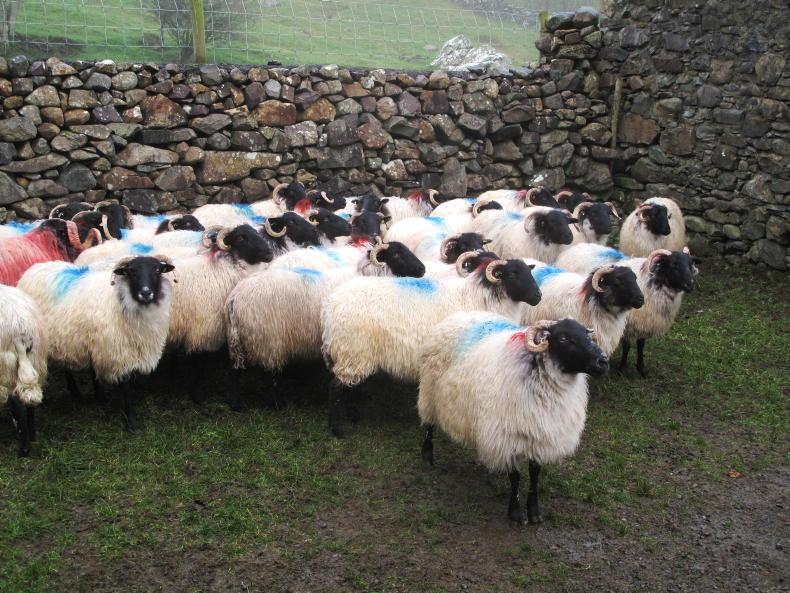
In the mid-2010s the farm introduced Lleyn sheep with the aim of lifting performance above the Scottish Blackface elite genetics.
The breed initially delivered a performance boost but were decimated by the Beast from the East in 2018 with performance of affected sheep never fully recovering.
Moves were made to experiment with incorporating Lleyn genetics in a crossbreeding programme with Scottish Blackface sheep.
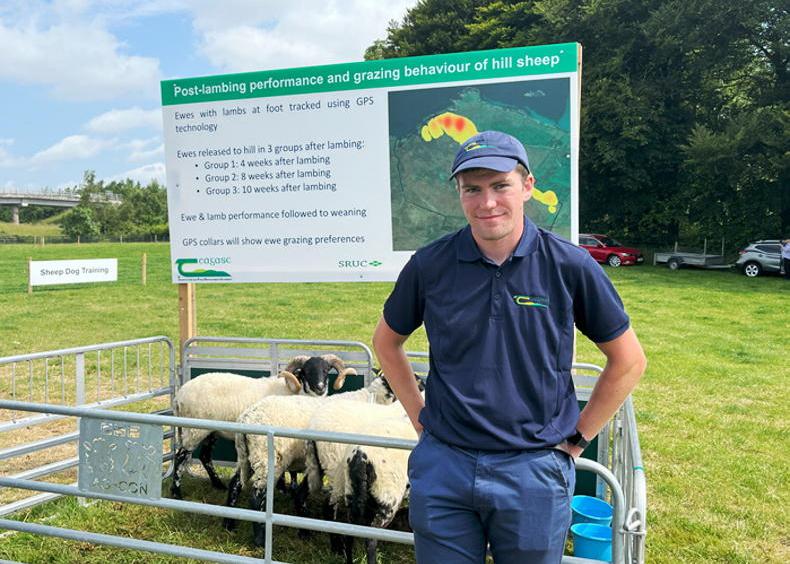
The resulting first cross-progeny achieved a higher litter size but analysis of grazing behaviour showed the first-cross Lleyn’s grazed a much narrower range of upland areas.
The second cross-Blackface progeny of Lleyn x Blackface ewes cover a greater area and could be a better fit with research ongoing.
Davy highlighted that if such aspects are not measured and monitored then there is a risk of progressing down the wrong breeding route which could harm the environment you are trying to manage.
Biodiversity and woodland
Davy says that on most farms areas to improve biodiversity and plant trees can be found.
Fencing of watercourses and strategic un-grazed margins has greatly enhanced species and insect activity around rivers and while four ponds introduced has not had profound changes in terms of bird species in decline it has significantly enhanced the activity of other wildlife and invertebrates.
He adds: “You don’t need to do a lot at a big scale to have a big benefit on biodiversity.”
Farmer reluctance concerning woodland or planting trees will need to change according to Davy.
In 10 to 15 years’ time he says woodland / shelter belts or groves of trees or individual trees will be vital to provide shelter for animals from extreme heat or rainfall.
He said that trees are not easy to establish and protecting them is expensive.
Selecting a good site and native species suitable to the area is critical.
He used the example of 250ha of trees sown on the farm 26 years ago with the aim of silvopasture (grazing between trees).
Some of the trees in the most exposed areas are no higher than 1.5m and no thicker than his thumb all this time later but the vegetation that has been allowed to develop among the trees is seen as a good option for slowing down the passage of water from the hill.
Need for metrics
Data collection in uplands areas can be extremely difficult and according to Davy can often throw out more questions than answers.
However, without it, it would not be possible to even ask those questions and there is a big value in this both at farm and industry level.
Such information at industry level is vital to inform policy and to provide a robust defence from external pressures on how best to manage upland areas.
Without science then the debate simply becomes a measure of who shouts loudest in the absence of clear facts.



SHARING OPTIONS