
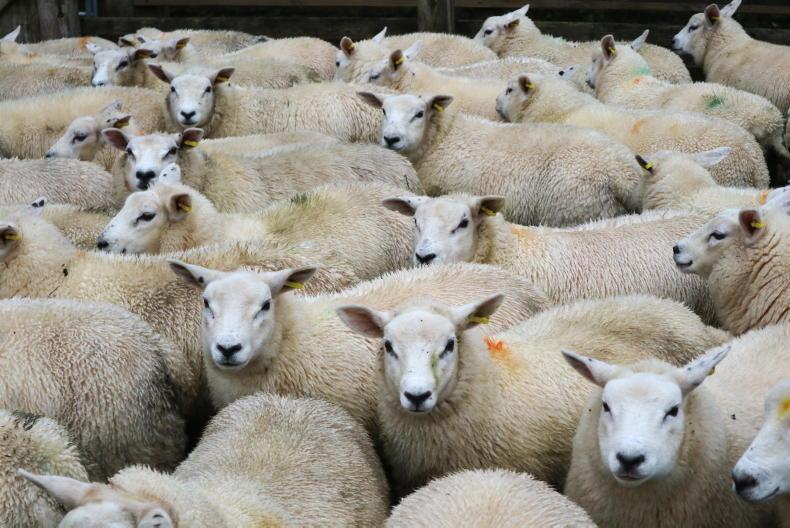
The recent downward trend in UK sheep production is predicted to extend into at least 2027, with the sheep kill expected to reduce by another 3% in 2027. The forecast contained in the latest Agriculture Horticulture Development Board (AHDB) market outlook follows on from what is looking likely to be upwards of a 3% decline in throughput in 2026.
Lamb slaughtering in 2026 has been variable across the year. AHDB reports that throughput in the first half of 2026 totalled 5.46m head – equating to a reduction of 2%, or 116,000 head, compared to the first half of 2025.
Within this, the lamb kill was actually up by 5% in quarter one of 2026, stemming from a higher carryover of lambs from the 2025 lamb crop. Throughput in quarter two was much tighter, with the sheep kill especially under pressure in June – culminating into production falling by 9% in quarter two.
The lamb slaughter in the second half of 2026 is predicted in the region of 5.74m head, down over 3% year-on-year. The reduction in lamb slaughter figures is not translating to a similar fall in production, with total UK sheepmeat production for 2026 forecast to reduce by 1.3% compared to 2025, to 269,000t.
AHDB lead red meat analyst Hannah Clarke explains that this is based on higher average carcase weights delivered in recent months. Clarke says that average sheep carcase weights have been marginally heavier than in 2025 and attributes this to attractive concentrate feed prices, which has encouraged some producers to feed lambs to heavier weights.
2027 forecast
A much lower carryover of 2026-born lambs into 2027 is expected, which is underpinning a very significant reduction in the sheep kill of 7%, as reflected in Figure 1. This is occurring at a key timeframe with regard to demand, with a much greater appetite for lamb for the religious festivals of Ramadan (8 February to 7 March 2027) and Easter (28 March 2027).
Overall, AHDB reports that clean sheep slaughter in 2027 is forecast at 10.89m head, down 2.7% from the 2026 forecast. The forecast for adult sheep throughput is also for reduced throughput. When combined, this is feeding into sheepmeat production falling by 2.5%, or about 7,000t, to 262,000t.
As touched upon briefly, the reduction in sheep slaughter figures is being underpinned by contraction in the UK breeding ewe flock and production thwarted by the bluetongue virus. AHDB predicts that the breeding ewe flock will stand in the region of 12.98m head on 1 December 2026, a fall of 1% on 2025 figures.
Bluetongue virus
The possible effects of the bluetongue virus on output are impossible to predict with high levels of accuracy, but there are grave concerns in areas that were hit hard by the virus in 2026 and the surrounding hinterland.
There were over 3,300 farms with confirmed cases of bluetongue virus, serotype three (BTV-3) in 2026. Some industry commentators observe that this figure is likely to be under-reported, with some farmers in areas worst affected not inclined to report cases, as there was no significant benefit in doing so.
The AHDB has developed a ‘likely bluetongue scenario’, which assesses the possible effect of disease on production. It assumes that the geographic spread of the virus is for now concentrated in the southwest, west midlands, east midlands, northwest, Yorkshire (south and west) and Wales.
It assumes that 20% of sheep within 25% of flocks in these areas become infected, which it says is equivalent to 5% of the total sheep flock in the affected area. Mortality rates are assumed to be in the region of 25%, with fertility falling by 30% among infected ewes.
Clarke explains that there is limited first-hand evidence on the likely mortality and fertility impacts under UK conditions and as such these assumptions have been based on industry engagement and the most realistic assessment of a plausible impact.
She adds that AHDB has also tested a range of scenarios using higher and lower mortality and fertility assumptions, commenting that “while these change the scale of losses at farm level, they do not materially alter the direction of the national production outlook presented here”.
Production impacts
Clarke states that modelling the above scenario results in UK sheepmeat production reducing by a greater level than the ‘baseline forecast’ outlined above.
However, she says that “while bluetongue could have a devastating impact on affected farms, when it is grossed up to the national level the overall impact is modest”.
In this scenario, lamb slaughter is expected to fall by a further 83,000 head before Christmas, or approximately 1% of the kill, with a further 103,000 breeding ewes lost equating to about 1% of the national ewe flock.
This means that production reduces by a further 2,000t in 2026 compared to the ‘baseline forecast’.
“The more significant impact is on fertility rates and thus the size of the lamb crop born in 2027. As a result, lamb slaughter is forecast to fall by an additional 95,000 to 150,000 head per year, compared to the baseline forecast.
“Assuming average carcase weights, this reduces sheepmeat production by a further 2,000t to 3,000t per year compared to the baseline forecast.”
The differences are shown in Figure 2. Vaccination strategies have the ability to greatly alter these predictions.
In the modelling, AHDB has assumed that vaccine uptake has been modest in 2026 and will only become widespread in the 2027/2028 season, adding that a quicker uptake of vaccination would bring predicted sheep production much closer to the baseline forecast.
Import trends
Information on sheepmeat imports is available for the period January through to July. Total volumes imported are 46,300t product weight, including fresh, frozen and processed product.
This is 1% higher that the corresponding period in 2025. Growth in import volumes from Australia (+11%) and Ireland (+8%) has compensated for reduced volumes imported from New Zealand (-5%). This is reflected in Figure 3.
The value of imports increased by a much larger figure of 18% year-on-year to reach £318m (€380m) owing to increased value of sheepmeat imports from southern hemisphere countries in particular. AHDB reports that sheepmeat imports are making up a greater percentage of the overall UK sheepmeat supply.
Imports will remain an important supply element in the future, but they are not expected to increase majorly despite forecast tighter domestic production. This, according to AHDB, is due to “constrained global supply, price competitiveness and subdued domestic consumer demand”.
“Southern hemisphere availability is expected to remain tight, with industry outlooks pointing to lower production in New Zealand and Australia through 2027. Lower supply in these regions have supported prices and narrowed the advantage to UK lamb”.
The latest figures from Australia’s Department of Agriculture, Fisheries and Forestry shows that Australia has filled 41%, or 17,457t, of its 41,667t of its free-trade agreement and 12,699t of its historical quota of 13,335t.
Sheepmeat exports
AHDB report that sheepmeat exports began the year strongly, but have generally weakened as the year has progressed.
For the year-to-date (Jan-Jul), UK sheep meat exports (including fresh, frozen and processed) totalled 50,400t (product weight).
Clarke reports: “this was 2% higher than the same period in 2025, with growth to several European destinations including Belgium (+32%), Germany (+15%) and Italy (+15%). Volumes shipped to France fell by 5%. Growth was also noted to several non-EU countries, including Saudi Arabia”.
These exports were valued at £428.7m, (€512m) up 13% year-on-year, on the back of an increase in volumes and value. Exports are forecast to grow by 3% in 2026 and 1% more in 2027.
AHDB expects that tight European sheepmeat supplies should continue to underpin demand for UK exports, but lower UK production is likely to be a key constraint on growth.
It flags opportunities including reduced UK-EU trade friction as having the potential to grow exports while possible risks to export volumes include higher volumes of southern hemisphere lamb being diverted to the UK / EU if current global trade flows are disrupted.
From an Irish sheep producer context the UK will continue to be a competitor in key high value European markets but a reduction in domestic production should ensure that volumes do not increase drastically. While lower production should also hopefully lift demand for Irish exports to the UK market.