



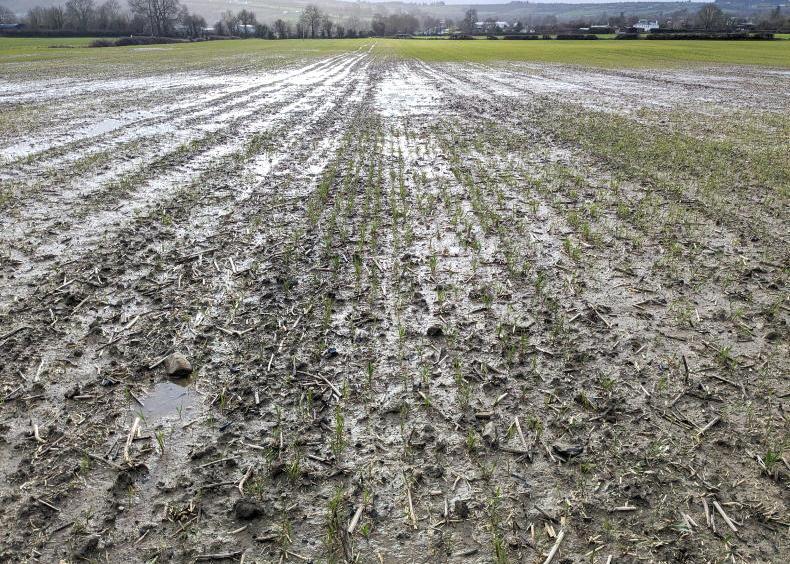
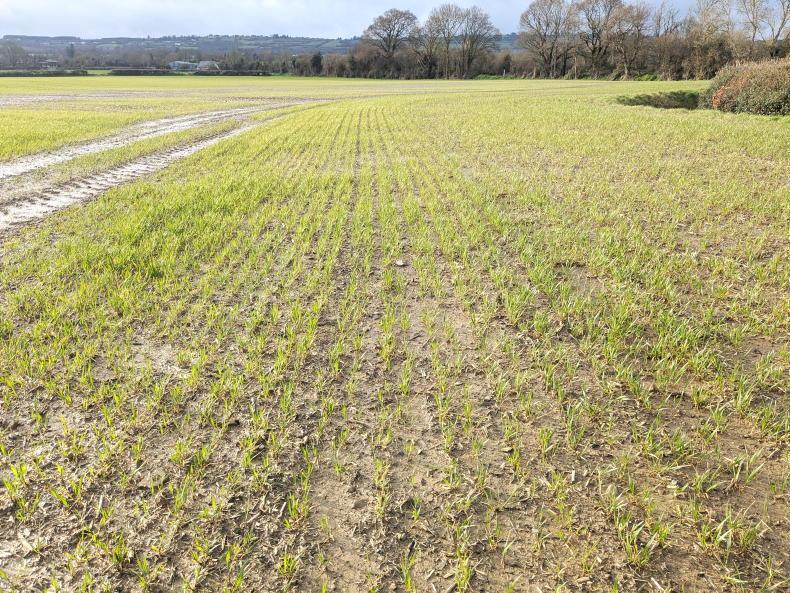
Moving away from the plough has become more common over the past few years but there is still much to learn with these systems.
From the Tramlines participant Hugh McDonnell has been practising non-inversion tillage for over 20 years near Bagenalstown in Co Carlow.
There is still a plough on the farm for tricky autumns, especially with half of the farm sitting on very heavy soils.
However, the direction of travel has been firmly away from turning the sod for two decades, underpinned by a disciplined approach to straw management, soil sampling and detailed record-keeping that stretches back 30 years.
Hugh had been finishing a large number of cattle on the farm until the foot-and-mouth outbreak in 2001, when he converted the remaining grassland to tillage.
The removal of livestock had a knock-on effect that would define Hugh’s approach to soil management ever since.
When the farm was finishing cattle, every bale of straw on the farm was used for bedding and additional straw was bought in to meet demand when required.
That system generated large quantities of farmyard manure which was spread back onto the tillage ground, increasing organic matter and providing nutrients to the following year’s crop. When the cattle went, so did this valuable source of manure.

To combat this, Hugh decided to begin chopping straw to keep the organic matter and nutrients inside his farm-gate.
He now chops most of his straw, with some years seeing no bales made on the farm.
Chopping all straw most years is not without its challenges, particularly when oilseed rape features in the rotation.
Establishing oilseed rape in chopped straw is difficult and then the residues left behind after harvest are a haven for slugs.
Hugh is frank about the challenges this brings.
“Some years you don’t get any bother, more years they’d break your heart,” he says about slugs. Slug pellets are applied to the crop that follows oilseed rape using a disc spreader mounted on the front of the tractor while spraying.
Even straw distribution across the full width of the combine header is essential. Hugh noticed a huge improvement here when a new set of blades were installed on the straw chopper last year.
Hugh tends to incorporate straw with his tine cultivator at a depth of 4” to 5”, giving plenty of opportunity for the straw to mix with the soil.
He sometimes will go even deeper during a particularly dry year. The heavy packer on the back of the cultivator helps increase straw-to-soil contact too.

While not always possible, Hugh tries to get his straw incorporated as soon as possible after harvest, with the cultivator often in the same field as the combine.
Before the winter barley harvest last year, Hugh was hesitant about chopping the straw as he intended to drill winter oilseed rape. There was a very heavy crop of straw on the barley but in the end, he went ahead and chopped it. The field was then subsoiled to a depth of between 12” and 14” and left for a number of weeks.
When Hugh went back in the middle of August to inspect the field, he was amazed. “The straw disappeared,” he says.

He puts this down to the healthy soils on the farm that have an abundance of earthworms and fungi to carry the straw down into the soil and begin the decomposition process. He did not encounter any problems at sowing and the oilseed rape established very well.
The healthy soils have been built not through one single action but a combination of many different practices on the farm including 20 years of the non-inversion system, straw chopping, a diverse crop rotation and cover cropping.
Hugh has experimented with cover crops over the years and has found that a simple approach suits him best. He has used phacelia on its own many times and likes the condition it leaves the soil in, the way it quickly covers the ground and of course the purple flowers that provide food for pollinators over the autumn months.
Even though winter crops are preferred when the weather allows, Hugh will still try to get a cover crop in for the eight to twelve weeks before the autumn sowing kicks off.
Hugh will typically spray off a cover crop and then go straight in and plant his crop.
He sees a lot of people rolling cover crops in the frost and thinks it’s a good idea but that the rolling should be done at a 90° angle to the direction of ploughing or cultivating to make the most of any discs that can chop up the roots and stems of the cover crop.
One of the defining characteristics of Hugh’s operation is his meticulous record-keeping stretching back 30 years.
These records allow Hugh to see what has worked or not worked on the farm, review the trends in soil fertility and why this may be occurring and to ensure that the crop management plan for the current season is carried out without confusion.
Soil sampling is completed every four years, with one sample taken for each hectare or thereabouts, generating detailed soil maps of pH, P and K indices and the subsequent nutrient requirements across the farm.
Even though he does not have a variable rate fertiliser spreader, Hugh still uses this information to variably spread fertiliser across the farm through changing the tractor’s speed and he says his contractor is very good at using these maps to spread lime too.





SHARING OPTIONS