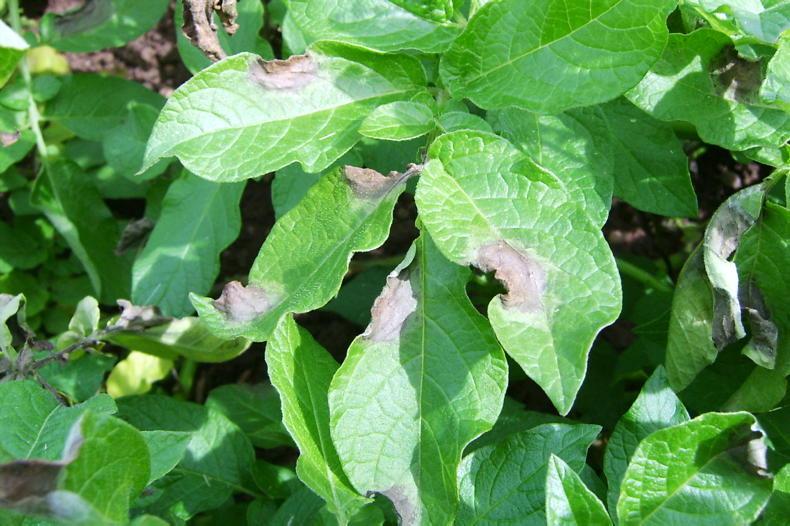
A field test to detect potato blight is hoped to be on the market in two years at a cost of around €35 per kit, Weili Guo of the AgSense project told the Irish Farmers Journal last week.
Speaking at the Haggard Stores potato variety open day in Meath, Guo, a post-doctoral researcher at Dublin City University, said that the commercialisation fund is being sought at the moment.
“Currently, there is no effective monitoring, forecasting or detection system for blight, leaving very few options for growers. Normally, the only option is to blanket spray their crops.
“This comes at a big cost in terms of money, time and labour. The AgSense project is trying to tackle this problem.”
Funded by Research Ireland, in conjunction with DCU, Teagasc and Met Éireann, the AgSense project is aimed at creating an effective and accurate monitoring, forecasting and detection system for potato blight.
“Our goal was to develop a test that can detect blight at species and strain level, directly from leaf and air samples,” Guo told farmers.
Field tests
“At the moment, Irish growers must send their samples to labs in the UK where technology called QPR is used. This can take days to get results, compared to our technology CRISPR CAS. This highly specific technology doesn’t require lab-based equipment, so growers can use it in their field."
Based on CRISPR CAS, a test or species-level detection was developed.
This test can operate at a constant low temperature. The temperature required is room temperature of 37°C, according to Guo. The test has a simple radar platform, which is lateral flow, working similar to strip in a COVID test.
In 2023, the assays were applied to air samples collected in Dublin and successfully detected blight in the samples.
A colorimetric single tube assay was also developed, which changes colour from purple to pink when blight is present.
Strains
The researcher added that another assay specific to the EU43 strain has been developed, which, when the assay is applied on to the lateral flow strips, can show results in five minutes.
“Currently, we are working on lab-to-field translation - we are trying to operate the assay without using any lab-based equipment. We are also looking to get the assay as simple, cheap and as rapid as possible,” Guo concluded.