




Varieties, planning, disease control in oilseed rape, market outlook and the new sustainable use directive on pesticides were the topics down for discussion. Some of these are reported on here.
Variety comments
A bad year for farming and farmers tends to be a good year for trialling and that certainly was the case in 2012, said Josephine Brennan from the variety evaluation division of the Department of Agriculture.
The really bad weather led to all kinds of disease problems, as well as lodging and straw breakdown. These are characteristics that are extremely important to growers but they are only occasionally given a really stern test in the field.
At the forum, Josephine reported that only one oat trial remained to be harvested out of the myriad that are grown to support recommended and national list variety evaluation.
But the general delay in harvesting has delayed the assessment of the results and so the recommended lists were not available on the day.
Winter barley
On winter barley Josephine said that there was no seed of Anisette multiplied for this harvest and so it will automatically drop off the recommended list as a consequence. And while there were a number of new varieties in contention for recommendation, such as KWS B99, SY Bamboo and California, there is also no seed of these available and so there will not be any new varieties on the list.
The six-row hybrid variety, Volume, again produced very high yield in the 2012 trials despite disappointing commercially, especially on quality. Bamboo, another six-row hybrid, did even slightly better.
The other six-row, Leibniz, was back on yield coming in beside Cassia, which was the best of the recommended two-row types.
Looking ahead, KWS B99 (now called Discovery I gather) was one point higher than Cassia, and Bamboo was one point higher than Volume. In among the newer varieties was a two-row called KWS Tonic at 111 for yield and a new numbered six-row hybrid from Syngenta, SY210-77, yielded 120.
Winter wheat
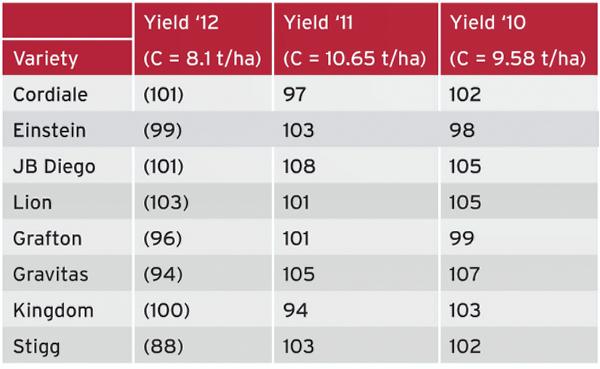
Not surprisingly, the performance of wheat varieties was a bit more mixed. The yield of the control varieties in the recommended list trials in 2012 (8.1 t/ha) was 1.5 t/ha lower than in 2012 and 2.5 t/ha lower than last year (see Table 1).
Lion headed the pack of the recommended varieties followed by JB Diego and Cordiale. Kingdom, which had a bad year in 2011, appears to have bounced back this year, both in trials and commercially.
Stigg had a bummer and that will not surprise commercial growers. Gravitas experienced a lot of problems in commercial crops and had a bad year in the trials also. Grafton was only a little better but there were some good commercial performances.
Of the newcomers, Avatar seemed to head the bunch at 107, followed by Dunmore, SY Epsom and KWS Lumos.
Yield results from the early sown trials were less than clear-cut but Lion did well followed by Diego, Cordiale, Gravitas and Kingdom.
Of the newcomers, Avatar did very well, as did Lumos and Dunmore. And within the trials it appears that Gravitas and Lion are best suited as first wheats with Diego doing well in both slots.
Winter oats
On the winter oats Husky stretched its yield advantage so it will show relatively bigger yield numbers when the list is produced. Evita will not be recommended because there is no seed available.
Seed availability
Asked about seed availability for the coming season Donal Fitzgerald of Goldcrop indicated that there should not be an issue with availability of certified winter barley seed. But the possibility of an increase in demand for this crop could result in problems.
“The situation will be much different with winter wheat”, Donal stated. The bad weather in the south resulted in up to 90% rejection with only 30-40% saved in the northeast. So there is a likelihood that we could be 5,000-6,000 tonnes short on native supply.
“And the situation is no better in Britain, given the low yields and quality problems being encountered there.
So, depending on the weather this backend, wheat supply could be very tight.
Profit from planning
“Real planning must be part of any profitable farm business”, stated Martin Bourke, Teagasc’s crop adviser in Wicklow. Planning must start long before the crop is sown and yet disease control is the topic that receives most debate and analysis.
Planning helps to control costs. Martin commented that on the home farm in Arklow the frequent use of hen manure had helped to decrease fertilizer costs and that this had raised soil P levels at the expense of potash.
So now they are switching to a local cattle slurry source to provide a better K balance in the soil.
Being able to make good use of organic manures means having relevant and recent soil tests and using the results wisely. Too often this does not happen.
Martin emphasised the importance of the choice of variety for individual rotational slots, including barley. Too often barley is given a high take-all risk slot where it suffers on many soil types.
Planning also means using your time wisely. With the Single Farm Payment being such a critical component of profit it is very important to keep records up-to-date and accurate to help avoid penalties.
Martin also warned against over-selling forward because bad harvests do occur once in a while. Hopefully this one will be the last for many years. He suggested that 2012 could be summed up in three words: hardship, disappointment and relief.
The hardship was obvious.
The disappointment relates to the very disappointing yields after a very big spend in 2012 and the poor quality that will continue to cause problems for forward contracts for some time yet.
The relief is the fact that it is just about over and now we must get the land back into reasonable order and start again.
Production costs
Based on a sample of 20 commercial tillage farmers completing the Teagasc E Profit Monitor, Martin stated that the fixed cost level found on these farms amounted to approximately €120/ac. And roughly two-third of these was machinery related costs.
He emphasised the importance of knowing the full cost of production. This is just good business but it is essential when availing of forward sales.
Based on the average costings found on the 20 farms in 2011, he stated that the cost of a hectare of winter wheat was €1,219 which, based on a yield of 9.67 t/ha, equated to €126/t. Costs have increased considerably in recent years and he stated that fertilizer and machinery are now broadly similar cost items at over €350/ha.
Given the higher costs encountered in 2012 and a yield of 8.42 t/ha, which many growers did not manage to achieve, the cost per tonne produced jumped to €157/t. And if you add in land rental at only €150/ac it is easy to see how losses occur. Martin did the same exercise for the other crops and those figures and results can be found in the forum proceedings on the Teagasc website.
2013
Looking towards 2013, Martin indicated that winter barley in good rotational slots offers the highest potential for margin and should be looked after.
Grain markets
Looking at the grain markets, James Nolan of R&H Hall said that 70-80% of our 2012 crop is below the quality spec set by forward contracts and that the total crop size is down. But, given that global supplies of all grains are tight, he suggested that it may yet be necessary to use this grain subject to some price modification to be agreed within the trade.
Supplies and stocks of wheat, corn and barley are all tight globally.
Prices have risen as a consequence and this is indirectly a mechanism to decrease consumption in order to ration supply. But there is no sign of price sensitivity in soya and this is still indirectly affecting the price of cereals by pulling up corn prices, as corn and soya compete for the same acres in many parts of the world.
One of the biggest pressures comes from the fact that there is less crop to export from Central Europe. And the fact that these countries are exporting at a substantial rate currently is giving cause for concern that exports will cease from these destinations in the near future leading to the possible loss of both cheap and high quality grain in the near future.
So politics and potential export embargoes are setting the tone of the market. And the election year in the US may also have an impact, particularly on decisions to relax the obligatory inclusion rate for bioethanol in fuel there.
What all this means for the market going forward is less than certain. James commented that it possible we will see a level of upward pressure in the short-term but that this could ease or reverse in a few months when the extent of the potential of the southern hemisphere harvest is known. But if a new set of production problems were to emerge in the southern hemisphere who knows where the market could end up.



SHARING OPTIONS