In October 2015, I reported on the installation of a new solid fuel burner that was used to supply hot air to dry grain. The system uses heat transfer to avoid the grain being exposed to exhaust gases. That installation was at Nolans outside of Tullow, Co Carlow, and at the start of this month I returned to ask Patrick Nolan about the experiences of one full year of grain drying using this system.
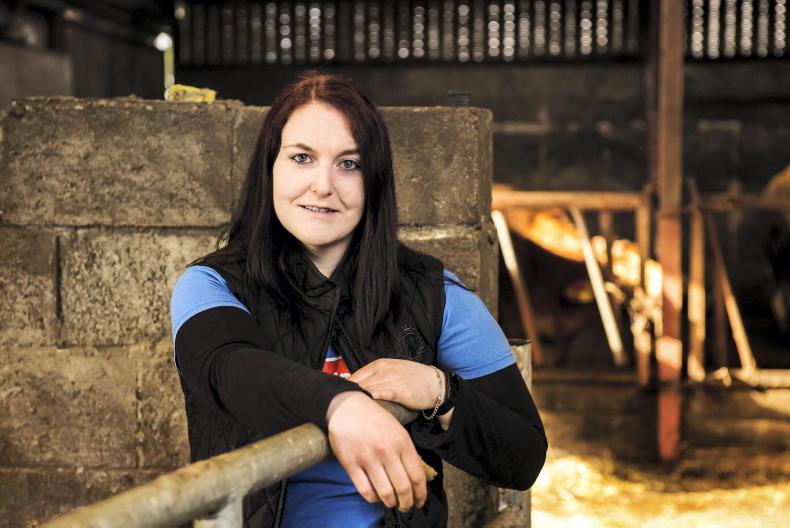
 The solid fuel burner used miscanthus as a source of fuel. It was an interesting project because it was one of very few markets for the crop as a genuine energy source to produce heat. This unit is being operated by Patrick Nolan (photo) who dries a very significant amount of grain on contract for Quinns of Baltinglass Ltd.
Indeed, Patrick handles more than 40,000t of green grain each season and he installed the Polish-engineered Graso NPA 2.5MW burner at the end of last season. This was done to help reduce the fuel cost associated with drying and the unit was chosen to burn miscanthus and to match the heat requirement of his grain dryer at that time.
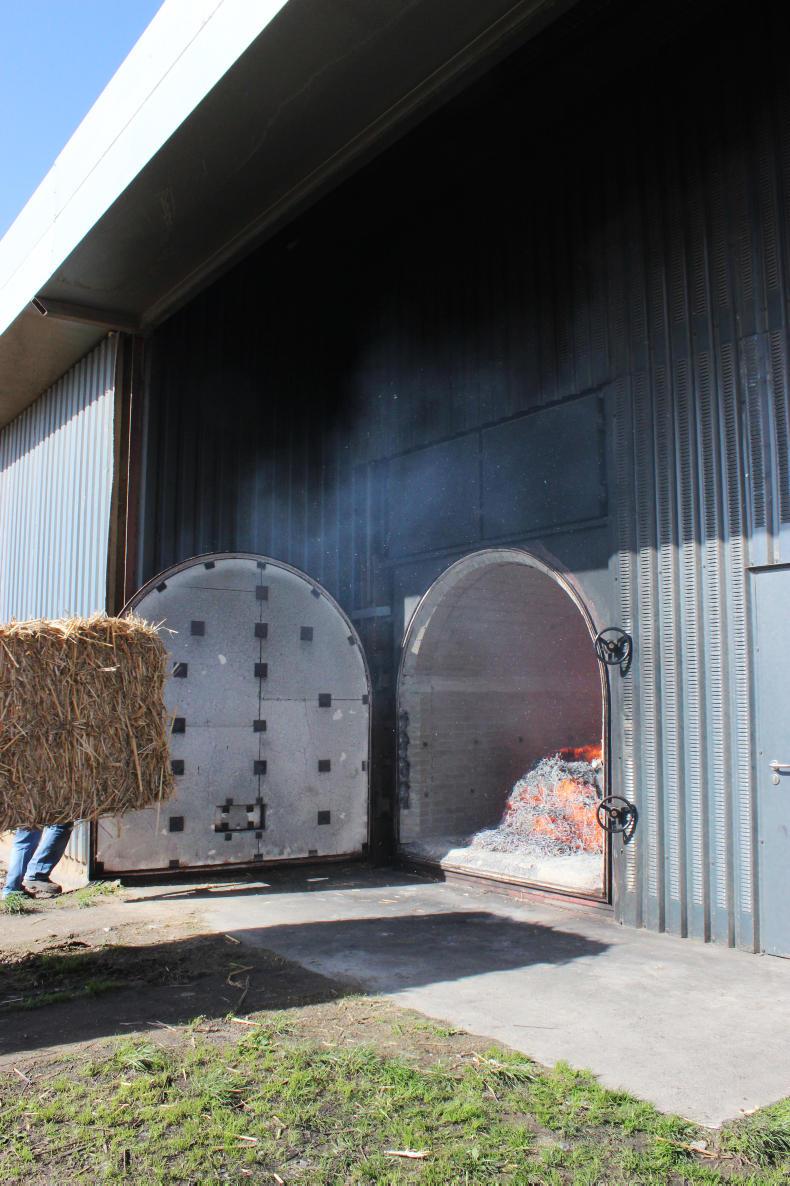
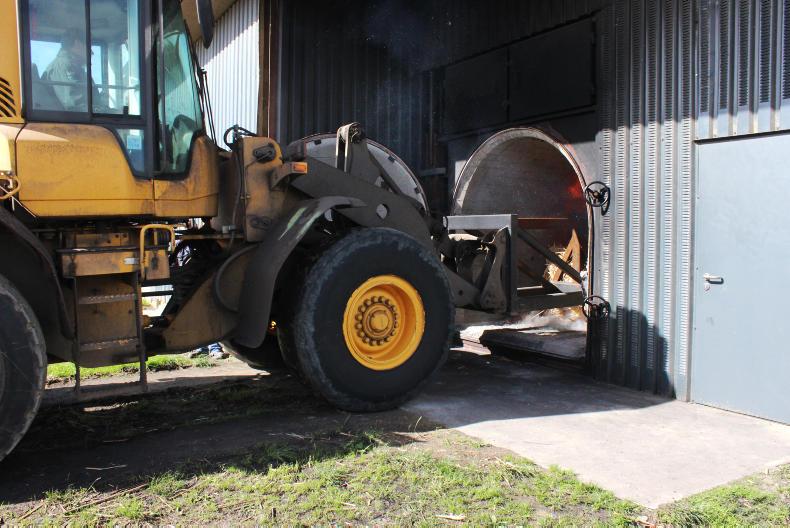
Last year, I reported that the boiler had successfully replaced oil with a few operational teething problems at the start. The miscanthus was grown nearby on Patrick’s farm and stored indoors until the drying season began. The unit is loaded manually (mechanically) and the intention was to install an automated process. However, this did not happen and Patrick has stayed with manual loading because there is always a man and a loader in the yard when the dryer and burner are in operation.
New appearance
While the burner is still in the same location, it has been enclosed in its own shed, so it is now covered except for the opening door at the end for loading. The unit is now fitted with good scrubbing units, which have eliminated the plumes of black smoke that occurred around loading.
Last year, I reported that the heat output from the miscanthus source was found to be higher than was anticipated. The combination of the burner and the fuel (miscanthus) brought the heat output closer to 3MW, as distinct from its rated 2.5MW. And it was higher than might be realistically expected from burning straw or even black oats. So the system appeared to show synergistic benefits from the boiler/fuel combination.
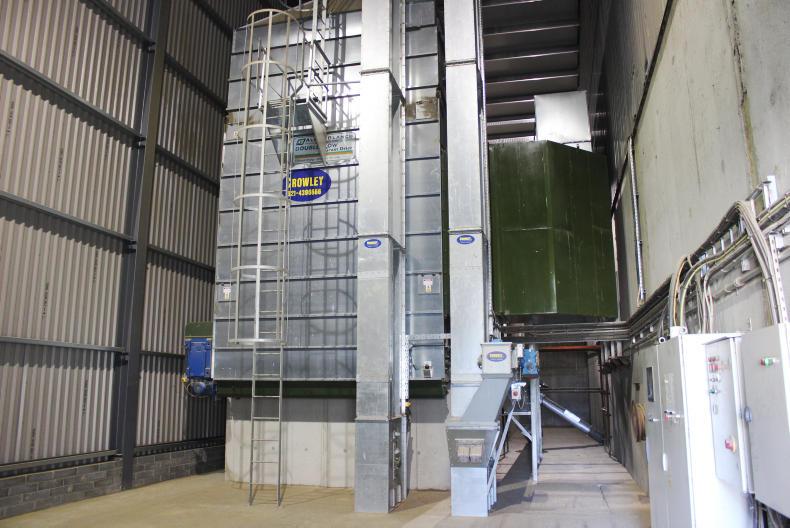
Patrick is now pushing for even greater efficiency in the system. He has since changed his grain dryer from a tower type to an Alvan Blanch Double Flow continuous flow unit. It is estimated that this dryer needs 4MW of heat to ensure its throughput on a standard 5% moisture reduction. This is a big dryer with a rated capacity of up to 50t per hour.
Its heat requirement meant that the miscanthus burner is not capable of supplying the full heat requirement for the new dryer. But rather than replacing this one-year old burner, Patrick decided to continue to use it and to add supplementary heat produced from oil, if and when necessary. “This dual fuel option is also adding to the efficiency of the new dryer because it ensures that the air temperature going into the dryer is uniform at all times. The oil is acting as a stabilising factor for the solid fuel,” Patrick stated.
The drying unit
The new Alvan Blanch dryer utilises two separate heated-air systems. The air coming from the miscanthus burner is entering at around 85oC and this is the bulk of the heat requirement. This air could be heated to a higher temperature if needed. The temperature in the burner is closer to 770OC and this heats a separate air stream which is then transferred to the dryer. Any slight fluctuations in the temperature of the delivered air will trigger the dryer’s oil-fired burner to cut in or out.
Miscanthus fuel
One of the big bonuses from the system is that the majority of the fuel used to dry the 40,000 plus tonnes is produced on the farm from 50 acres of miscanthus. This receives basic fertilisation, mainly in the form of pig slurry, to produce an 8t/ac fresh crop on this good fertile land.
At 8t/ac, miscanthus produces over 3,000 litres of heating oil per acre or 150,000 litres from the 50 acres of crop at 20% moisture. The energy value would be higher if this yield was produced at lower moisture content. Lower yield would mean less energy produced also. But 6 t/ac may be a more realistic yield level for many.
With roughly 20 bales produced per acre at 400kg per fresh bale, the 50 acres will produce around 1,000 bales annually. These will be stored indoors to help moisture reduction, which can be down to 15% or even close to 10% by harvest. This obviously increases the energy delivery from each bale, which can be down to 350kg when used.

The drying regime operates a 14- to 15-hour day and this takes approximately 12 bales per day. So the 1,000 bales now provide the bulk of the fuel for over 80 days of drying, from roughly mid-July to just into October.
Patrick said that the moisture content of the bale is important as the lower the moisture, the longer the burn time for the bale and so the greater the efficiency of heat generation. So getting bale moisture levels down is an area that will get greater attention in future.
Energy value
Working on the assumption that normal oil-fired drying systems use about seven litres of fuel to dry a tonne from 20% moisture, Patrick said that a 25t/hr throughput dryer would use about 175 litres of fuel per hour.
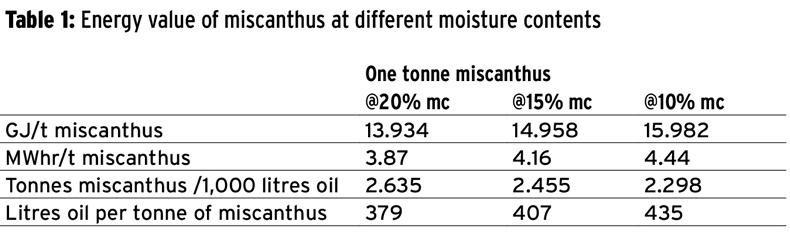
In his system, the same throughput level would burn 22 litres of fuel plus one 8x4x3 bale of miscanthus. So a bale is replacing 153+ litres of fuel and this equates to the energy value of a 400kg bale at 20% moisture at any moisture levels indicated in Table 1.
The energy value of one tonne of miscanthus is estimated to be [18.03 - (0.2048 x MC%)] gigajoules per tonne (GJ/t). So a tonne at 20% moisture would contain 13.934 GJ at 20% moisture content or 15.982 GJ/t at 10% moisture (Table 1). And with one megawatt hour (MWhr) equivalent to 3.6 GJ, 1,000 litres of oil contain 10.2 megawatts. Using these conversion factors, Table 1 shows the value of miscanthus as a fuel expressed in different ways.
Putting this in perspective, at 50c/l the oil cost alone would be approximately €87.50/hour. In comparison, Patrick’s oil cost is just over €10/hour for this throughout level. And the bale would cost less than €50 at a theoretical delivered cost of €120/t. So it would be less than €60 to dry 25t or about €2.50/t in total fuel cost. The additional capital cost of the burner must be paid off of course before savings can be made. One dry 350kg miscanthus bale is equivalent to roughly 160 litres of oil.

At this point, it is thought that the running costs on the burner will be minimal over time. Seals and bricks are the more likely cost items as the burner has no moving parts. With miscanthus, there is very little ash and there is no clinkering to deal with.

The burner
The Graso NPA 2.5MW miscanthus burner was supplied by CPB Biomass. I asked Conor Bruton from that company what scale of operation would be needed to justify going solid fuel.
He said that the minimum burner size available is a 0.5MW and he told me that it would need to be drying about 5,000t to get pay-back on the investment.
“A few years ago, this boiler system was completely new and we had to learn from scratch about the fuel systems we were using,” Conor stated.
Whytes in the Naul have a similar burner fuelled on straw and we have significantly improved the efficiency of that system also.
This burner is now using 75% barley straw plus 25% oilseed rape straw, where the latter is used to help dissolve the clinkers that are formed when burning straw.
They also now leave the straw to weather and whiten before it is baled as this increases its conversion efficiency to close to what can be achieved from woodchip.
Miscanthus is used to supply nearly 80% of the heat requirement in Patrick Nolan’s new Alvan Blanch dryer.Even without a heat incentive, the system will pay for itself in a relatively short period of time. The higher the dryer throughput, the greater the potential saving from going to solid fuel.The miscanthus is grown on the farm, resulting in a reduced carbon footprint associated with the renewable fuel. The lower the moisture content, the greater the heat energy in the bale.
In October 2015, I reported on the installation of a new solid fuel burner that was used to supply hot air to dry grain. The system uses heat transfer to avoid the grain being exposed to exhaust gases. That installation was at Nolans outside of Tullow, Co Carlow, and at the start of this month I returned to ask Patrick Nolan about the experiences of one full year of grain drying using this system.
The solid fuel burner used miscanthus as a source of fuel. It was an interesting project because it was one of very few markets for the crop as a genuine energy source to produce heat. This unit is being operated by Patrick Nolan (photo) who dries a very significant amount of grain on contract for Quinns of Baltinglass Ltd.
Indeed, Patrick handles more than 40,000t of green grain each season and he installed the Polish-engineered Graso NPA 2.5MW burner at the end of last season. This was done to help reduce the fuel cost associated with drying and the unit was chosen to burn miscanthus and to match the heat requirement of his grain dryer at that time.
Last year, I reported that the boiler had successfully replaced oil with a few operational teething problems at the start. The miscanthus was grown nearby on Patrick’s farm and stored indoors until the drying season began. The unit is loaded manually (mechanically) and the intention was to install an automated process. However, this did not happen and Patrick has stayed with manual loading because there is always a man and a loader in the yard when the dryer and burner are in operation.
New appearance
While the burner is still in the same location, it has been enclosed in its own shed, so it is now covered except for the opening door at the end for loading. The unit is now fitted with good scrubbing units, which have eliminated the plumes of black smoke that occurred around loading.
Last year, I reported that the heat output from the miscanthus source was found to be higher than was anticipated. The combination of the burner and the fuel (miscanthus) brought the heat output closer to 3MW, as distinct from its rated 2.5MW. And it was higher than might be realistically expected from burning straw or even black oats. So the system appeared to show synergistic benefits from the boiler/fuel combination.
Patrick is now pushing for even greater efficiency in the system. He has since changed his grain dryer from a tower type to an Alvan Blanch Double Flow continuous flow unit. It is estimated that this dryer needs 4MW of heat to ensure its throughput on a standard 5% moisture reduction. This is a big dryer with a rated capacity of up to 50t per hour.
Its heat requirement meant that the miscanthus burner is not capable of supplying the full heat requirement for the new dryer. But rather than replacing this one-year old burner, Patrick decided to continue to use it and to add supplementary heat produced from oil, if and when necessary. “This dual fuel option is also adding to the efficiency of the new dryer because it ensures that the air temperature going into the dryer is uniform at all times. The oil is acting as a stabilising factor for the solid fuel,” Patrick stated.
The drying unit
The new Alvan Blanch dryer utilises two separate heated-air systems. The air coming from the miscanthus burner is entering at around 85oC and this is the bulk of the heat requirement. This air could be heated to a higher temperature if needed. The temperature in the burner is closer to 770OC and this heats a separate air stream which is then transferred to the dryer. Any slight fluctuations in the temperature of the delivered air will trigger the dryer’s oil-fired burner to cut in or out.
Miscanthus fuel
One of the big bonuses from the system is that the majority of the fuel used to dry the 40,000 plus tonnes is produced on the farm from 50 acres of miscanthus. This receives basic fertilisation, mainly in the form of pig slurry, to produce an 8t/ac fresh crop on this good fertile land.
At 8t/ac, miscanthus produces over 3,000 litres of heating oil per acre or 150,000 litres from the 50 acres of crop at 20% moisture. The energy value would be higher if this yield was produced at lower moisture content. Lower yield would mean less energy produced also. But 6 t/ac may be a more realistic yield level for many.
With roughly 20 bales produced per acre at 400kg per fresh bale, the 50 acres will produce around 1,000 bales annually. These will be stored indoors to help moisture reduction, which can be down to 15% or even close to 10% by harvest. This obviously increases the energy delivery from each bale, which can be down to 350kg when used.
The drying regime operates a 14- to 15-hour day and this takes approximately 12 bales per day. So the 1,000 bales now provide the bulk of the fuel for over 80 days of drying, from roughly mid-July to just into October.
Patrick said that the moisture content of the bale is important as the lower the moisture, the longer the burn time for the bale and so the greater the efficiency of heat generation. So getting bale moisture levels down is an area that will get greater attention in future.
Energy value
Working on the assumption that normal oil-fired drying systems use about seven litres of fuel to dry a tonne from 20% moisture, Patrick said that a 25t/hr throughput dryer would use about 175 litres of fuel per hour.
In his system, the same throughput level would burn 22 litres of fuel plus one 8x4x3 bale of miscanthus. So a bale is replacing 153+ litres of fuel and this equates to the energy value of a 400kg bale at 20% moisture at any moisture levels indicated in Table 1.
The energy value of one tonne of miscanthus is estimated to be [18.03 - (0.2048 x MC%)] gigajoules per tonne (GJ/t). So a tonne at 20% moisture would contain 13.934 GJ at 20% moisture content or 15.982 GJ/t at 10% moisture (Table 1). And with one megawatt hour (MWhr) equivalent to 3.6 GJ, 1,000 litres of oil contain 10.2 megawatts. Using these conversion factors, Table 1 shows the value of miscanthus as a fuel expressed in different ways.
Putting this in perspective, at 50c/l the oil cost alone would be approximately €87.50/hour. In comparison, Patrick’s oil cost is just over €10/hour for this throughout level. And the bale would cost less than €50 at a theoretical delivered cost of €120/t. So it would be less than €60 to dry 25t or about €2.50/t in total fuel cost. The additional capital cost of the burner must be paid off of course before savings can be made. One dry 350kg miscanthus bale is equivalent to roughly 160 litres of oil.
At this point, it is thought that the running costs on the burner will be minimal over time. Seals and bricks are the more likely cost items as the burner has no moving parts. With miscanthus, there is very little ash and there is no clinkering to deal with.
The burner
The Graso NPA 2.5MW miscanthus burner was supplied by CPB Biomass. I asked Conor Bruton from that company what scale of operation would be needed to justify going solid fuel.
He said that the minimum burner size available is a 0.5MW and he told me that it would need to be drying about 5,000t to get pay-back on the investment.
“A few years ago, this boiler system was completely new and we had to learn from scratch about the fuel systems we were using,” Conor stated.
Whytes in the Naul have a similar burner fuelled on straw and we have significantly improved the efficiency of that system also.
This burner is now using 75% barley straw plus 25% oilseed rape straw, where the latter is used to help dissolve the clinkers that are formed when burning straw.
They also now leave the straw to weather and whiten before it is baled as this increases its conversion efficiency to close to what can be achieved from woodchip.
Miscanthus is used to supply nearly 80% of the heat requirement in Patrick Nolan’s new Alvan Blanch dryer.Even without a heat incentive, the system will pay for itself in a relatively short period of time. The higher the dryer throughput, the greater the potential saving from going to solid fuel.The miscanthus is grown on the farm, resulting in a reduced carbon footprint associated with the renewable fuel. The lower the moisture content, the greater the heat energy in the bale. 







SHARING OPTIONS