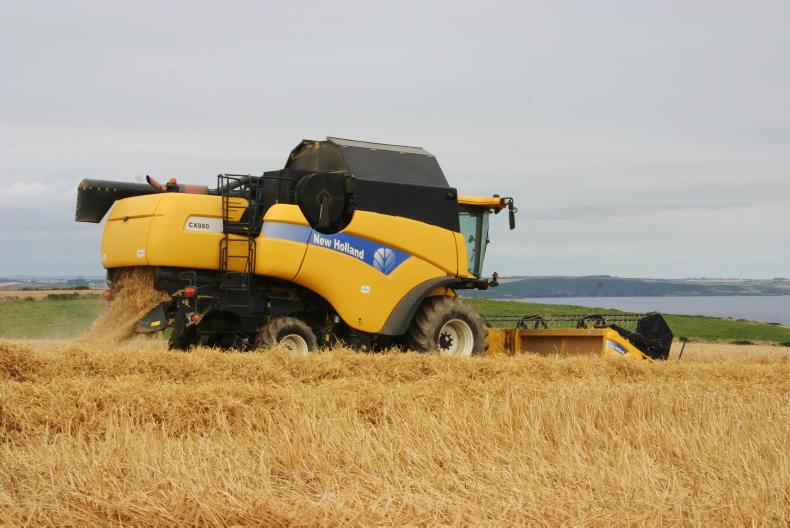
The past week has provided a welcome respite from the broken weather for most tillage farmers. While the west and northwest remain a definite exception, many growers along the eastern half of the country have been able to get on with harvest but some have suffered considerable frustration with skinning in malting barley.
A number of people who are not malting barley growers have asked me what skinning is and what its implications are. Skinning is where part or all of the husk or seed coat has been removed from a barley grain when tested. You can see where the husk or skin has been damaged or removed with the naked eye. Skin removal on a grain could be as little as 5%, 50% is quite common and 100% removal is possible.
The implications of skinning
At its simplest, a skinned grain has lost a portion of its protective shield or coat and so is more subject to attack by microorganisms and could be less stable in storage. It is particularly an issue for uses that require the germination of the grains, such as seed and malting. On the flip side, having a portion of the seed coat missing could be perceived as a benefit for feeding as it means less fibre and proportionately more starch.
For a seed crop, the danger of skinning might result from direct damage by the seed dressings. There is also danger from a range of potentially damaging organisms which can more easily attack and damage skinned seeds.
While the latter is of definite concern to the drinks industry, they have other issues also. The fact that some seeds in a sample would have part of the seed coat removed allows faster uptake of water into those seeds during steeping.
The husk of the grain is naturally permeable to water. This allows the grain to dry out for harvest and to take in moisture for germination. The husk restricts the speed of flow of water into the grain during steeping, which is the early part of the malting process.
Because of the importance of the husk in controlling water uptake, there is a possibility that skinned seeds could be drowned in the early part of the malting process. This may be possible because of the surplus water during the steeping stage, as intact grains will be slower to take in the water. But if they are not killed, the skinned grains will germinate earlier and move faster through the malting process. By the time the intact grains are at the correct stage, skinned grains may have gone too far and this can lead to challenges for the end users.
So having a lot of skinned grains present can make the sample more difficult to malt. If it is not malted fully this can impact on alcohol yield, especially for distilling. Also, during the brewing process some filtration systems use the remaining husk to act as a filtration bed. When this is changed in any way it can either speed up or slow down the run-off period. So having too little husk can be an issue. This is especially important in plants fitted with a Lauter tun, as they use the husk as a filtration bed.
Is it a farmer’s problem?
So in trying to understand the significance of skinning, it is certainly an issue in the subsequent malting and brewing processes. We must accept that it has implications for both malting and brewing but it would not appear to be a black and white, accept or fail issue.
Yet skinning has been implemented as a new criterion at malting barley intakes and loads are being accepted or rejected on this criterion alone. And the vast majority of rejected samples are otherwise perfect specimens of good malting barley.
While we must accept that bad skinning can have knock-on issues, what is the impact to the maltster, brewer or distiller of a 2%, 4%, 6% or even 10% skinned grain sample? Where is the proof that alcohol yield is being impacted to a specific degree by grain with different levels of skinning? What we appear to have currently is a new standard being set by maltsters and imposed on growers.
It is just not possible to make a natural product grown in the open fit a specification profile to perfectly suit computerised systems. To attempt to do this would require a premium in excess of €100/t to make it worthwhile over a five-year period. There is nothing wrong with trying to align spec to fit end-market requirements but when those specs contain a variable that is more to do with variety and environment, such as skinning, is this the grower’s fault?
There is validity to all of the specs demanded for malting but it is interesting that these are not universal. Different companies set different specs. But we must accept that good specific weight (KPH) is an indicator of the starch content in a variety and so its ability to produce sugars; screenings or small grains have much less starch and so are not desirable; germinative energy is critical to drive the germination process.
All of these criteria impact on yield for the end user and minimum cut-off levels are agreed and implemented at contract and intake levels.
Skinning is the new criterion and it has been having a huge impact. But given the inability of growers to have any serious impact on it, it can hardly be fair that this characteristic, which has been around for decades, can now be introduced as yet another rejection criterion. The very fact that the cut-off criteria have been adjusted recently, points to the folly of making this a rejection issue.
Breaking point
For many growers this is the straw that may break the camel’s back. The introduction of unnegotiated criteria challenges the confidence of growers. Rejection rates for skinning alone were reportedly to be up to 80% in some areas. Since then the standards have been relaxed but the trust is shattered.
As for the susceptibility to skinning, variety has an impact, environment is hugely important and combine settings can only be used to minimise the damage that is already predisposed in a given field and year.
Variety choice is not within the control of the grower; the weather is completely outside of the grower’s control; combine adjustments can be a compromise between achieving two contradictory quality requirements (low skinning and high specific weight).
Is it too much to ask that any new quality criterion has proven and independently quantified economic consequences? On the outside looking in, it seems far more sensible that skinning be an economic variable rather than accept or reject. Skinning often occurred in the past and malt and beer were still produced. If it is proven to affect issues like alcohol yield then agree a deduction on the premium within agreed boundaries.
If the industry is to prosper in what appears to be times of opportunity for distilling in particular there needs to be fair play. What has happened so far this harvest cannot be described as fair play. Livelihoods are being put at risk as a result of the rejection of barley which is regarded as acceptable one or two weeks later due to altered specifications.
For whatever reasons, certain seasons predispose barley grains to the loss of their husk, skin or seed coat and this is called skinning.Skinning seems to be almost totally outside of the control of the grower.While it may well have an impact on malting and brewing, it would not appear to be sufficiently black and white to justify total rejection. The high levels of rejection forced on growers in recent weeks has dented grower confidence in the malting crop for both malting companies.
The past week has provided a welcome respite from the broken weather for most tillage farmers. While the west and northwest remain a definite exception, many growers along the eastern half of the country have been able to get on with harvest but some have suffered considerable frustration with skinning in malting barley.
A number of people who are not malting barley growers have asked me what skinning is and what its implications are. Skinning is where part or all of the husk or seed coat has been removed from a barley grain when tested. You can see where the husk or skin has been damaged or removed with the naked eye. Skin removal on a grain could be as little as 5%, 50% is quite common and 100% removal is possible.
The implications of skinning
At its simplest, a skinned grain has lost a portion of its protective shield or coat and so is more subject to attack by microorganisms and could be less stable in storage. It is particularly an issue for uses that require the germination of the grains, such as seed and malting. On the flip side, having a portion of the seed coat missing could be perceived as a benefit for feeding as it means less fibre and proportionately more starch.
For a seed crop, the danger of skinning might result from direct damage by the seed dressings. There is also danger from a range of potentially damaging organisms which can more easily attack and damage skinned seeds.
While the latter is of definite concern to the drinks industry, they have other issues also. The fact that some seeds in a sample would have part of the seed coat removed allows faster uptake of water into those seeds during steeping.
The husk of the grain is naturally permeable to water. This allows the grain to dry out for harvest and to take in moisture for germination. The husk restricts the speed of flow of water into the grain during steeping, which is the early part of the malting process.
Because of the importance of the husk in controlling water uptake, there is a possibility that skinned seeds could be drowned in the early part of the malting process. This may be possible because of the surplus water during the steeping stage, as intact grains will be slower to take in the water. But if they are not killed, the skinned grains will germinate earlier and move faster through the malting process. By the time the intact grains are at the correct stage, skinned grains may have gone too far and this can lead to challenges for the end users.
So having a lot of skinned grains present can make the sample more difficult to malt. If it is not malted fully this can impact on alcohol yield, especially for distilling. Also, during the brewing process some filtration systems use the remaining husk to act as a filtration bed. When this is changed in any way it can either speed up or slow down the run-off period. So having too little husk can be an issue. This is especially important in plants fitted with a Lauter tun, as they use the husk as a filtration bed.
Is it a farmer’s problem?
So in trying to understand the significance of skinning, it is certainly an issue in the subsequent malting and brewing processes. We must accept that it has implications for both malting and brewing but it would not appear to be a black and white, accept or fail issue.
Yet skinning has been implemented as a new criterion at malting barley intakes and loads are being accepted or rejected on this criterion alone. And the vast majority of rejected samples are otherwise perfect specimens of good malting barley.
While we must accept that bad skinning can have knock-on issues, what is the impact to the maltster, brewer or distiller of a 2%, 4%, 6% or even 10% skinned grain sample? Where is the proof that alcohol yield is being impacted to a specific degree by grain with different levels of skinning? What we appear to have currently is a new standard being set by maltsters and imposed on growers.
It is just not possible to make a natural product grown in the open fit a specification profile to perfectly suit computerised systems. To attempt to do this would require a premium in excess of €100/t to make it worthwhile over a five-year period. There is nothing wrong with trying to align spec to fit end-market requirements but when those specs contain a variable that is more to do with variety and environment, such as skinning, is this the grower’s fault?
There is validity to all of the specs demanded for malting but it is interesting that these are not universal. Different companies set different specs. But we must accept that good specific weight (KPH) is an indicator of the starch content in a variety and so its ability to produce sugars; screenings or small grains have much less starch and so are not desirable; germinative energy is critical to drive the germination process.
All of these criteria impact on yield for the end user and minimum cut-off levels are agreed and implemented at contract and intake levels.
Skinning is the new criterion and it has been having a huge impact. But given the inability of growers to have any serious impact on it, it can hardly be fair that this characteristic, which has been around for decades, can now be introduced as yet another rejection criterion. The very fact that the cut-off criteria have been adjusted recently, points to the folly of making this a rejection issue.
Breaking point
For many growers this is the straw that may break the camel’s back. The introduction of unnegotiated criteria challenges the confidence of growers. Rejection rates for skinning alone were reportedly to be up to 80% in some areas. Since then the standards have been relaxed but the trust is shattered.
As for the susceptibility to skinning, variety has an impact, environment is hugely important and combine settings can only be used to minimise the damage that is already predisposed in a given field and year.
Variety choice is not within the control of the grower; the weather is completely outside of the grower’s control; combine adjustments can be a compromise between achieving two contradictory quality requirements (low skinning and high specific weight).
Is it too much to ask that any new quality criterion has proven and independently quantified economic consequences? On the outside looking in, it seems far more sensible that skinning be an economic variable rather than accept or reject. Skinning often occurred in the past and malt and beer were still produced. If it is proven to affect issues like alcohol yield then agree a deduction on the premium within agreed boundaries.
If the industry is to prosper in what appears to be times of opportunity for distilling in particular there needs to be fair play. What has happened so far this harvest cannot be described as fair play. Livelihoods are being put at risk as a result of the rejection of barley which is regarded as acceptable one or two weeks later due to altered specifications.
For whatever reasons, certain seasons predispose barley grains to the loss of their husk, skin or seed coat and this is called skinning.Skinning seems to be almost totally outside of the control of the grower.While it may well have an impact on malting and brewing, it would not appear to be sufficiently black and white to justify total rejection. The high levels of rejection forced on growers in recent weeks has dented grower confidence in the malting crop for both malting companies. 






SHARING OPTIONS