



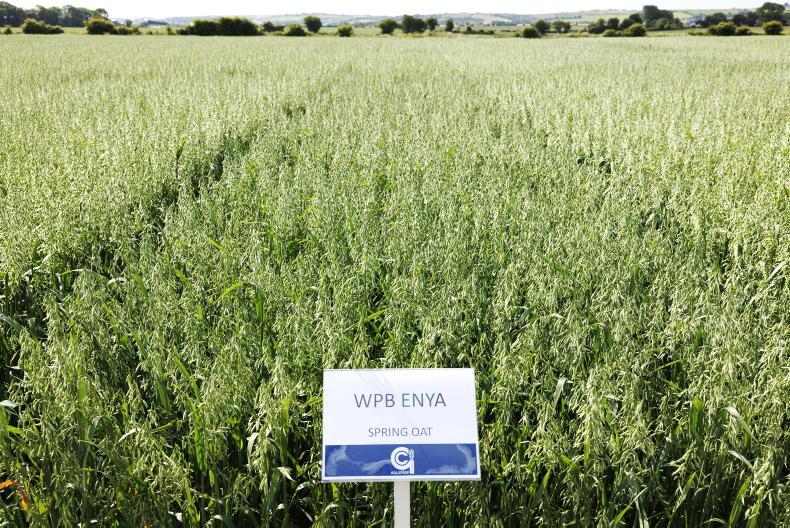
Oats have been a consistent crop for farmers in recent years, which has helped with margins.
However, this year markets are limited with lower demand for gluten-free oats.
On the Department of Agriculture's winter oats recommended list, WPB Enya has moved from provisionally recommended to fully recommended.
It was first placed on the winter list in 2025. It’s the highest yielder on the list, with a relative yield score of 103, followed by Husky at 102 and WPB Isabel at 98.
Enya is the shortest variety on the list at 104cm, which can be a good thing when it comes to oats. However, it has the poorest score for resistance to lodging at a five. It’s in the middle on straw breakdown.
Husky comes in at 111cm and WPB Isabel is tall at 118cm. Husky performs poorly on straw breakdown with a score of five, while WPB Isabel comes out best on seven.
WPB Isabel has the lowest maturity rating, while Husky is an early variety with a score of eight.
Disease profiles are similar across varieties. However, there are good differences in grain quality. WPB Isabel has the highest kernel content and hectolitre weight, while WPB Enya has the highest thousand grain weight.
No market for oats?
Unfortunately, at present, we keep hearing there are no markets for oats. Oats are going to be exported from this country over the coming weeks and months.
Policy has driven many farmers to grow oats without a premium market to comply with crop diversification requirements. Yet, policy has not encouraged the use of native grains.
It is very easy to say that there is no market for oats and farmers should not grow them, but policy needs to push for the use of oats and advice needs to change on animals’ diets. We are hearing the same thing on rye and beans.
Nutritionists have been openly advising dairy farmers to feed palm kernel in recent weeks. No doubt palm kernel is easier to feed - it can be fed ad lib. However, palm kernel is shipped from half way across the world and it is not environmentally friendly.
Where the straw is chopped on a crop of Irish oats, research is shown that Irish oats can be carbon neutral or carbon positive. Surely, we should try to feed sustainable Irish ingredients to feed our animals.
To say oats are being shipped out as no one will use them is shocking and shows a major issue with our farming system.
We’re importing up to six million tonnes of feed, producing about 1.5m tonnes of grain for animal feed and now Ireland will end up exporting that grain. No wonder the tillage sector is in trouble.
There’s a bigger picture here. One point those feeding palm kernel and other imported ingredients need to note is tillage is in serious trouble and there will be nowhere to spread slurry or manure from dairy, beef, pig or poultry farms if it declines further.


SHARING OPTIONS