



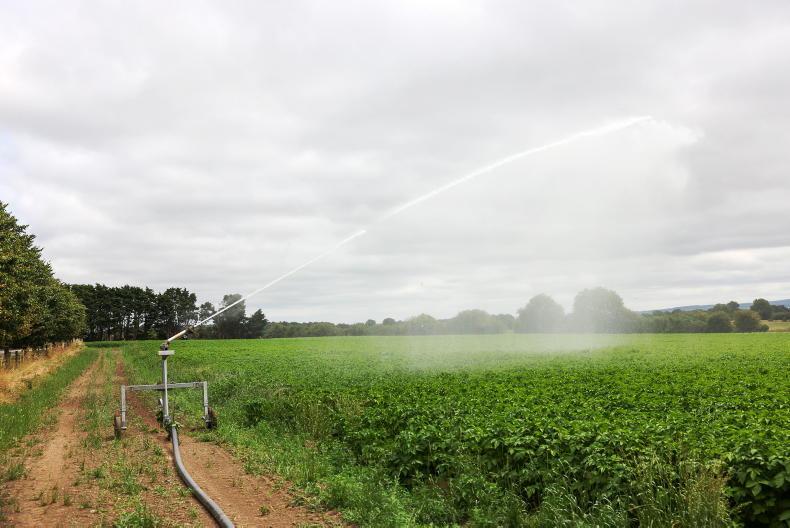
Potato crops that received no irrigation this year are in a bad way, Teagasc crop specialist Shay Phelan has indicated.
“Anything that has got irrigated is probably ok, but anything that hasn’t – on light or sandy soils – they are in a bad situation at the moment," according to Phelan.
"In a lot of cases, they have probably given up, and they are starting to senesce at this stage."
Speaking at Haggard Stores potato variety open day in Tara, Co Meath, this week, he said that “for those crops there probably isn’t going to be huge yields, but anything that has a body underneath them and has been irrigated, they are probably going to be reasonably ok.”
“Overall, we are probably going to be looking at a deficit, and certainly lower yields.
“At this stage, you’re trying to keep crops alive and keep them going for yield. That’s the priority now.”
In terms of potato crop management, knowing what you are trying to do is critical, the crop specialist stated.
Irrigation
Phelan suggested going through each crop individually and seeing if there is an adequate source of water and how the crop has been affected already.
“Have they been set back? Has the skin started to set? Putting water on skin that has set causes more problems – you are going to cause cracking, secondary growth and all that type of thing.
“I would be very sceptical of putting water on a crop that hasn’t got it already – you can cause problems – splitting and cracks.”
If you are just starting to irrigate, he recommends starting small, with 10-15mm per application and for two or three applications, before gradually building up to 20 or 25mm.
However, he warned that this depends on whether rain falls over the next few days, and if it does, it needs to be factored in.
“It is very difficult to give standard advice on irrigation for everyone. Every field is different.
“Look at the field, see what you’re trying to do and see what the moisture level is in that crop.
Cost
As we approach the end of August, he warned that the benefits of starting irrigating now are smaller than a month ago.
“You need to ask if it is worthwhile - it adds hugely to cost.
“We estimate that per application it costs between €60 and €80 an acre, manpower and labour, and it adds drastically to the workload of the farmer.”
Planning ahead
Not panicking about crops is the main thing, Phelan said.
“Look at what’s there. Be realistic about what you have and prioritise the crops that you know are going to make a better-quality crop.
“If you have a lot of scab, you prioritise that market. The peeling market is going to be where a lot of that ends up – for the 7.5kg bag. So, you know when to dig that, when to prioritise that.
“You also need to look at desiccation – how you desiccate these crops? That will be the next thing people are going to have to look at.
“There is talk among growers that they are going to have to grow out crops for maybe two or three weeks longer than they normally would. If you do that, then how do you take that crop down – how do you desiccate it?
“Have a plan in place for how you handle that crop before you harvest it,” he recommended.


SHARING OPTIONS