


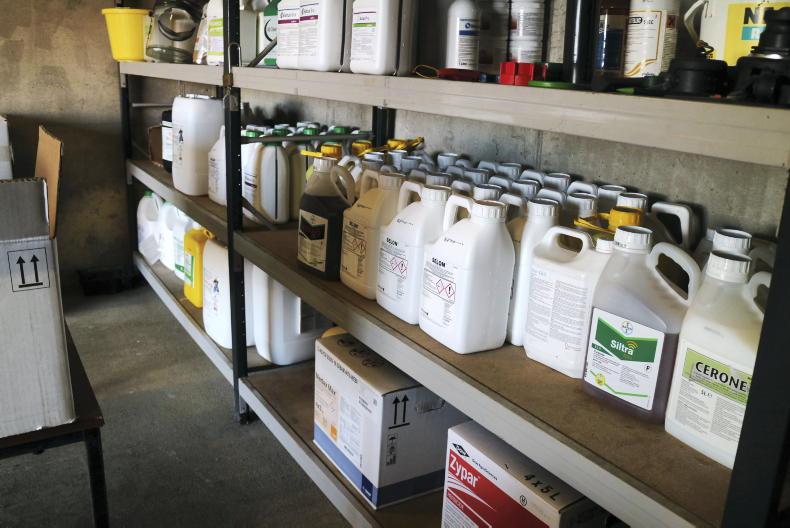
Based on feedback from a number of recent on-site farmer visits carried out by DAFM, it is apparent that the requirement to keep records of all pesticides applied on the holding is not being complied with by many SPS applicants. Also, many applicants have substandard facilities in place for the storage of the pesticides they use. This seems to be a particular issue on grassland farms engaged mainly in livestock enterprises.
The reasons given for the failure to comply with the requirements for record keeping relate, in some cases, to a lack of awareness as to what a pesticide is. For example, some farmers do not consider ‘Roundup-type’ products to be a pesticide. A significant number of applicants claimed that it was too onerous to expect that such records be maintained.
Basic requirements
To be clear – the use of all pesticides used by a professional user must be recorded. (All farmers are considered to be professional users.)
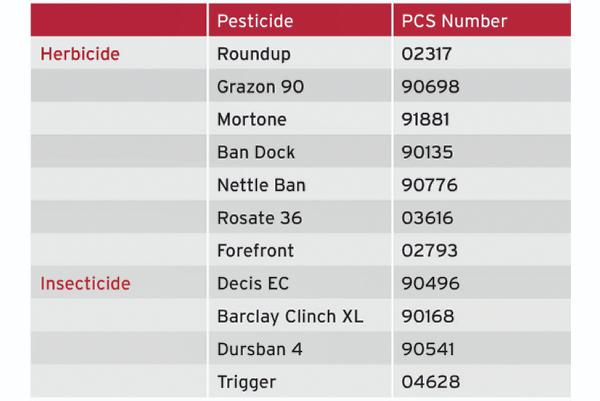
Table 1 contains examples of pesticides frequently used by grassland farmers, the use of which must be recorded.
Valid records of use
It cannot be over-emphasised that the failure to produce valid records of pesticide usage will incur a direct penalty under the Single Payment Scheme (SPS) and may also have knock-on consequences for other schemes such as REPS and AEOS. In addition, a subsequent non-compliance under SMR9 (pesticide component of the Cross-Compliance Inspection) in any of the following three years could lead to a further substantial deduction from the SPS payment.
In signing up for the SPS, the applicant undertakes to comply with the relevant legislation. Record keeping with respect to pesticide usage, is one of the requirements. It makes no sense to risk incurring a penalty for what is a fairly simple and straight forward exercise for the majority of farmers.
Issue 4 in this series of articles explained what was required with regard to keeping records in some detail. Several individuals have asked if there was a book, similar to the herd register, for recording such information. The short answer is “no”, but such a record book may result from finalising the details of the Sustainable Use Directive. In the meantime, it is suggested to:
Purchase a decent and durable notebook
Read all labels on the products used
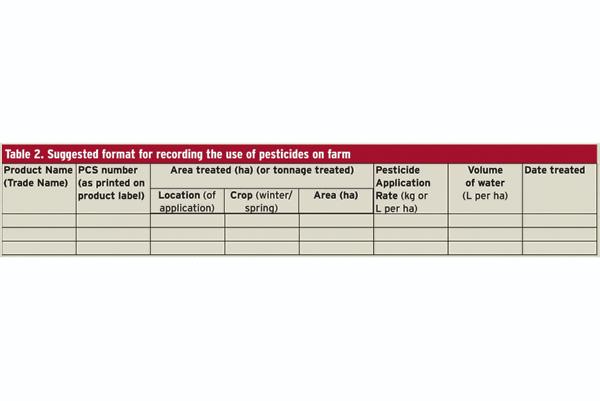
Record the information as detailed in Table 2.
A copy of the Pesticide Application Record Log may be downloaded from the following website http://www.pcs.agriculture.gov.ie/Default.htm. This states what needs to be recorded for each application of each product (see Table 2).
Proper use
Pesticides are tools used to manipulate occurrences of nature in the farmers favour. But such products are pesticides and need to be treated with care and caution.
Pesticides, if not used correctly, are potentially dangerous to the user, the consumer of the produce and the environment.
Keeping accurate records protects end users from the, often unfounded, allegations of improper use.
Where residues are detected, a failure to keep accurate records makes it more difficult to demonstrate that pesticides are being used according to the conditions of the registration and, as well as the financial penalty, the use of these products will inevitably become more restricted, and possibly be removed from the market.
Remember:
As an SPS applicant, you have undertaken to comply with the statutory requirements.
Protect your business and future income – comply with the requirement to keep records.
Records indicate responsible use – if you are not inclined to keep records, do not use pesticides.
Triple rinse empty containers and dispose of all containers safely – see the pesticide container rinsing leaflet in a previous edition of the Irish Farmers Journal or click on the ‘Good Practice Guide for Empty Pesticide Containers’ on the website page mentioned previously.
Note: before using a product in a knapsack, check to make sure it has approval for use in a knapsack sprayer!


SHARING OPTIONS