



Rodenticides are a class of pesticides designed to kill rodents – specifically, rats and mice. Rats, in particular, are associated with the spread of human pathogens by contamination of stored produce (and animal feed) with urine and faeces. They also carry disease and can damage the structure of buildings.
Consequently, there are valid health and economic reasons why they need to be controlled. However, as scavengers, rodents are difficult to kill with poisons because their feeding habit is to eat a small bit of food and wait – if they don’t get sick, they continue to eat.
Thus, an effective rodenticide must be odourless and tasteless in lethal concentrations, with a delayed effect.
In the main, rodenticides are anticoagulants and work by causing the rodents’ death through internal bleeding. The advantage of anticoagulants over other poisons is that the time taken for the poison to induce death means that the rats do not associate the impairment with their feeding habits.
Currently, the majority of the products on the market are ‘second generation’ anticoagulants and are significantly more toxic than ‘first generation’ products.
Typically, they are applied in lower concentrations in baits and are lethal after a single ingestion of the bait. They are also effective against strains of rodents that had become resistant to first generation products.
Secondary poisoning
The downside to rodenticide baits is that:
i) organisms other than the target organism can come into contact with the bait and, as a result of ingestion, suffer the same fate as the target rodent.
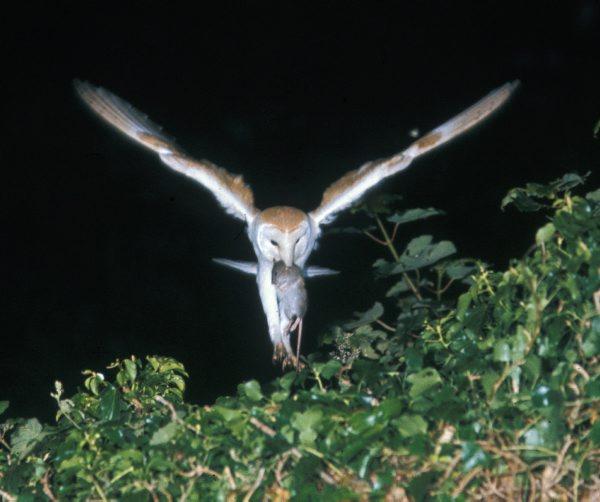
ii) organisms that feed on rodents, e.g. birds of prey, can hunt dying or dead rodents (poisoned as a result of ingesting rodenticide) and accumulate residues of the poison in their bodies.
||PIC2||
If the level of toxicity in the prey animal is sufficiently high, it will harm the predator. This is known as secondary poisoning, and is a cause for concern amongst wildlife experts, environmentalists and agriculturalists.
The problem of secondary poisoning is further compounded in Ireland, compared with the UK and mainland Europe, because of our restricted number of small mammal species.
Effectively there is only one species of rat and two mice species. Ireland has only one vole – the bank vole. There are no water voles or field voles, or common or water shrews. There are no moles, very few dormice, and no harvest mice or yellow necked mice.
Consequently, rodent-catching predators are particularly dependant on rats and mice – much more so than in other countries.
Whilst all instances of secondary poisoning are a cause for concern, there is increasing evidence that birds of prey such as kestrels, buzzards, barn owls and long eared owls are particularly vulnerable because rodents are their main source of food. Also at risk are kites, foxes, stoats and pine martins.
Data compiled by BirdWatch Ireland assessed the residual levels of second generation anticoagulant rodenticides in the Irish barn owl population and this highlighted substantial exposure.
Of 69 barn owl carcasses tested, over 85% had detectable residues of the four main second generation rodenticide compounds. The concentrations of the residues recorded in these birds were also at worrying levels – up to four times greater than comparable studies in the UK.
Use responsibly
These findings highlight the need to address the way rodenticides are used and to attempt to reduce the threat of secondary poisoning.
In order to increase awareness of the impact of rodenticide use in Ireland, a campaign for responsible rodenticide use is being established in Ireland (CRRU Ireland) and this was launched last week at the Ploughing Championships.
CRRU has developed guidelines for the responsible use of rodenticides and is fully supported by the companies who manufacture the rodenticides. It is also supported by other interested parties.
The CRRU Ireland code promotes the following strategies for using rodenticides:
Always have a planned approach.
Always record quantity of bait and where it is placed.
Use enough baiting points.
Always collect and dispose of rodent bodies.
Never leave bait exposed to non-target animals and birds.
Inspect bait regularly.
Never leave bait down at the end of a treatment programme.
These guidelines promote best practice in rodent control and will reduce to a minimum the potential harmful effects on wildlife. They will also help users get the best results from their rodent control programs.
For example, rodents ingesting second generation anticoagulants will not die immediately or necessarily beside the bait station. Dead carcases can be found several days later and up to 100m away from where the rodenticide was laid.
Poisoned carcases can be eaten by scavengers, e.g. kites and foxes, and dying rats are more easily caught by predators than fully healthy ones.
For these reasons, it is very important that all dead rats and mice are gathered up and disposed of safely, although this is easier said than done in a farming environment.
Habitats
Rats and mice (like any other living creatures) need a suitable habitat in which to live. The more abundant the food supply and shelter is, the more breeding will take place leading to higher numbers.
CRRU Ireland identifies environmental changes that can be made to make the area less attractive to rodents.
It is crucial that when rodenticides are used that they be effective in dealing with an infestation problem. Use the guidelines stated.
The alternative is that rodents become resistant to the rodenticide used. If this were to happen, stronger and more toxic poisons will be required, with possible further deterioration of environmental quality. CRRU is already operating successfully in Britain and is a welcome step towards improving our natural environment for wildlife.
The next step will be the development of a FETAC-approved ‘wildlife aware’ course for trained pest control technicians. Following on from this will be training modules for farmers, and a comprehensive product stewardship system. Further information can be obtained from www.thinkwildlife.org
Product update
A comprehensive list of recently withdrawn products and their use-by dates can be found at www.pcs.agriculture
.gov.ie/Docs/
Use-up details for some high profile products in 2013 and 2014 are listed in Table 1. Also included are four products granted ‘emergency use authorisations’. Note the last date for use and do not apply after these dates.




SHARING OPTIONS