Like so many good ideas, there was an element of fortune in the origins of A Season of Sundays.Produced by the photographic agency Sportsfile, the new edition of the annual pictorial record of the Gaelic Games year – the 29th such offering – is now in the shops. Since the first volume back in 1997, it has become a staple of GAA literature.
For this columnist, 1999 marked the beginning of a Christmas morning tradition of studying it around the breakfast table, so imagine the excitement that followed when, upon leafing through a copy in a shop in November 2008, I saw myself there in glorious technicolor, snapped while working away.
Across the inter-county season and across all codes, the photos run the gamut of the sporting condition – the highs and the lows and everything in between.
Sportsfile founder and owner Ray McManus is the man behind it all, who was driven by a sense of defiance when a call came in, asking if there were any photos “lying around” that could be used in an upcoming publication.
“I said to myself, ‘Our pictures deserve better than someone to ask if they’re lying around,’” Ray remembers.
“The inference was that literally if you had any old scraps lying around, you know, they’d take them. And I thought, no, the pictures deserved a better landing point than that.
Book origins
“So I went into Easons on the Saturday after that and had a look around, and I saw a book about the coastline of Ireland, which was 300 [millimetres] by 300 – the same size as A Season of Sundays is now.
“It displayed the pictures very well, so I said, ‘Here, I’m going to try one of those.’ I rang Peadar Staunton, who designs the book, we had a chat and I said, ‘Look, it could be called A Season of Sundays.”
The rest is, literally, sports-image history. Back then, there were fewer inter-county games, but they were spread over a longer period of time, and the production process was more laborious.
The move to digital and the advent of the split-season have helped to make things a bit less frantic when it comes to putting the book together.
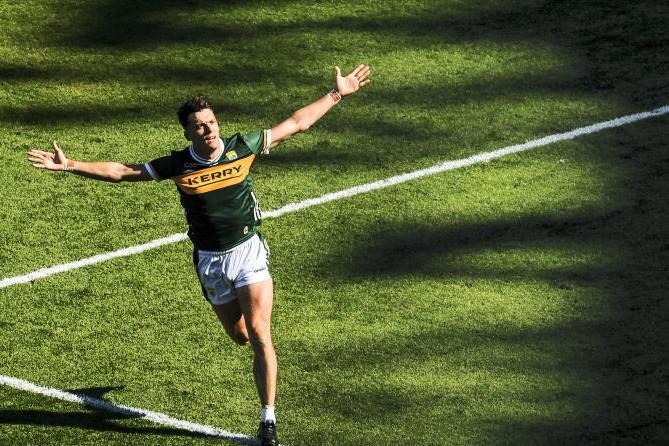
The front cover of the book is David Clifford of Kerry celebrating after scoring his side's first goal during the All-Ireland Senior Football semi-final against Tyrone in Croke Park. \Ramsey Cardy/Sportsfile
“Originally, we were on film,” Ray says, “so it was a much more difficult process to print the prints and scan them and do everything, whereas nowadays the digital files are much better. The quality of the book has improved dramatically over time.
“What we would do is go through each month and prepare it. Now, the captions obviously wouldn’t be done until the end of the year, but with six months of the year gone, we’d have half the book done.
“The changed season has helped us a lot in that it allows us to get it out in a reasonable time. Previously, when you were nearly into October with the games, it would have been the middle-to-end of November in the shops, whereas now it’s already been in there for the last few weeks.
“The camogie is the last of the four finals so you’d be finishing it up that week and then going to print the following Monday.”
Despite its longevity, though, Ray points out that the publication is not one that makes him millions. While dear to many GAA enthusiasts, it is something that requires assistance to ensure it remains on the go.
“It’s not a major profit-making exercise, but it’s one that we enjoy,” he says.
“It sells a couple of thousand copies per annum, but without the sponsorship of Forvis Mazars, we just couldn’t do it.
“People often slag me and say, ‘Oh, you’re making a fortune out of that book!’ – well, if I was to be paid 50 pence an hour, I wouldn’t make a profit.”
Including full-time and freelance workers, Sportsfile has 19 photographers and all of them have their work published in the finished product.
“I’m very much into encouraging youth,” McManus says. “There’s two young lads, John Sheridan and Peter Langan, who came into us and happened to get a picture good enough that we would use in the book.
“They might only have one each, but I believe that if it’s the better picture on the day, then we’ll use it.”
And so, when asked if there are any favourite images among the 29 different tomes, McManus’s reply gives an insight into the mindset of the photographer – essentially, the next picture is the best one.
“There wouldn’t really be [a favourite] in that, you know, we work on the principle that today’s front page is the most important,” he says.
“It’s kind of like, ‘How good is your last picture?’ kind of thing. We like the ‘one man and his dog’ kind of picture, those ones in the early part of the year where you get the shots that a are a bit out of the ordinary.”
Like so many good ideas, there was an element of fortune in the origins of A Season of Sundays.Produced by the photographic agency Sportsfile, the new edition of the annual pictorial record of the Gaelic Games year – the 29th such offering – is now in the shops. Since the first volume back in 1997, it has become a staple of GAA literature.
For this columnist, 1999 marked the beginning of a Christmas morning tradition of studying it around the breakfast table, so imagine the excitement that followed when, upon leafing through a copy in a shop in November 2008, I saw myself there in glorious technicolor, snapped while working away.
Across the inter-county season and across all codes, the photos run the gamut of the sporting condition – the highs and the lows and everything in between.
Sportsfile founder and owner Ray McManus is the man behind it all, who was driven by a sense of defiance when a call came in, asking if there were any photos “lying around” that could be used in an upcoming publication.
“I said to myself, ‘Our pictures deserve better than someone to ask if they’re lying around,’” Ray remembers.
“The inference was that literally if you had any old scraps lying around, you know, they’d take them. And I thought, no, the pictures deserved a better landing point than that.
Book origins
“So I went into Easons on the Saturday after that and had a look around, and I saw a book about the coastline of Ireland, which was 300 [millimetres] by 300 – the same size as A Season of Sundays is now.
“It displayed the pictures very well, so I said, ‘Here, I’m going to try one of those.’ I rang Peadar Staunton, who designs the book, we had a chat and I said, ‘Look, it could be called A Season of Sundays.”
The rest is, literally, sports-image history. Back then, there were fewer inter-county games, but they were spread over a longer period of time, and the production process was more laborious.
The move to digital and the advent of the split-season have helped to make things a bit less frantic when it comes to putting the book together.
The front cover of the book is David Clifford of Kerry celebrating after scoring his side's first goal during the All-Ireland Senior Football semi-final against Tyrone in Croke Park. \Ramsey Cardy/Sportsfile
“Originally, we were on film,” Ray says, “so it was a much more difficult process to print the prints and scan them and do everything, whereas nowadays the digital files are much better. The quality of the book has improved dramatically over time.
“What we would do is go through each month and prepare it. Now, the captions obviously wouldn’t be done until the end of the year, but with six months of the year gone, we’d have half the book done.
“The changed season has helped us a lot in that it allows us to get it out in a reasonable time. Previously, when you were nearly into October with the games, it would have been the middle-to-end of November in the shops, whereas now it’s already been in there for the last few weeks.
“The camogie is the last of the four finals so you’d be finishing it up that week and then going to print the following Monday.”
Despite its longevity, though, Ray points out that the publication is not one that makes him millions. While dear to many GAA enthusiasts, it is something that requires assistance to ensure it remains on the go.
“It’s not a major profit-making exercise, but it’s one that we enjoy,” he says.
“It sells a couple of thousand copies per annum, but without the sponsorship of Forvis Mazars, we just couldn’t do it.
“People often slag me and say, ‘Oh, you’re making a fortune out of that book!’ – well, if I was to be paid 50 pence an hour, I wouldn’t make a profit.”
Including full-time and freelance workers, Sportsfile has 19 photographers and all of them have their work published in the finished product.
“I’m very much into encouraging youth,” McManus says. “There’s two young lads, John Sheridan and Peter Langan, who came into us and happened to get a picture good enough that we would use in the book.
“They might only have one each, but I believe that if it’s the better picture on the day, then we’ll use it.”
And so, when asked if there are any favourite images among the 29 different tomes, McManus’s reply gives an insight into the mindset of the photographer – essentially, the next picture is the best one.
“There wouldn’t really be [a favourite] in that, you know, we work on the principle that today’s front page is the most important,” he says.
“It’s kind of like, ‘How good is your last picture?’ kind of thing. We like the ‘one man and his dog’ kind of picture, those ones in the early part of the year where you get the shots that a are a bit out of the ordinary.”





SHARING OPTIONS