


Vion Food Group (Vion) was founded in 1930 as a rendering plant in southern Holland and for the next six decades was focused primarily on rendering and slaughtering.
It acquired several rendering plants throughout the Netherlands and Belgium. However, from 1990, Vion entered its first phase of international expansion with a series of acquisitions – Banner in the US, Sidmak in France and Rousselot in Spain.
Then from 2002, the company entered its next phase of international acquisitions, acquiring, for the first time, meat processing operations and moving further up the supply chain. Acquisitions included Maksel, HMG, Sudfleisch in Germany and the Nethlerlands. In 2006, this rapidly expanding food group changed its name from ‘Best Agrifund Covion NV’ to Vion Food Group.
This was followed by a series of acquisitions in Britain, Russia, Poland, Brazil and China, as well as in its ‘home’ markets of Germany and the Netherlands.
acquisitions
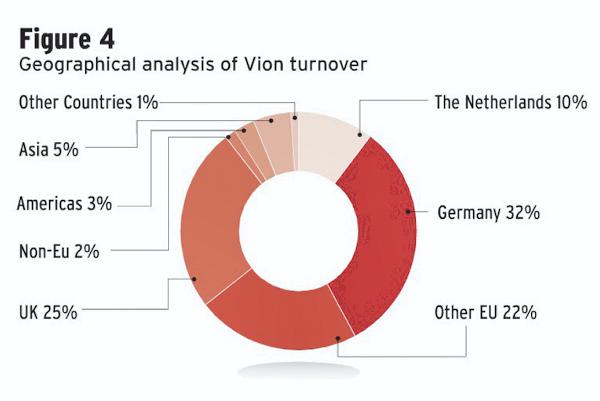
Following the large scale acquisitions of J&J Tranfield and Grampian Country Food Group in Britain in 2008, its British division was renamed Vion Food United Kingdom; today, this division accounts for 25% of total group sales (€2.4 billion).
Since then, Vion’s business can be segmented into three ‘home markets’ – the Netherlands, Germany and Britain – which account for almost 70% of total group revenues (Figure 4).
Vion is a public limited company (plc) and is owned by one shareholder, NCB Ontwikkeling, which, in turn, is owned by ZLTO, an association of 18,000 Dutch farmers.
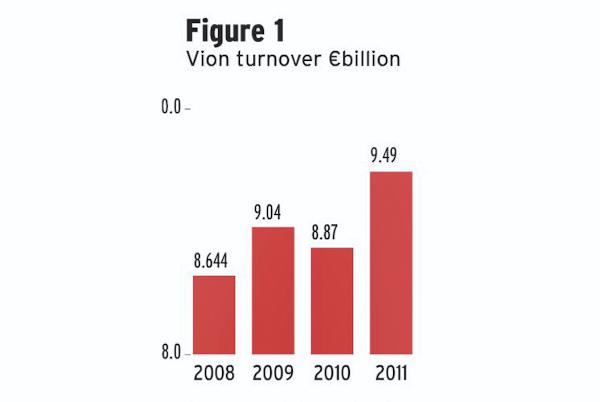
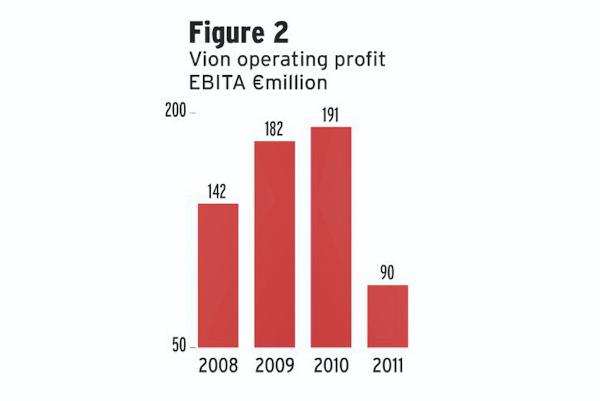
Vion has over 26,000 employees; sales of €9.5 billion and generated operating profits of €90.1m last year – a fall of 53% on the previous year.
Vion is experiencing increasing financial pressures with ongoing speculation surrounding the viability of some of its British plants.
consolidating
It is now focused on consolidating its position within its key markets of the Netherlands, Germany and Britain.
COMMENT
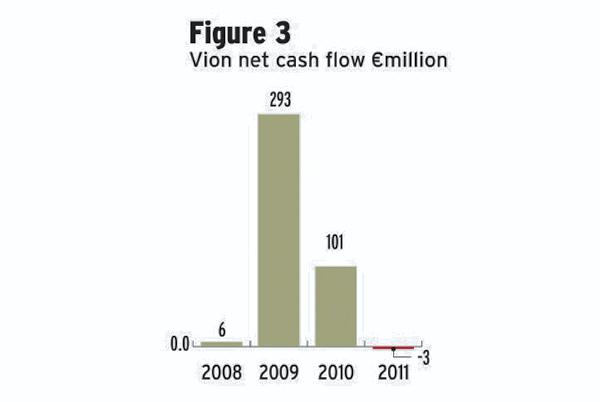
2011 saw a significant reversal of fortunes financially for Vion, with operating profits falling 53% and free cash flow falling from €101m in 2010 to -€3m last year, underlining the challenges this food group now faces.
Vion is caught between rising input costs, increasingly value conscious consumers and dominant retailers across its three key markets.
With €930m of bank debt, Vion’s debt to profit ratio increased from two times in 2010 to 2.9 times last year, while its interest cover stands at just 4.2 times.
Vion currently has a €1.1 billion credit facility from a syndicate of 11 banks which is due to be re-financed in November 2015.
The group’s acquisition spree of recent years is likely to slow while it shifts its focus to consolidating its existing facilities within its key markets and increases its profit margins once again.
VION FOOD GROUP BUSINESS DIVISIONS
Vion is segmented into two overall business divisions – Vion Food and Vion Ingredients. In recent years the group has significantly expanded its route to markets across Europe, America and the BRIC countries.
Vion Food
Vion Food produces and processes a range of beef, lamb, pork, bacon and chicken products as well as convenience products such as sausages, cooked meats and added value cooked chicken.
Vion Food has extensive operations across the Netherlands, Germany and Britain from farms and hatcheries to primary production, processing and packing.
Vion Ingredients
Its core activity is adding value to animal byproducts – proteins and fats. These value added products are used as ingredients in highly diverse markets such as pharmaceuticals, cosmetics, food, feed, energy (bioenergy) and technology.
Vion Ingredients operates under four main businesses – Ecoson, Rendac, Sonac and Rousselot. These are involved in the ongoing production and development of gelatine (a brittle protein made from animal byproducts); biodigestion – producing energy from second-generation raw materials; biogas; biodiesel and animal fats, and producing other high quality proteins and fats from animal byproducts.
Such ingredients are used within a wide variety of industries, from the pharmaceutical to the cosmetic sector.
VION Food UK
Vion Food UK has its head office in Livingston, Scotland, and employs 11,500 across its sites throughout Britain. It has a number of recognised brands, such as Debbie & Andrew’s, Case & Sons, Cookstown of Northern Ireland and Halls.
Vion is one of Britain’s largest poultry companies, processing over three million birds each week into fresh chicken products.
Vion’s UK red meat business operates from five sites, with three well established brands – McIntosh Donald, Welsh Country Foods and St Merryn Foods.
Vion’s ongoing financial challenges have forced the company to consolidate its British operations by re-organising its operations at its Haverhill plant and, more recently, with the announcement of the potential closure of its Halls of Broxburn plant in Scotland, putting 1,700 jobs at risk.
Cookstown
Vion’s Cookstown site in Northern Ireland is a complete pork processing operation and currently has the largest pork slaughter throughput of any single facility in Britain or Ireland.
As well as slaughter facilities, the site has fully developed facilities for boning, bacon curing and slicing, sausage manufacture and pre-packed fresh pork production.
Its customer base includes Tesco, Asda, Marks & Spencer, Sainsburys and Dunnes, as well as local multiples within Northern Ireland.
The company also sells products under the Cookstown brand label in Northern Ireland and the Republic of Ireland.
This plant slaughters in excess of 20,000 pigs per week. Of these, 45% are sourced in the Republic of Ireland.
Therefore, of the 3.5 million pigs available for slaughter each year within the 26 counties, 612,000 pigs (17%) are exported to Northern Ireland each year.
Vion (Cookstown) purchases 75% of these pigs with the balance purchased by Grants and Stephens (Cullybackey).
Vion Food Netherlands
This accounted for over 10% (€969m) of group sales in 2011. The acquisition of Weyl Beef last year enabled Vion to significantly increase the numbers of cattle slaughtered in the Netherlands.
The company also supplies an increasing range of organic beef and pork under its De Groene Weg subsidiary with ambitions to expand this organic range across Germany and Britain.
Vion Food Germany
Germany is Vion’s largest market and accounts for almost 32% of all group sales (€2.9bn); a record 8.4 million tonnes of meat were produced last year.
The Dioxin scandal in early 2011 affected the consumption of not just pork but of all meats in that market.



SHARING OPTIONS