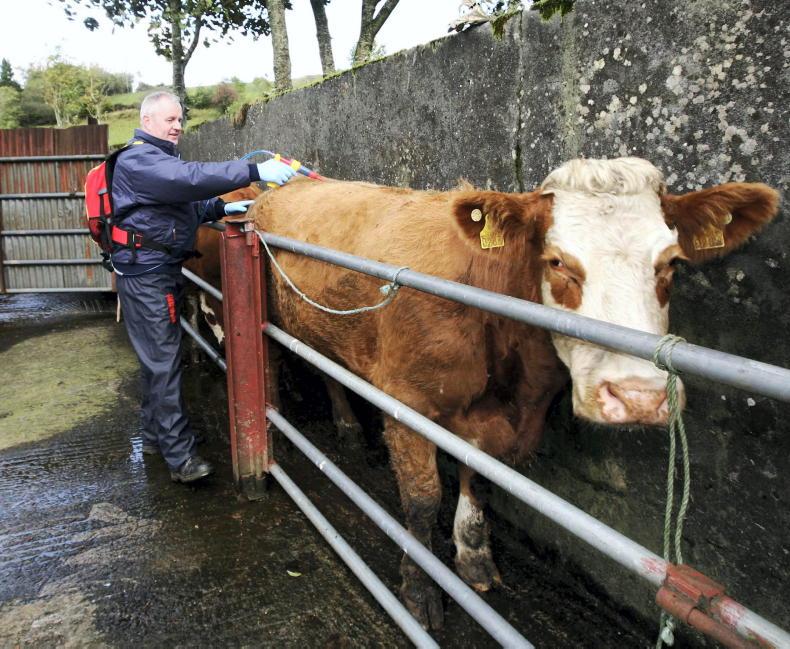
Scientists at the Agri Food and Biosciences Institute (AFBI) in Hillsborough, Co Down, are researching ways of reducing phosphorus (P) levels in cattle slurry and AD-plant digestate.
Although the use of chemical fertilisers containing phosphate has reduced in NI in recent years, high P levels in soils remains an issue. Many dairy farms have significant P surpluses, mainly due to feeding high levels of P-rich concentrates to cows.
One technology on display at AFBI’s dairy open day this week was a screw press separator. The device separates slurry into liquid and solid forms. Between 25% and 40% of P in slurry can be removed in the solid form, which is around 25% dry matter.
ADVERTISEMENT
The separated solids can be moved off farm and spread on low-P index soils at a lower transport cost than exporting unseparated slurry. The material can also be dried, composted or pelletised and used as a fertiliser with an approximate N:P:K ratio of 10:2:5.
This leaves the separated liquid, which has 25% to 40% less P, but only around 15% less nitrogen and around 10% less potash. It can be spread on the farm of origin, meaning a lower P balance. Further processing of the separated liquid with other technologies is also possible.
The screw press separator has a capital cost of around £25,000 and has an electricity requirement of around 0.4 to 0.5kWh per m3 of slurry.
Higher cost
Another technology at AFBI Hillsborough is the decanting centrifuge separator. This technology can remove over 60% of P from slurry into the solid faction and is therefore more effective at lowering a farm’s P balance.
However, a decanting centrifuge separator currently costs over £100,000 and running costs are also much higher than the screw press separator, at between 3 and 5kWh per m3.

This content is available to digital subscribers and loyalty code users only. Sign in to your account, use the code or subscribe to get unlimited access.
The reader loyalty code gives you full access to the site from when you enter it until the following Wednesday at 9pm. Find your unique code on the back page of Irish Country Living every week.
CODE ACCEPTED
You have full access to the site until next Wednesday at 9pm.
CODE NOT VALID
Please try again or contact support.
Scientists at the Agri Food and Biosciences Institute (AFBI) in Hillsborough, Co Down, are researching ways of reducing phosphorus (P) levels in cattle slurry and AD-plant digestate.
Although the use of chemical fertilisers containing phosphate has reduced in NI in recent years, high P levels in soils remains an issue. Many dairy farms have significant P surpluses, mainly due to feeding high levels of P-rich concentrates to cows.
One technology on display at AFBI’s dairy open day this week was a screw press separator. The device separates slurry into liquid and solid forms. Between 25% and 40% of P in slurry can be removed in the solid form, which is around 25% dry matter.
The separated solids can be moved off farm and spread on low-P index soils at a lower transport cost than exporting unseparated slurry. The material can also be dried, composted or pelletised and used as a fertiliser with an approximate N:P:K ratio of 10:2:5.
This leaves the separated liquid, which has 25% to 40% less P, but only around 15% less nitrogen and around 10% less potash. It can be spread on the farm of origin, meaning a lower P balance. Further processing of the separated liquid with other technologies is also possible.
The screw press separator has a capital cost of around £25,000 and has an electricity requirement of around 0.4 to 0.5kWh per m3 of slurry.
Higher cost
Another technology at AFBI Hillsborough is the decanting centrifuge separator. This technology can remove over 60% of P from slurry into the solid faction and is therefore more effective at lowering a farm’s P balance.
However, a decanting centrifuge separator currently costs over £100,000 and running costs are also much higher than the screw press separator, at between 3 and 5kWh per m3.
If you would like to speak to a member of our team, please call us on 01-4199525.
Link sent to your email address
We have sent an email to your address. Please click on the link in this email to reset your password. If you can't find it in your inbox, please check your spam folder. If you can't find the email, please call us on 01-4199525.
ENTER YOUR LOYALTY CODE:
The reader loyalty code gives you full access to the site from when you enter it until the following Wednesday at 9pm. Find your unique code on the back page of Irish Country Living every week.
SHARING OPTIONS