While spring calving into a long grazing season seems the cheapest and most logical option, autumn calving systems have big benefits too.
Cows can calve outdoors – an inherently healthier environment – in a fit state to do so.
Huge pressure is taken off in the spring from a grazing point of view, both in terms of grass supply and land trafficability.
For live sellers targeting back-end weanling sales, a stronger, more mature animal is hitting the ring.
AI breeding is easier, given animals are housed at breeding time.
In split herds, it can spread the workload and help cashflow with more sale periods.
However, a poorly run autumn calving system will lose much more money than a poorly run spring system. Autumn calvers haven’t got the luxury of high feed value spring grass going into their cows during the most crucial period of the production cycle, the postpartum interval (time between calving and conception). Keeping this period as short as possible is critical for successful suckling and nutrition is the key to doing so. Conserved forage and potentially meals are the staples. Feeding meal to suckler cows might seem sacrilegious, but it can be minimised where silage quality is good enough in an autumn-calving scenario.
ADVERTISEMENT
What do we mean by good enough? 75% dry matter digestibility. Is this being achieved on autumn-calving farms? Rarely.
Silage quality
The first thing I ask an autumn-calving farmer is what quality his silage was or is. Not knowing is almost as bad as having poor-quality stuff. Right up there on his or her main goals list for the year should be to make rocket fuel silage for their suckler cows. Feeding creep meal to young calves during their first winter period is a given on these farms and actually a very worthwhile investment – young animals are extremely feed-efficient, but lots of kilos going into cows to prop up a poor silage crop is a situation they desperately need to avoid for the sake of their wallets.
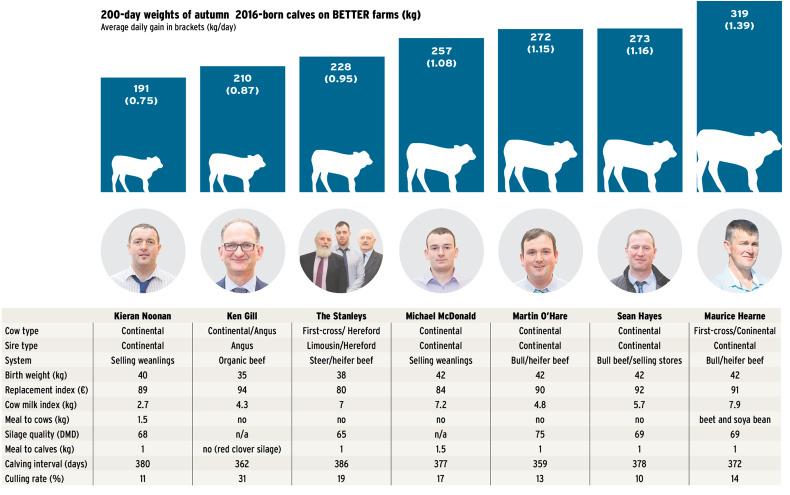
So, with this in mind, how do the BETTER farm group fare? A suckler cow’s number one job is to produce a heavy weanling on the button every year. Our autumn calvers with 200-day weights on calves are laid out above. Birth weights are assumed based on parental genetics in the herds, with Corkman Kieran Noonan having recorded his own.
Fertility
Given the importance of fertility, calving interval is presented also and, as a high culling rate can mask infertility in a herd, this has been added to the mix as well.
In terms of 200-day weights, Kieran is at the lower end of the group, but this can be put down to an outbreak of respiratory disease which hit calves hard last winter. On top of this, his herd could do with some milky genetics, given its low average milk index figure. Like all of our autumn-calvers, save for Martin O’Hare, he will need to improve on his silage quality and reduce his meals in the cow trough. While Martin doesn’t top the list from a 200-day weight point of view, you could argue that he is as deserving of the accolades as top weight-producer Maurice Hearne.
His exceptional calving interval, achieved with no meal, is a true reflection of fertility and not created by an unusually high culling rate as is the case with Offaly’s Organic man Ken Gill. For me, Ken has huge potential in that he is growing a pea/barley mixed crop as well as oats and red clover on the farm so there is plenty of nutrition there to tap into to ramp up the energy going into his cows which, in turn, will drive on calf weight gain, fertility and reduce the need for such big empty cow culling rates.
Maurice Hearne’s 200-day weights are huge and show what can be done with a milky cow (lots of first-cross Limousin/Friesian here) and the right feeding. His silage quality could be better, but the fodder beet is homegrown and fits well into his system. His calving interval is low, and the culling rate is acceptable – so fertility is good here.
This content is available to digital subscribers and loyalty code users only. Sign in to your account, use the code or subscribe to get unlimited access.
The reader loyalty code gives you full access to the site from when you enter it until the following Wednesday at 9pm. Find your unique code on the back page of Irish Country Living every week.
CODE ACCEPTED
You have full access to the site until next Wednesday at 9pm.
CODE NOT VALID
Please try again or contact support.
While spring calving into a long grazing season seems the cheapest and most logical option, autumn calving systems have big benefits too.
Cows can calve outdoors – an inherently healthier environment – in a fit state to do so.
Huge pressure is taken off in the spring from a grazing point of view, both in terms of grass supply and land trafficability.
For live sellers targeting back-end weanling sales, a stronger, more mature animal is hitting the ring.
AI breeding is easier, given animals are housed at breeding time.
In split herds, it can spread the workload and help cashflow with more sale periods.
However, a poorly run autumn calving system will lose much more money than a poorly run spring system. Autumn calvers haven’t got the luxury of high feed value spring grass going into their cows during the most crucial period of the production cycle, the postpartum interval (time between calving and conception). Keeping this period as short as possible is critical for successful suckling and nutrition is the key to doing so. Conserved forage and potentially meals are the staples. Feeding meal to suckler cows might seem sacrilegious, but it can be minimised where silage quality is good enough in an autumn-calving scenario.
What do we mean by good enough? 75% dry matter digestibility. Is this being achieved on autumn-calving farms? Rarely.
Silage quality
The first thing I ask an autumn-calving farmer is what quality his silage was or is. Not knowing is almost as bad as having poor-quality stuff. Right up there on his or her main goals list for the year should be to make rocket fuel silage for their suckler cows. Feeding creep meal to young calves during their first winter period is a given on these farms and actually a very worthwhile investment – young animals are extremely feed-efficient, but lots of kilos going into cows to prop up a poor silage crop is a situation they desperately need to avoid for the sake of their wallets.
So, with this in mind, how do the BETTER farm group fare? A suckler cow’s number one job is to produce a heavy weanling on the button every year. Our autumn calvers with 200-day weights on calves are laid out above. Birth weights are assumed based on parental genetics in the herds, with Corkman Kieran Noonan having recorded his own.
Fertility
Given the importance of fertility, calving interval is presented also and, as a high culling rate can mask infertility in a herd, this has been added to the mix as well.
In terms of 200-day weights, Kieran is at the lower end of the group, but this can be put down to an outbreak of respiratory disease which hit calves hard last winter. On top of this, his herd could do with some milky genetics, given its low average milk index figure. Like all of our autumn-calvers, save for Martin O’Hare, he will need to improve on his silage quality and reduce his meals in the cow trough. While Martin doesn’t top the list from a 200-day weight point of view, you could argue that he is as deserving of the accolades as top weight-producer Maurice Hearne.
His exceptional calving interval, achieved with no meal, is a true reflection of fertility and not created by an unusually high culling rate as is the case with Offaly’s Organic man Ken Gill. For me, Ken has huge potential in that he is growing a pea/barley mixed crop as well as oats and red clover on the farm so there is plenty of nutrition there to tap into to ramp up the energy going into his cows which, in turn, will drive on calf weight gain, fertility and reduce the need for such big empty cow culling rates.
Maurice Hearne’s 200-day weights are huge and show what can be done with a milky cow (lots of first-cross Limousin/Friesian here) and the right feeding. His silage quality could be better, but the fodder beet is homegrown and fits well into his system. His calving interval is low, and the culling rate is acceptable – so fertility is good here.
If you would like to speak to a member of our team, please call us on 01-4199525.
Link sent to your email address
We have sent an email to your address. Please click on the link in this email to reset your password. If you can't find it in your inbox, please check your spam folder. If you can't find the email, please call us on 01-4199525.
ENTER YOUR LOYALTY CODE:
The reader loyalty code gives you full access to the site from when you enter it until the following Wednesday at 9pm. Find your unique code on the back page of Irish Country Living every week.





SHARING OPTIONS