



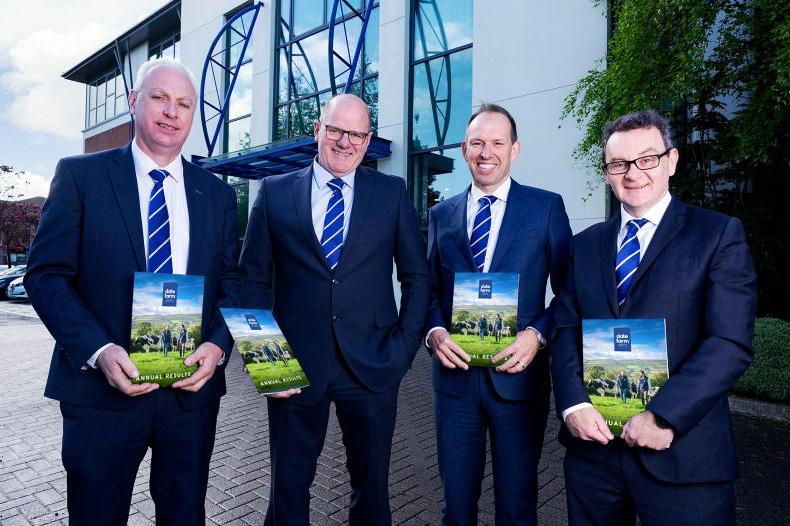
Dale Farm, the Northern Irish dairy co-op, reported an increase in turnover to £749.3m (€866.3m) and in profit before tax to £33m (€38.1m) in the 12 months to the end of March 2026. Net debt at the co-op dropped to £29.6m (€34.2m), less than half the amount outstanding a year earlier.
The co-op said in a statement that the strong financial results were achieved after returning more than £10m to farmers through paying an additional 1p/l bonus 13th payment on every litre of milk supplied during the year. Dale Farm’s milk pool exceeds 1bn litres and has grown by 16% over the last two years.
During the financial year, Dale Farm paid an average of 40.38p/l, which the co-op said is a “leading and competitive milk price” that “compares favourably with average milk prices across both Northern Ireland and the Republic of Ireland”. In April and May 2026, the co-op paid an additional market support payment to farmers of 1ppl and 2ppl respectively, which Dale Farm said was in response to changing market conditions.
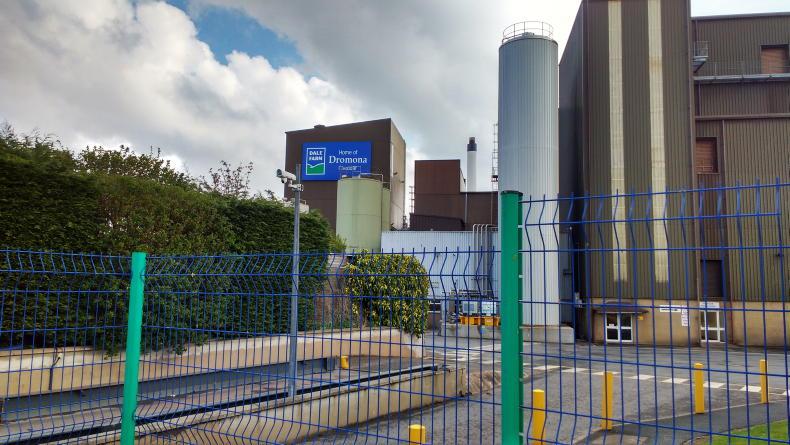
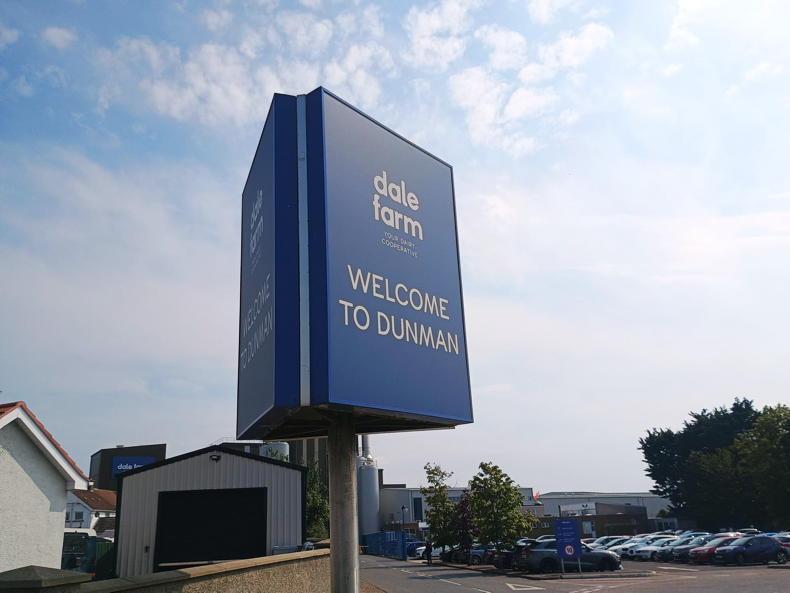
The co-op is further expanding its cheddar production capacity at its Dunmanbridge facility, with upgrades to the processing plant set to increase throughput and bring total cheddar capacity at the plant to 100,000t.
The Irish Farmers Journal sat down with Dale Farm CEO Nick Whelan, to discuss the results and plans for the future of the co-op.
“The big driver during the year was cheddar. The new facility came online, so we had higher volumes of cheddar. We also achieved three patents for our cheese, which has been a big help to us,” he said.
Whelan explained that Dale Farm have two outlets for its cheese production. The first is into retail where the co-op makes the full range of cheeses for its customers. The co-op provides an end-to-end service where the product leaves Dale Farm ready to be put on the shelves of its – mostly German discounter – customers. Whelan said that business has grown “very strongly”, and that its business into the EU is now larger than its sales into the UK.
“This year we’ll be tipping around 100,000t of cheddar, [Dunmanbridge] is now the largest cheddar plant in Europe.”
He said that Dale Farm has over 50% of its cheese in retail at the moment and that is predominantly mature cheddar.
“That’s a good business, if you set it up right. You have to have a true cost-plus model in place. That means [the cheese] is costed on the day you buy the milk and that is tracked the whole way.
“It is the kernel of our business that we have cost-plus, and our retailers understand that. It is tough on them sometimes when the cheese market is down and they are paying an exceptionally high price because the milk price was up 18 months ago.
“But they get that if they are going to have long-term rolling contracts and have the scale that they need, then they need to support the milk at whatever milk price it is.”
Whelan said that Dale Farm would not make mature cheese without the cost-plus model, adding that it has the advantage for the farmer in that it takes some of volatility out of milk prices.
The other outlet for Dale Farm’s cheese products is in the B2B (business-to-business) space.
“When you look at B2B today, it can get very commoditised. We try not have any commodity products, so what we’ve done is to get three patents on our cheddar. One of those is around functional curds, which allows the curds to work more effectively on the lines large processed cheese manufacturers.
“We can go to these customers and show that using our product can get their throughputs up by 7& or 8%, we then do the maths with them and because they run at such scale, the cost savings for them really can make a difference.”
He described the relationship with those business customers as a technical relationship, rather than one where they just sell a product. He said that the technical solutions they offer can add £50 per tonne to product sold “and that adds up”.
Dale Farm also has an advantage over some other suppliers because, due to its comparatively flat milk supply curve, it is in a position to meet business customer needs for 12 months of the year.
However, when it comes to ambitions about further growth in the co-op’s cheese business, Whelan sounds a note of caution.
“I’m a little bit worried. There’s ferocious investment going into the US at the moment, $11bn last year, a lot of it in cheddar and whey. A lot of that is going to find its way to the Middle East and North Africa, and that concerns us a little bit.
“Do I want to do 130,000t of cheddar? I don’t. For us, 100,000t is the sweet spot, as I know we can sell it. I don’t want to be relying on traded stuff, because I think it is going to get very competitive in cheddar, globally.”
While Whelan might be happy with the size of the cheddar business, that does not mean the end of Dale Farm’s wider growth plans.
“There is a huge amount of ambition here, a massive amount,” Whelan said. “We were trying to demonstrate that with the Aurivo deal, and we will do something in [the mergers and acquisitions] space.
“We won’t do it just to be bigger because we’re never going to be big, we need to have the attitude that we’re going to be a disruptor in the categories that we go into.”
He added that while Dale Farm would never win on scale, it can win on technology and service. He cited the Aurivo deal as an example of that ambition, saying it was about “putting two businesses together that make a lot of sense from a cost and a technology point of view, from a synergy point of view, that’s what Aurivo was about”. He said that there is still a relationship with Aurivo and that good progress had been made on the strategic projects which were announced when the businesses decided to step back from a full merger.
“They’ve gone better than we thought, and we’ll be making announcements soon on them. There’s a good few million quid that we’re going to generate together.”
With Dale Farm’s cheese business, it might seem obvious for the co-op to make further investments in its whey stream. Whelan said that the relationship Dale Farm has with Arla, its customer for its whey, is “solid” and while the co-op is looking at some big investment moves, whey is not one of them.
“We’re very keen in looking at other proteins, we’re really, really interested in the whole area of milk proteins. We wouldn’t be diversifying away from dairy, we’re really interested in dairy proteins, so that’s an area we’re exploring.
He added that if Dale Farm doesn’t find the right dairy protein partner, “we’ll build our own. We’d be confident that the whole protein market is not a fad.”
Flattening the curve
The Northern Irish dairy model is very different from the one in the Republic, with farmers producing milk all year round from their herds. In the Republic, there was more than seven times as much milk delivered for processing in May 2025 than there was in January 2025.
For Dale Farm, the ratio between peak and trough milk months is 1.4:1, a hugely flatter profile than in the Republic. This gives Dale Farm significant advantages when it comes to efficient use of its processing assets, which can be at or close to capacity all year round, and allows it supply to customers on a twelve-month basis.
The co-op, however, wants to flatten its supply curve even further. With this in mind, it introduced a “milk production realignment” bonus for suppliers two years ago. Under the plan suppliers get a payment of 4ppl for every additional litre of milk produced above their reference from August to January. Suppliers have reacted positively to the incentive, moving calving to earlier in the Autumn. The co-op said that the payment in 2025 was worth around 0.6ppl on all milk supplied between August and January.
The target for Dale Farm is to match the Great Britain supply curve of 1.2:1, and if that is reached, the extra efficiency gained in processing will pay for the bonus payments.
The scheme is also very attractive for new dairy entrants, as they will get the 4ppl bonus on all their milk as they will have no reference period.
Comment
When Dale Farm and Aurivo announced it was entering talks with a view to a merger, two things quickly became obvious. Firstly, from a business perspective, the deal made a lot of sense. Dale Farm is in cheese, Aurivo is in powders and ingredients. The deal would allow for synergies, but also diversification for both processors. The second one was that it was very unlikely that the merger could proceed, as the members of both co-ops knew very little about each other, and without that necessary understanding, and trust, a deal could not be completed.
Nick Whelan acknowledged this in our conversation with him, saying that some of the farmer comments he heard suggested that they didn’t even know Dale Farm was a real dairy co-op, or that it made anything other than ice cream.
The results published this week show that Dale Farm not only is a co-op paying a strong milk price, it also is a profitable one in a very healthy financial position. Whelan is obviously keen to get this message out, and while he is still interested in pushing forward with a relationship with Aurivo, ambitions at the co-op mean they are not going to hold off on other investments while waiting on a possible change of mind from Aurivo members on a merger.
The business model of Dale Farm is built on long-term relationships with a small number of key customers. This has served the business well through steady growth and relatively predictable returns. The challenge for management, looking at investments in dairy proteins and other parts of the dairy business, is to maintain that pattern as it expands.




SHARING OPTIONS