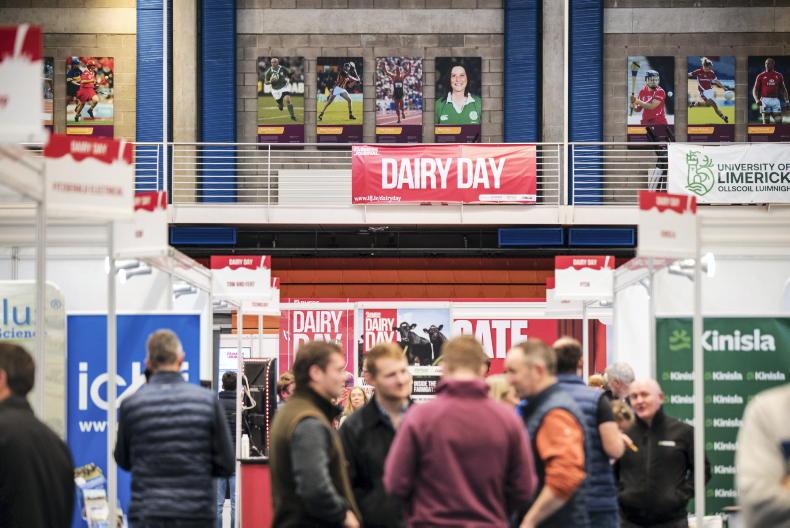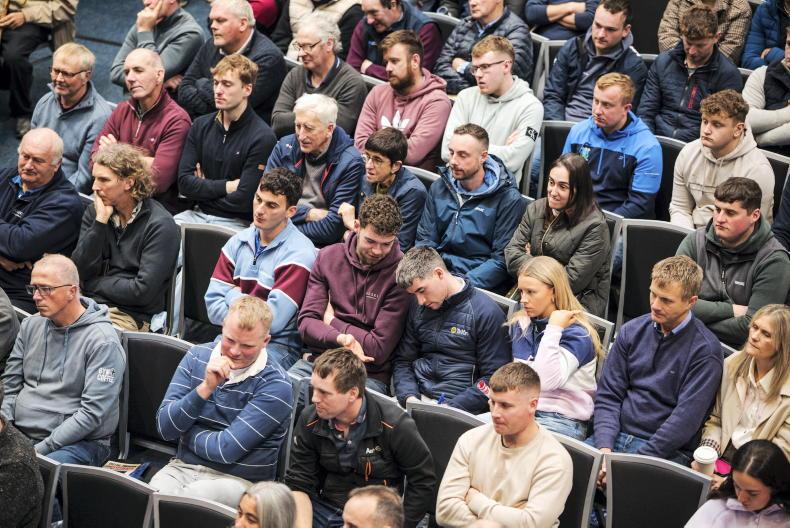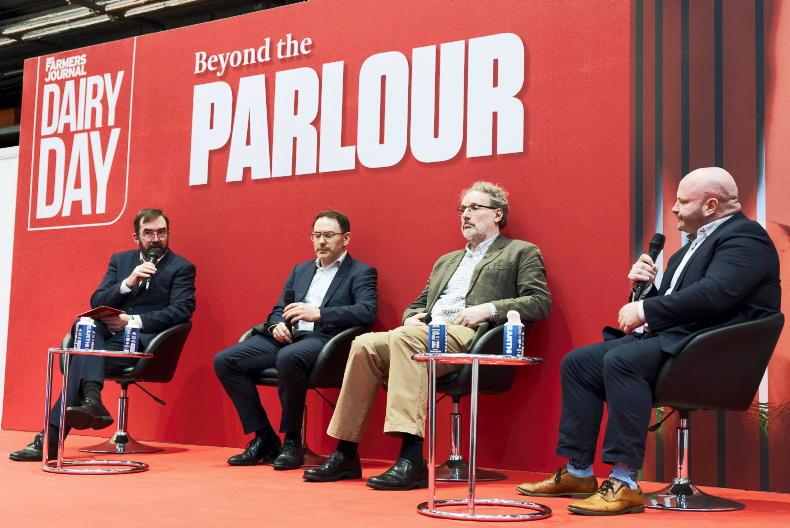
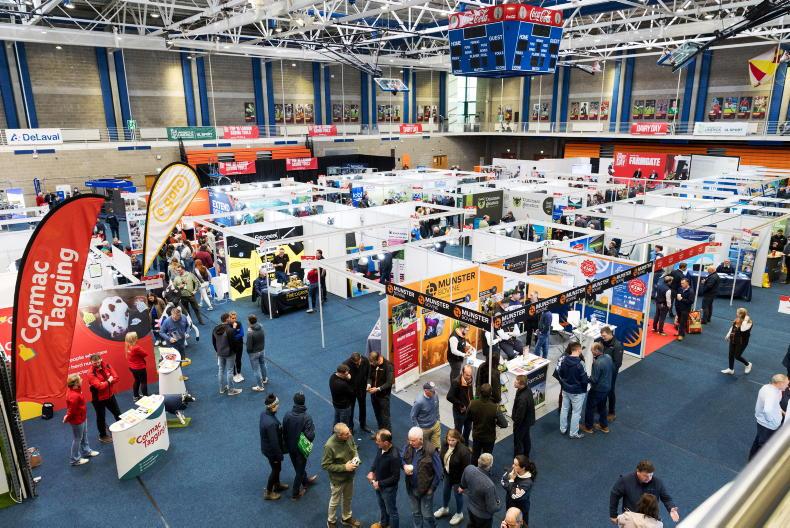
USA dairy consultant Mike McCully, speaking at Dairy Day 2026 on Saturday 14 November in Limerick, succinctly laid out the problem facing Irish dairy. If Irish milk supply is not growing any more, then “you’ve got to get more money, more revenue, out of the same amount of milk”.
Speaking on the panel titled ‘Getting Irish dairy on the right path for success’, McCully said that in order to properly look at how the country’s dairy industry is positioned, its strengths and weaknesses need to be defined. A survey of farmers showed that on the strengths, the farmer-owned co-op model is seen as positive, as is the country’s grass-based dairy system. On the weaknesses side, survey respondents said there are too many, too small co-ops in the country. The high cost of doing business was also cited as a weakness.
McCully said that in general there are more farmers worried about the future than hopeful about the future, but he suggested that the answers might be a little different if the current milk price was higher.
Edward Carr, chair of ArraTipp Co-op and president of the Irish Co-operative Organisation Society (ICOS), said that Irish dairy farmers are better off than anywhere else in the world.
“Where else can you make a living for a family off 80, 90 or 100 cows?” he said, adding that we don’t want to follow the US model, where there are farms with thousands of cows.
“We have to protect what we have in the family farm model and the grass-based system. Those are the two things we pride ourselves on,” Carr said.
He also said that the farmer-owned co-op model is very important, as it gives farmers a say in their own destiny: “I’m not saying we can’t improve, of course we can, but the model we have is exceptional.”
When it comes to getting more money out of the approximately nine billions litres of milk produced in the country, Carbery CEO Jason Hawkins said: “With our grass-fed production and our sustainability credentials, we can really differentiate ourselves as a value-added high-end producer of speciality dairy products.”
He acknowledged that none of the processors in Ireland can compete with the volume of US production when it comes to commodity products.
“The scale just isn’t here. Also, the grass-based system means there is a production curve in Ireland, whereas US milk is all-year-round. It just isn’t feasible to compete on that basis. For the smaller co-ops, they have to be investing in efficiency, but also there can be collaboration between co-ops.”
Hawkins cited the example of the four west Cork co-ops that came together to form one dairy processor which is where all the value is added.
“There are probably opportunities for some of that collaboration across the co-ops more largely”.
Carr agreed that if there are savings to be made through collaboration, then the co-ops “owe it to our farmers to try to achieve that”.
On mergers, Carr said that the changes in the number of co-ops is happening “but it might be at a slow pace”, and those that have occurred have been very successful. He added that co-op boards are open-minded people and there is an acknowledgment that “it probably is going to have to happen to have a really successful dairy industry”.
Hawkins agreed saying that “it will happen, and there will be co-ops that will look at mergers. For some, it will make sense due to the investments required in state-of-the-art facilities, and for cost optimisation”.
However, he warned against “putting all the milk in Ireland into one plant” as even at that scale the country could barely compete with US production. “You’re more likely to get an extra two or three cent a litre by focusing on adding value and the grass-fed product, rather than trying to save your way to prosperity.”
McCully agreed that value-added products is the place for Irish dairy to concentrate: “Litres of milk doesn’t pay the bills, money does. There are plenty of good examples around the world to look at with small co-ops making strong profits through specialisation and the production of value-added products.”
Hawkins noted that one of the roadblocks to mergers in the co-op sector is around how farmers identify with their own co-op. “People are precious around stainless steel at times,” he said, and suggested that collaboration might be the better route forward. That would mean every processor would not have to try to do everything, while farmers would continue to identify with their own co-op which would continue to collect their milk.
McCully finished the discussion on mergers by saying: “In looking at mergers, you want a position where both are healthy, both are strong. The old saying is if you combine two sick people you don’t make a healthy one. You don’t want to get to a point where someone is weak, so do it sooner and think more broadly.”
Income volatility
While there was much comment at Dairy Day about the future of the industry, there was also a panel on whether individual farmers can protect themselves against income volatility.
The speakers were John Lancaster from StoneX; James O’Connell, director of sustainability and agribusiness at Kinisla; and Declan O’Connor, senior lecturer at Munster Technological University. They discussed what, if anything, dairy farmers can do to avoid the worst effects of market price swings.
Lancaster noted that most currently available financial products are not suitable for dairy farmers as investors need to be of a certain size in order to access market futures and options products. In some cases, there are no reasonable products available for farmers to be able to hedge their input costs and future milk prices.
The panel agreed that in order for farmers to be able to properly protect their margin, they need to be able to both fix the milk price, and fix their input costs
James O’Connell said that Kinisla currently has no fixed milk price option available for its suppliers. He said the processor, then part of Kerry Group, had run numerous fixed-price programmes with suppliers up to 2022 and they had been quite popular.
But the unprecedented rise in input cost following the Russian invasion of Ukraine meant that the fixed milk price fell below the cost of production for many suppliers. This experience soured many dairy farmers, both at Kinisla and other processors, to the product.
The panel agreed that in order for farmers to be able to properly protect their margin, they need to be able to both fix the milk price, and fix their input costs. Unlike milk prices, some of the farmers’ input costs can be hedged on financial markets. There are well-established financial futures markets in grains, feeds and fuel. However, the panel did point to the difficulty in finding a product which would allow future fertiliser costs to be managed.
This doesn’t mean that volatility reduction and margin management are impossible in dairying. There is an active market for products in New Zealand, with that country having the advantage of what is effectively a single milk price for all farmers. Processors can also help take some the risk by forward selling products such as fertiliser and feed to allow farmers to lock in prices.
A recording of the panel will be available on this week’s Down to Agribusiness Podcast which will be published at 3pm on 20 November.
Comment
Anyone who pays much attention to the Irish dairy industry knows well that the conversations about the “right” number of co-ops in the country are very common. Each conversation generally concludes that the right answer is probably “fewer co-ops”, but also that it is unlikely to happen quickly.
The panellists at Dairy Day said there has been some progress on the number of processors over the past decade. While they are correct, the mergers have generally been ones which were forced when a processor got into financial trouble. The one recent proposed merger between two healthy co-ops, Aurivo and Dale Farm, failed because of resistance from members to the deal. As Jason Hawkins pointed out at Dairy Day, farmers have pride in the co-op they supply to. This is almost certainly a good thing, but farmers also need to keep in mind that their co-op is not their GAA club or their parish. The founding principles of the co-op movement are better farming, better business and better living. Fundamentally, the co-ops have always existed to provide the best return to Irish farmers for their milk. If there is a better return to be achieved from having fewer co-ops, then farmers and co-op boards should be doing everything they can to make that happen. After all, the only thing that will get the next generation of farmers into the industry will be the ability to make a good living from milking cows.