



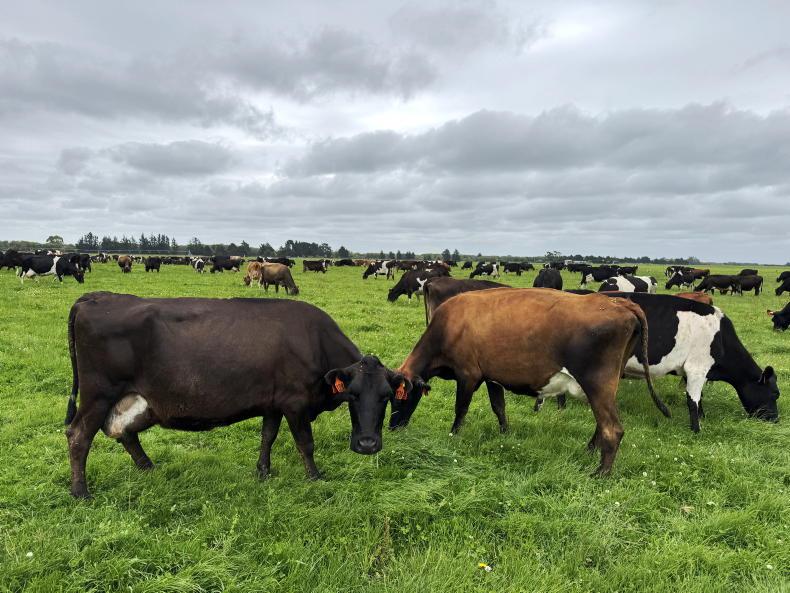
The government in New Zealand have announced new targets for the reduction in the country’s methane output. The new targets are for a reduction between 14% and 24% from the levels emitted in 2017 by 2050. The previous target for methane reduction, introduced in 2019, called for a reduction of between 24% and 47%.
The official announcement of the change in policy was made on 12 October, with the notice signed by the Minister for Agriculture Todd McClay, Minister for Climate Change Simon Watts and Minister for Food Security Andrew Hoggard. The announcement said that the revised targets reflected the findings of the Independent Science Review which reported its results in 2024.
Among the other measures announced was a review of the 2040 biogenic methane target and an investigation of the possibility of a split gas target for all of the country’s future international climate change commitments.
The ministers also said that there would be no tax introduced on agricultural methane emissions. There was also a commitment to recognise and protect the importance of food production in New Zealand by better aligning domestic legislation with language in the Paris Agreement on climate change.
An investment of NZ$400m(€198m) with industry to speed up the development and roll-out of methane reduction tools for agriculture was also confirmed. Minister Watts said that technology has the potential to deliver emissions reductions while allowing the food sector to grow.
Minister McClay said that the government had released an on-farm emissions calculator which would “allow farmers to better measure their methane and evaluate ways to reduce their emissions without harming production”.
“By setting sensible targets and backing innovation, we’re ensuring New Zealand farmers remain world leaders in producing high-quality, safe, and sustainable food, while meeting our international commitments,” McClay said.
The announced changes were welcomed by New Zealand’s farming representatives with Federated Farmers president Wayne Langford saying: “Kiwi farmers have been bogged down in completely unscientific, unaffordable and unrealistic climate policy for far too long.
“At times it’s felt like absolute madness that we’d even be talking about policies that would shut down farms, send production offshore, and completely undermine New Zealand’s economy.
“This new target brings New Zealand’s climate policy in line with what the research tells us is actually required to stop Kiwi farmers contributing to further warming.”
Key argument
That last comment from Langford gets to the heart of the opposition to the changes announced by New Zealand’s government this week. The targets set by the country were based on the principle of ‘no additional warming’ rather than the previous targets which were set to help reduce global warming.
Dr Jocelyn Turnbull, principal scientist, Earth Sciences New Zealand said: “[the] government announcement to reduce the biogenic methane goal puts New Zealand in the ‘stabilise methane in the atmosphere’ camp, rather than the more ambitious ‘reduce methane in the atmosphere’ camp. On the international stage this move could impact on our ‘clean and green’ image that helps us command a premium on our products.”
Professor James Renwick, formerly lead author for the Intergovernmental Panel on Climate Change (IPCC) went further, calling the changes a “major step backwards in ambition and in climate action.”
He said that basing the targets on ‘no additional warming’ in no way represents the ‘highest possible ambition’ as laid out in Article 4 of the Paris Agreement. “Our trading partners are unlikely to smile on this reduction in ambition,” he added.
Trade deals
Last year the trade agreement between New Zealand and the EU came into force, following the free trade agreement with the UK in 2022. Both agreements are important to New Zealand’s agricultural sector, and both make commitments to adhere to the Paris Climate Agreement.
Under the UK agreement, both parties agreed to “take action to reduce greenhouse gas emissions with the aim of strengthening the global response to climate change by holding the increase in global average temperature to well below 2oC above pre-industrial levels and pursuing efforts to limit the temperature increase to 1.5oC”.
The wording in the EU trade text is stronger, stating that both parties’ commitment to the Paris Agreement “includes the obligation to refrain from any action or omission that materially defeats the object and purpose of the Paris Agreement”.
The EU trade agreement sets out a procedure for dispute resolution where either party to the deal is found to have failed to comply with the stated ambitions around the Paris Agreement.
It remains to be seen if the EU will see the policy changes in the New Zealand as sufficiently large to trigger an investigation under the trade deal.
Comment
With Ireland and New Zealand having similar climates and grass-based agricultural systems, changes to environmental targets in that country will be closely watched by producers here.
New Zealand’s previous targets for reductions in biogenic methane were seen as arduous by the country’s farming community, and went well beyond what was proposed in other countries. The promise by the government not to introduce a tax on farm methane – something which some European countries such as Denmark are progressing with – was also welcomed by farming representatives.
Those same farm representatives make the point, as do representatives in Ireland, that the grass-based system means that production of milk and beef there is among the most climate-friendly in the world.
Perhaps the most important piece in the announcement from the three ministers wasn’t an actual policy change, but rather the acknowledgment that climate policies would have to be implemented while allowing the country’s farmers to continue to grow food production.
As Langford from Federated Farmers says, the growing world population is desperate for healthy, nutritious and affordable food, adding that “New Zealand can play a significant role in meeting that need.”
Ireland can also play a significant role in meeting that need, but like New Zealand, it needs policies put in place which will allow the sector to grow while also meeting critical climate and environmental targets.
In brief




SHARING OPTIONS