



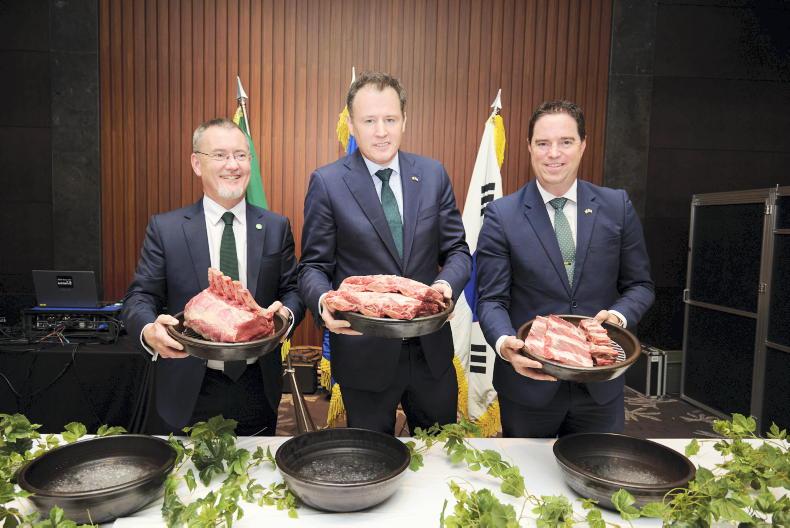
South Korea has triggered its safeguard tariff on beef imports from Australia.
This means that instead of Australian beef paying an 8% tariff on entering the country, it will now be paying a 24% tariff until the end of the year.
The safeguard is part of the trade deal between the countries and is triggered when Australian beef exports pass 192,659 tonnes (t).
This was adjusted down to 170,659t in 2025 because of a carryover of 21,547t from last year, when the safeguard was triggered in late October, according to Meat and Livestock Australia (MLA).
MLA also points out that Australian beef will now be at a competitive disadvantage with the other main supplier of South Korean beef imports - the US - which has a tariff of 2.6%.
There will be an automatic reset of tariffs and lifting of the safeguard from the beginning of the new year.
South Korean market
MLA is confident that Australian beef exports to South Korea can withstand the additional tariffs.
It points out that volumes exported are running 11% ahead (in volume) and 23% in value, while domestic production has declined.
Australian beef also enjoys strong consumer recognition and beef demand overall has benefited from increased consumer spending in the country, underpinned by government stimulus measures.
Irish beef exports to South Korea since the lifting of the ban last year remain tiny.
In the first half of 2025, Bord Bia export data shows that we exported just 221t of prime beef in addition to 3,760t of offal in the first half of this year.
The US is the biggest supplier of South Korean beef imports, accounting for 232,481t in 2024 (US Meat Exporters Federation).
After more than a decade of work, Irish Government and EU efforts finally secured approval for Irish beef exports to South Korea last year.
While this was welcomed by Irish exporters, it hasn’t been the cause of the beef price improvement experienced over the past year.
As with other exports outside the EU, there are already well-established supply chains for the almost 500,000t of beef that South Korea imports annually and these won't be displaced easily.
There will be opportunities, especially for offal, but, for prime beef, it will be a slow burn, as has been the case in Japan.
However, with US beef production running well below its long-term average, it may be possible to capture some of that business should the supply difficulty continue.
However, the main export market for Irish beef will remain the UK, followed by EU countries.



SHARING OPTIONS