



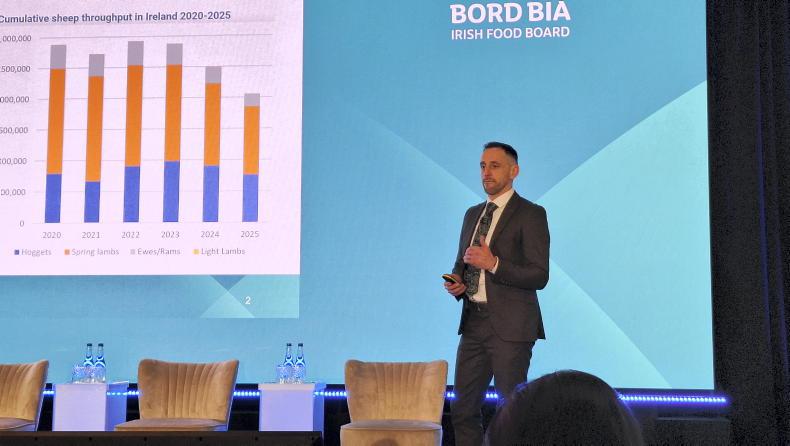
Irish sheepmeat production is expected to experience some stabilisation in 2026 following a collapse in throughput in both 2025 and 2024.
Speaking at Bord Bia’s Meat Market Seminar on Friday, sheepmeat and livestock sector manager Seamus McMenamin said that the forecast stabilisation in production levels, albeit at a low level, is stemming from some stabilisation in the national ewe flock and a higher carryover of 2025-born lambs which may support higher throughput in Q1 of 2026.
Seamus said that price sensitivity of consumers continues to be an issue, with retail insights showing consumers purchasing less lamb and beef, due to their recent higher price point, and increasing consumption of poultry and pigmeat.
However, there is some small positives expected in this regard, with consumption across Europe predicted to stabilise or reduce by a far lower level in 2026.
Lamb price
Farmgate prices are expected to follow a similar pattern as in 2025. While a growing Muslim population is bolstering demand for sheepmeat in Europe, religious festivals such as Ramadan and Eid al-Adha have not delivered anticipated price increases in recent years. The same can be said of trade surrounding Easter celebrations.
Irish sheepmeat prices have dipped below our European counterparts in recent months. The Irish price at the end of December stood at €7.44/kg, while prices in Northern Ireland averaged €7.04/kg.
This is significantly lower than the average equivalent British price of €8.15/kg, while prices in continental Europe were much higher, with French farmers receiving an average farmgate price of €9.85/kg and Spanish farmers €10.91/kg.
Seamus said that in recent years there has been a greater focus in markets such as France in supporting domestic production, with this leading to a higher differential between domestic and imported product.
He highlighted that Britain continues to import higher volumes of lower-cost sheepmeat from New Zealand and Australia and, in turn, is targeting exporting higher volumes of higher-value product to the EU market.
He said that despite much discussion of the UK diversifying its export portfolio following Brexit, over 95% of sheepmeat exports are destined for the EU market and competing head on with Irish product in key markets.
Price differential
The UK and EU market has been more attractive in the last 24 months for sheepmeat exports from New Zealand and Australia.
This was due in the main to prices in the northern hemisphere being almost double the price as in the southern hemisphere or, in monetary value, Irish and British prices were €3/kg to €4/kg higher, with some continental European markets upwards of €5/kg higher.
The differential between British and Australian prices narrowed to €2/kg (€8.15/kg v €6.12/kg) at the end of 2025, with the differential between British and New Zealand prices at over €2.50/kg (€8.15/kg v €5.42/kg).
This is reducing the competitiveness of southern hemisphere lamb in the British market and means that export volumes are likely to remain stable.
A 6% reduction in the Australian breeding flock and a forecast 6% reduction in production, along with higher culling of ewes (9%) and reduced production trending 6% lower year to date, will also influence availability of product destined for export.
That said, this is also reliant on the US market remaining vibrant and hoovering up any surplus volumes of Australian lamb.
2025 performance
The sharp collapse in throughput in 2025, which fell by 445,000 head, had a significant effect on Irish export volumes and value. Export volumes reduced by 15% to 51,000t, while the value of such exports reduced by 10% owing to increased farmgate prices for the first half of 2025.
The EU remains our key market for exports, accounting for 80% of export volumes. Trade with the UK declined further in 2025, with exports competing poorly with southern hemisphere imports.
Switzerland is our key international market and, unfortunately, Irish exports were also dented in this market by cheaper southern hemisphere product.
There are some hopes of the US market developing as a destination for sheepmeat in 2026. The US import market is dominated by Australian lamb, which Irish exports are not in a position to compete with in the commodity market. However, there is hope of Ireland carving out a niche market for higher-value cuts.



SHARING OPTIONS