



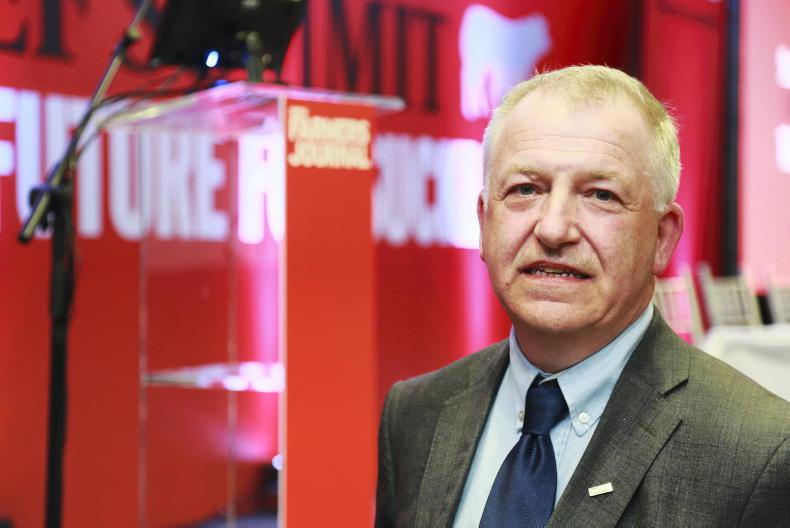
Imagine if Tim Cullinan had come out last year and said that any cuts to farmers’ CAP payments would have to be voluntary.
He would have been accused of living in cloud cuckooland. Because why would any farmers voluntarily reduce their payment? What would be in it for them? Voluntary reduction would have been laughed out of the room.
This Monday, the Food Vision 2030 Dairy Group met for the first time.
Afterwards, its chair Prof Gerry Boyle said that any measures to curb emissions emanating from the dairy sector would have to be voluntary.
So how is that meant to work? Is the expectation that a group of farmers will step forward and reduce their cow numbers so that others can maintain or even expand? That simply won’t happen.
The more demanding end of the sectoral target for farming is 30%
While dairy farmers wrestle with a narrow suite of options, the Oireachtas Committee on Climate Action has said: “The obligation to reduce total emissions by 51% is a collective target that will only be met if all sectors hit the more demanding end of their reduction targets.”
The more demanding end of the sectoral target for farming is 30%. The committee’s statement fairly blows the IFA’s “22% is the maximum we can do as well as the minimum we must do” stance out of the water.
This scenario also means the KPMG report commissioned by this newspaper gains relevance.
Scenario
Our front page in October of 2021 highlighted the scenario if a 30% cut in emissions by 2030 is enforced.
It envisaged a €4bn hit to farm output, and 56,400 farm-related jobs being lost.
Some of the people who characterised this as a doomsday scenario being presented by sectoral interests are now likely to call for that very target to be the “landing-zone”.
If reductions in dairy emissions require a reduction in cow numbers, and if that is going to be voluntary, there will have to be a cessation scheme
We’re talking about a 20% cut in the national herd, so all the rhetoric coming out of Monday’s dairy group meeting can go in the bin alongside the targets set for farming six months ago in Food Vision 2030; the very plan that led to the setting up of the working group. This is a circle that cannot be squared.
One final point. If reductions in dairy emissions require a reduction in cow numbers, and if that is going to be voluntary, there will have to be a cessation scheme.
One that pays farmers to stop milking cows.
And who will fund that scheme? It will need a hefty budget to have any significant impact. Will it be Government alone, or will co-ops and perhaps even continuing or prospective dairy farmers be asked to put money on the table?
We are entering a period of seismic change in Irish farming.


SHARING OPTIONS