


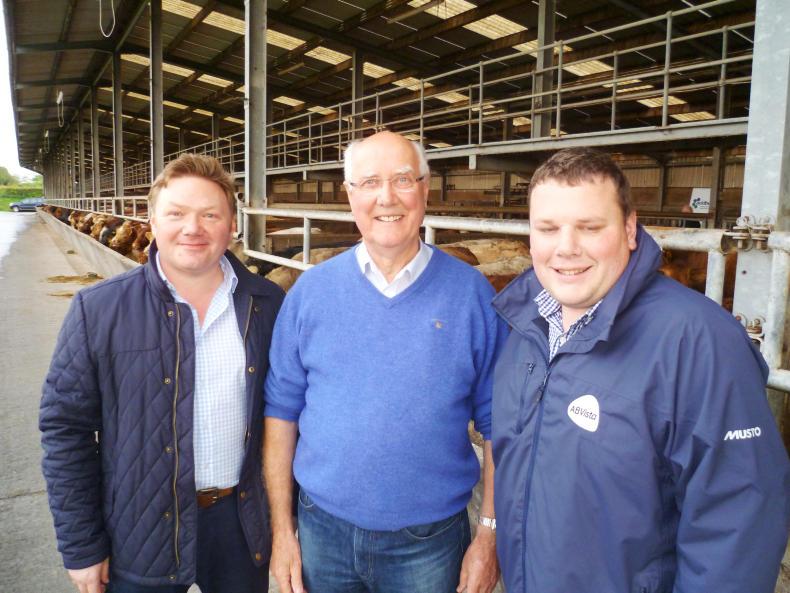
Eric Reid, the former production director with Moy Park, spent 45 years working for the company before retiring in 2010.
He was the man behind the successful fully integrated Moy Park model. It brought new thinking into local agriculture, as the company took control of production, and rewarded those farmers who met performance targets.
Since retiring Reid has got into beef production, finishing up to 500 cattle per year in a feedlot type system outside Richhill, Co Armagh.
Despite being into his 70s, he remains passionate about driving change in NI agriculture, and in particular, within beef production. While there are some good examples out there of farmers and factories working together, it is still a sector heavily reliant on direct payments, and where beef finishers take a punt every year on cattle prices remaining stable.
It is volatility in prices that Reid thinks should be taken out of the equation. “Which of you last year would have thought beef would be 370p/kg now? There is an extra £200 that you didn’t expect to get,” he pointed out to farmers visiting his unit last week.
His argument is that the £200 extra, can equally be £200 in the opposite direction. And without the safety net of direct payments, such swings in price would be unsustainable.
His challenge to the beef industry is not new – the need for an integrated model in beef production is something Reid has been saying for a number of years. Except perhaps the wider policy context has now changed, with the uncertainty caused by Brexit.
So how could something be taken forward? Reid puts the onus firmly on beef processors. As a starting point, just one processor to identify seven of eight young farmers interested in a career in finishing cattle.
Each farm erects purpose-built beef finishing accommodation for 300 to 500 cattle.
The factory could pay for the new shed (Reid argues that there would be no problem getting funding from a bank), supplies the cattle and stipulates a best-practice feeding and veterinary regime. The farmer gets rewarded for good management. The factory gets cattle when required, and to their specification. There are no arguments over price. Everything is done under contract.
Assuming it worked, the model could be widened out to include more finishers, and potentially bring in specialist sucker producers.
“The chicken industry has taken out volatility and driven efficiency. It is also being seriously addressed in the egg sector and in pigs. Why not beef? We have sheds lying empty for six months. We have factories operating with one shift and on four-day weeks. Who is paying for all that inefficiency. It has got to change. We must work together to drive efficiency,” argues Reid.
Eric Reid, along with his son Gary, farms around 130 acres, finishing up to 500 cattle per year. A specialist finishing house on the farm consists of 16 pens, capable of holding 20 in each pen.
Most of the cattle finished are young bulls bought at 320kg to 370kg. On average, they spend around seven to eight months on farm. All young bulls are slaughtered under 16 months, and once they hit a maximum liveweight of 685kg to 690kg. There are also some steers kept, which are grazed during the summer, and housed for finishing. The Reids also previously finished some heifers but got fed up with animals turning out in-calf.
Eric much prefers working with bulls given their ability to grow quickly. In general, they are fed 1kg of concentrate per 100kg of bodyweight, to a maximum of 7kg. Bulls up to 500kg receive a 18.5% high-quality (soya-based) protein concentrate. Above this weight, feed is topped up with a high energy, 13% to 14% protein ration.
Performance
To ensure performance is on target, top-quality silage is required, with three cuts taken and up to 1,800 bales made annually.
Performance is closely monitored, with housed cattle weighed every month. However, Eric has been investigating the possibility of putting in a weigh cell in each pen (at each drinker) that could capture weights on a regular basis.
He has also been working for a number of years on a method to capture animal temperatures as a way of monitoring animal health.
He initially used a temperature tag which included a probe inserted into the animal’s ear. However, that has now progressed to a bolus inserted into the rumen of each animal.
It sends a signal at a pre-determined interval (during this testing phase it is every 15 minutes). Each bolus is removed at slaughter.
Refinement and on-farm testing of the technology is still a work in progress. However, Eric is convinced the potential is significant.
He maintains that a temperature will start to rise 48 to 56 hours before definite signs of clinical illness. Catching the problem early means avoiding a significant loss of thrive. It also means cheaper (and less powerful) drugs can potentially be used. Any animal on the farm with a temperature over 39.3oc is treated.


SHARING OPTIONS