Donegal was buzzing last week in the run-up to the All-Ireland final. Green and gold flags along with green and gold fields made for an enjoyable drive up along the eastern side of the Inishowen peninsula looking out onto Lough Swilly.
It’s a beautiful part of the country and you could feel the sense of excitement talking to people about the big match at the weekend. Spare tickets as opposed to the cattle trade were the conversation opener of choice last Tuesday evening. Unfortunately for the people of Donegal Sam Maguire headed south for 2025 but I’m sure they are already looking to remedy things in 2026.
Like All-Ireland final week, the dry- stock sector is also buzzing at the moment. Good weather, beef back knocking on the door of €8/kg and record numbers of weanlings leaving the country are making 2025 look like one of the best years in the drystock game in quite a long time.
When you talk to finishers at the moment, they talk about the crippling replacement costs of stock being their biggest challenge.
There are obviously costs to keeping a suckler cow but it’s one of the benefits of a suckler system in that you have stock coming on all the time without being subjected to a store market that some are finding it hard to compete in at the moment.
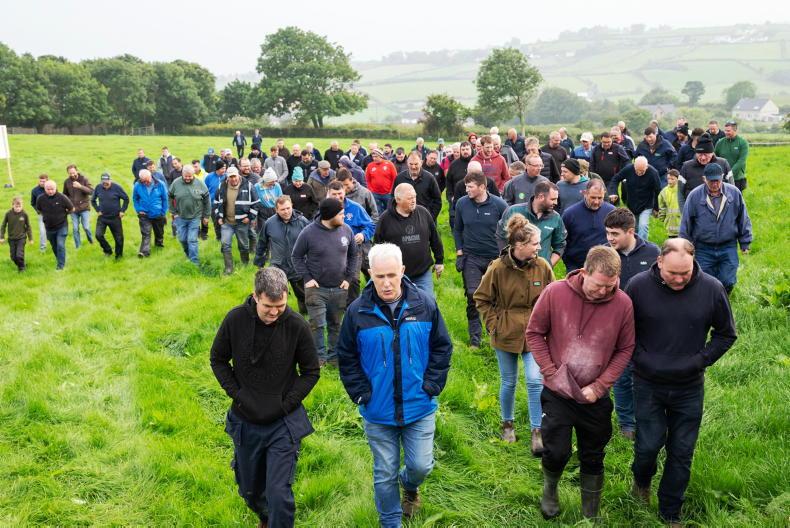
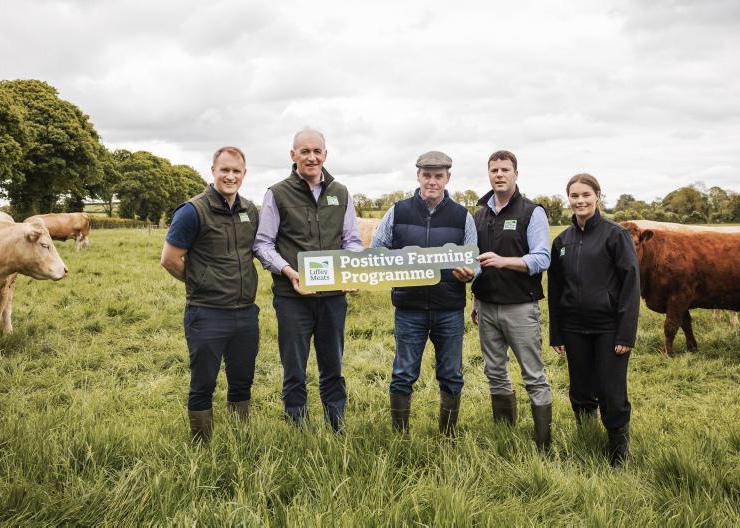
Farmers at the Teagasc Beef & Suckler Farm Walk on the farm of Thomas Hutchinson, Moville. Photo Clive Wasson
Robert and Thomas Hutchinson are farming 28Ha (70 acres) of rolling hillside just a short distance outside the Donegal town of Moville.
The area is known for its productive land and the Hutchinson farm would be described as being good free draining east Donegal land. As with all farms in the northwest, they struggle with high rain fall but in general manage to get stock out early every year.
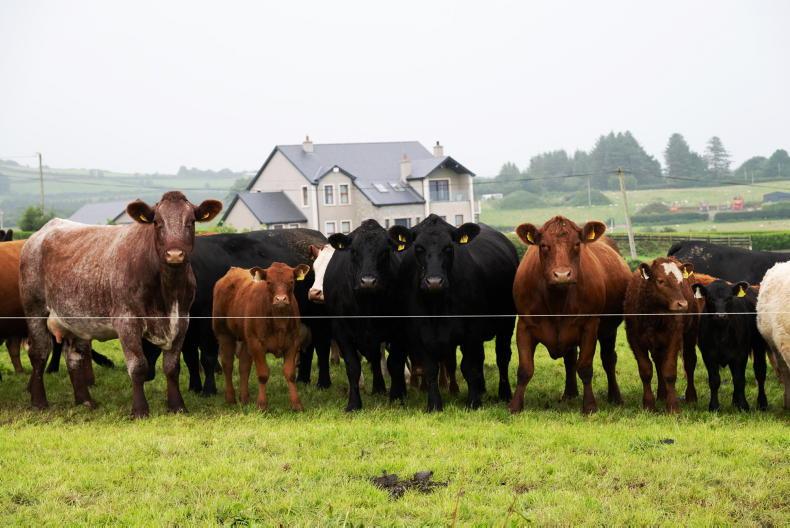
The farm is pretty much in one block divided by a small country road. Robert is at home full time while Thomas does some part time work on local farms. The farm is home to 28 suckler cows with everything brought through to beef.
Soil fertility
Soil fertility was a big focus of the night with Teagasc adviser Tommy Doherty going through in detail what is happening on the Hutchinson farm and what points farmers should be taking home with them.
Soil sampling was one of these points and Tommy explained that a lot of farmers still aren’t soil sampling regularly enough.
“It’s important that if you are going to the trouble of soil sampling that you are doing it right. That means getting a soil core about 10 cm in depth from a number of points in the field avoiding gaps and dung areas.
“Most of the phosphorus is captured in the top inch of your soil so soil sampling very wet soil and not getting down to where the roots of the grass plant are is a waste of time, in my opinion.”
Tommy went on to say that before any fertiliser comes onto a farm the pH is the first thing that farmers need to correct. The Hutchinsons are paying big attention to the pH of their soils with 95% of the farm currently above 6.1 for pH.
“I always get asked the question as to what lime is the best. The only lime that doesn’t work is the stuff that isn’t spread,” Doherty said.
Robert Hutchinson said: “I’m farming here 40 years and I’ve missed two years with lime spreading over those 40 years. I think our fertiliser works better when we keep working at the lime.”
Robert went on to explain some of the history behind the farm.
“When I came here 40 years ago my uncles were farming and they has a mixed farming system of growing vegetables along with oats and barley alongside livestock. I suppose you could call it sustainable. I don’t know whether what we are at now is sustainable but I know I make a living out of it anyway.”
There are currently 50% of the soils at Index 2 for phosphorus with another 50% at Index 3 on the farm. In terms of potassium or potash 50% of the soils on the farm are Index 2 with the other 50% Index 3. Ninety per cent of the Hutchinson farm has been soil sampled in the last five years with 14% of the farm reseeded in the last five years. The Hutchinsons have spread 60 tonnes of lime in the last three years.
The potash level in the plant will dictate how much energy from the sun the grass plant can capture.
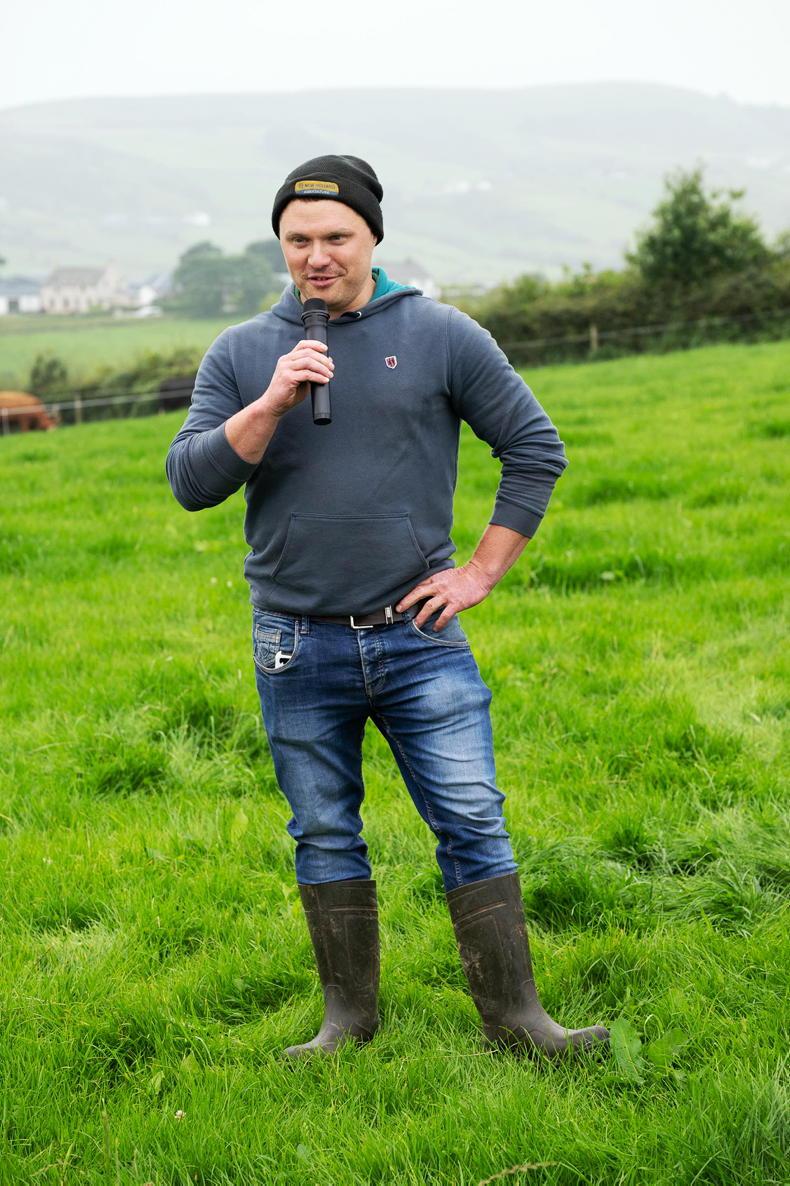
Thomas Hutchinson speaking at the Teagasc Beef & Suckler Farm Walk on his farm outside, Moville. Photo Clive Wasson
“Traditionally this area of Donegal would be low in potash and this is especially important if you’re taking heavy cuts of silage off your ground. There is no limit to spreading potash so there is no excuse for low potash levels,” Doherty said.
Breeding
The Hutchinsons have a passion for suckler cow breeding. Robert was born before any apps or herd management programmes were on the go and he carries a sheet of paper with all the cows listed, along with their sires, and the sires and dates of birth of the calves.
He has his own records to go back eight generations on any cow in the herd. The Hutchinsons are working with a mix of Limousin/Salers/Simmental and Aberdeen Angus cows, with Salers breeding dominating the breed type.
“We like the Salers for their maternal traits and they are great cows to calve a Charolais bull,” Thomas said.
All replacements are bred on the farm with no stock purchased in. The farm is currently practicing 100% AI. Some questions were asked on the night around getting cows in for AI.
It doesn’t faze Robert. He says the cows get used to coming into the yard and they know the drill. Getting across the road is a bit of a challenge at times but it all works out.
“There’s an odd Sunday morning when you would be cursing it but I think we have better quality with the AI to be honest,” Thomas said.
The farm has an impressive set of breeding performance figures. The herd’s calving interval currently stands at 369 days with 0% mortality at birth and 0% at 28 days.
The calves per cow per year figure is at 0.99 calf/cow/year with everything pointing to a herd well managed with the breeding programme working. Seventy-one per cent of the heifers in the herd calve between 22 and 26 months.
Cows calved over a five-month period with the majority (66%) calving in March and April. Bullocks are finished at 25.6 months at an average carcase weight of 395kg (R+3=) while any heifers not kept for breeding are either sold live or finished.
The Hutchinsons are quite ruthless when it comes to culling and always keep extra heifers to make sure they have enough to replace any culls.
“Any cow that we have a problem with doesn’t get a chance and she’s culled and sold. I always find you have enough of this year’s problems to deal with without bringing problems from last year as well,” Thomas said.
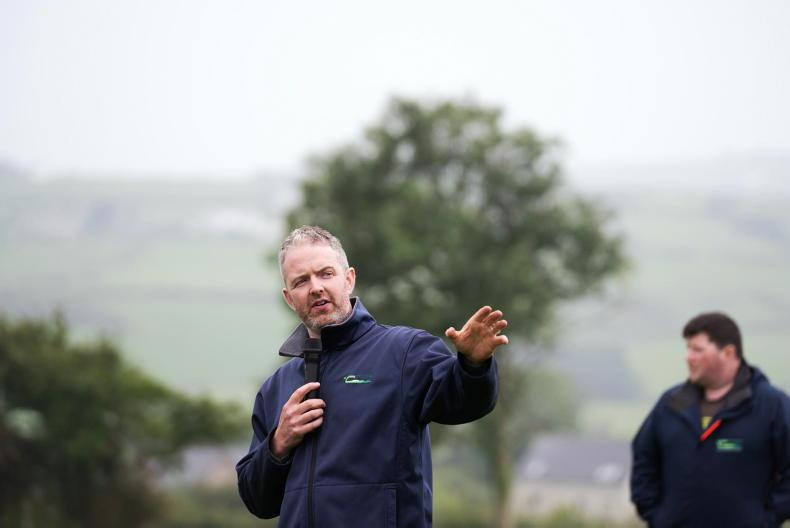
Tommy Doherty, Teagasc speaking at the Teagasc Beef & Suckler Farm Walk on the farm of Thomas Hutchinson, Moville. Photo Clive Wasson
David Tierney from Carn Vets, the local vet practice, gave a talk on antibiotic and antiparasitic resistance on farms and explained the importance of faecal sampling in the fight against resistance.
He also added that he had seen an increased amount of lungworm infections in recent weeks and for farmers to be vigilant for it. He talked about planning dosing tasks more taking into account the animal type which is being dosed, the parasite to be controlled and the product that is being used.
The Hutchinson farm walk was a great example of doing the simple jobs well on a suckler farm and how looking after the smaller things like soil fertility and cow fertility can have positive impacts on a farm system.
Farm size is very typical of many suckler and sheep farms with nothing special being done, just everything done right.
One of the take-home messages or thoughts for me for the night was the amount of positivity that was in the 100 strong crowd that turned up on the night.
Sucklers aren’t a bad word anymore with a genuine interest in driving on and making positive changes to their suckler farm amongst the farmers attending the walk.
Another notable change was the number of young people that attended the walk, I know it’s school holidays but young people taking the time out to spend three hours talking about sucklers has to be positive.
Top quotes
“Any cow that we have a problem with doesn’t get a chance and she’s culled and sold. I always find you have enough of this year’s problems to deal with without bringing problems from last year as well.”
Thomas Hutchinson, farm walk host.
“We would be very fond of spreading lime on this farm and we would generally spread 20-30 tonne every year working our way around the farm. I think I would rather spend money on lime than fertiliser to be honest. We get great results from it.”
Robert Hutchinson, farm walk host.
“ICBF come in for a lot of flak at times but in fairness if you look at the figures in this herd the five star cows are performing. You will always have one or two cows that will buck the trend but in the main the figures don’t lie.”
Tommy Doherty, Teagasc adviser.
“We need to be increasingly careful around the products we are using on farms, including antibiotic usage and dosing products. Resistance is a problem and it will become a bigger problem unless we change usage practices on farms.”
David Tierney, Carn Vets.
“I always get asked the question as to what lime is the best. The only lime that doesn’t work is the stuff that isn’t spread.”
Tommy Doherty, Teagasc adviser.
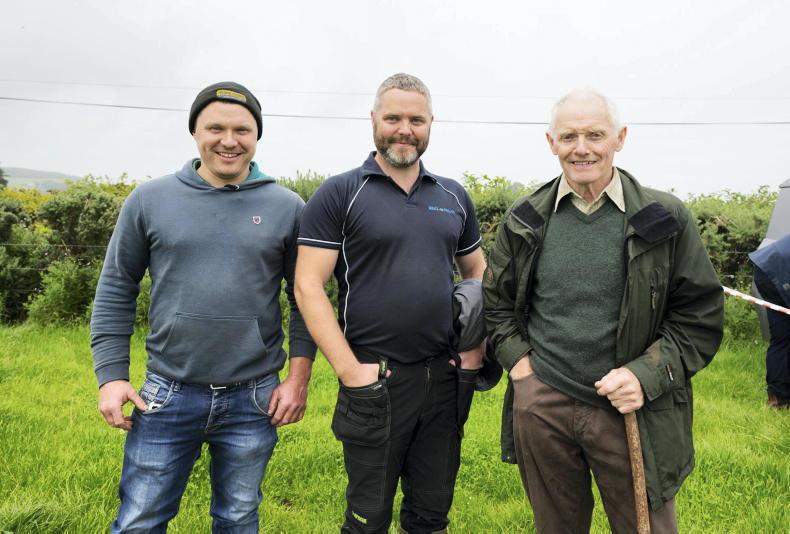
Thomas Hutchinson, Eddie Hutchinson and Robert Hutchinson at the Teagasc Beef & Suckler Farm Walk on the farm of Thomas Hutchinson, Moville. Photo Clive Wasson
Farm Facts
Name: Robert and Thomas Hutchinson, Moville, Co Donegal.Farm system: Suckler to beef and mid season lambing ewes.Farm size: 28Ha.Cow number: 28. Ewe numbers: 80.Cow breeds: Limousin/Salers/Simmental/Aberdeen Angus.Ewe breeds: Texel x Suffolk (Charollais ram).
Donegal was buzzing last week in the run-up to the All-Ireland final. Green and gold flags along with green and gold fields made for an enjoyable drive up along the eastern side of the Inishowen peninsula looking out onto Lough Swilly.
It’s a beautiful part of the country and you could feel the sense of excitement talking to people about the big match at the weekend. Spare tickets as opposed to the cattle trade were the conversation opener of choice last Tuesday evening. Unfortunately for the people of Donegal Sam Maguire headed south for 2025 but I’m sure they are already looking to remedy things in 2026.
Like All-Ireland final week, the dry- stock sector is also buzzing at the moment. Good weather, beef back knocking on the door of €8/kg and record numbers of weanlings leaving the country are making 2025 look like one of the best years in the drystock game in quite a long time.
When you talk to finishers at the moment, they talk about the crippling replacement costs of stock being their biggest challenge.
There are obviously costs to keeping a suckler cow but it’s one of the benefits of a suckler system in that you have stock coming on all the time without being subjected to a store market that some are finding it hard to compete in at the moment.

Farmers at the Teagasc Beef & Suckler Farm Walk on the farm of Thomas Hutchinson, Moville. Photo Clive Wasson
Robert and Thomas Hutchinson are farming 28Ha (70 acres) of rolling hillside just a short distance outside the Donegal town of Moville.
The area is known for its productive land and the Hutchinson farm would be described as being good free draining east Donegal land. As with all farms in the northwest, they struggle with high rain fall but in general manage to get stock out early every year.
The farm is pretty much in one block divided by a small country road. Robert is at home full time while Thomas does some part time work on local farms. The farm is home to 28 suckler cows with everything brought through to beef.
Soil fertility
Soil fertility was a big focus of the night with Teagasc adviser Tommy Doherty going through in detail what is happening on the Hutchinson farm and what points farmers should be taking home with them.
Soil sampling was one of these points and Tommy explained that a lot of farmers still aren’t soil sampling regularly enough.
“It’s important that if you are going to the trouble of soil sampling that you are doing it right. That means getting a soil core about 10 cm in depth from a number of points in the field avoiding gaps and dung areas.
“Most of the phosphorus is captured in the top inch of your soil so soil sampling very wet soil and not getting down to where the roots of the grass plant are is a waste of time, in my opinion.”
Tommy went on to say that before any fertiliser comes onto a farm the pH is the first thing that farmers need to correct. The Hutchinsons are paying big attention to the pH of their soils with 95% of the farm currently above 6.1 for pH.
“I always get asked the question as to what lime is the best. The only lime that doesn’t work is the stuff that isn’t spread,” Doherty said.
Robert Hutchinson said: “I’m farming here 40 years and I’ve missed two years with lime spreading over those 40 years. I think our fertiliser works better when we keep working at the lime.”
Robert went on to explain some of the history behind the farm.
“When I came here 40 years ago my uncles were farming and they has a mixed farming system of growing vegetables along with oats and barley alongside livestock. I suppose you could call it sustainable. I don’t know whether what we are at now is sustainable but I know I make a living out of it anyway.”
There are currently 50% of the soils at Index 2 for phosphorus with another 50% at Index 3 on the farm. In terms of potassium or potash 50% of the soils on the farm are Index 2 with the other 50% Index 3. Ninety per cent of the Hutchinson farm has been soil sampled in the last five years with 14% of the farm reseeded in the last five years. The Hutchinsons have spread 60 tonnes of lime in the last three years.
The potash level in the plant will dictate how much energy from the sun the grass plant can capture.

Thomas Hutchinson speaking at the Teagasc Beef & Suckler Farm Walk on his farm outside, Moville. Photo Clive Wasson
“Traditionally this area of Donegal would be low in potash and this is especially important if you’re taking heavy cuts of silage off your ground. There is no limit to spreading potash so there is no excuse for low potash levels,” Doherty said.
Breeding
The Hutchinsons have a passion for suckler cow breeding. Robert was born before any apps or herd management programmes were on the go and he carries a sheet of paper with all the cows listed, along with their sires, and the sires and dates of birth of the calves.
He has his own records to go back eight generations on any cow in the herd. The Hutchinsons are working with a mix of Limousin/Salers/Simmental and Aberdeen Angus cows, with Salers breeding dominating the breed type.
“We like the Salers for their maternal traits and they are great cows to calve a Charolais bull,” Thomas said.
All replacements are bred on the farm with no stock purchased in. The farm is currently practicing 100% AI. Some questions were asked on the night around getting cows in for AI.
It doesn’t faze Robert. He says the cows get used to coming into the yard and they know the drill. Getting across the road is a bit of a challenge at times but it all works out.
“There’s an odd Sunday morning when you would be cursing it but I think we have better quality with the AI to be honest,” Thomas said.
The farm has an impressive set of breeding performance figures. The herd’s calving interval currently stands at 369 days with 0% mortality at birth and 0% at 28 days.
The calves per cow per year figure is at 0.99 calf/cow/year with everything pointing to a herd well managed with the breeding programme working. Seventy-one per cent of the heifers in the herd calve between 22 and 26 months.
Cows calved over a five-month period with the majority (66%) calving in March and April. Bullocks are finished at 25.6 months at an average carcase weight of 395kg (R+3=) while any heifers not kept for breeding are either sold live or finished.
The Hutchinsons are quite ruthless when it comes to culling and always keep extra heifers to make sure they have enough to replace any culls.
“Any cow that we have a problem with doesn’t get a chance and she’s culled and sold. I always find you have enough of this year’s problems to deal with without bringing problems from last year as well,” Thomas said.

Tommy Doherty, Teagasc speaking at the Teagasc Beef & Suckler Farm Walk on the farm of Thomas Hutchinson, Moville. Photo Clive Wasson
David Tierney from Carn Vets, the local vet practice, gave a talk on antibiotic and antiparasitic resistance on farms and explained the importance of faecal sampling in the fight against resistance.
He also added that he had seen an increased amount of lungworm infections in recent weeks and for farmers to be vigilant for it. He talked about planning dosing tasks more taking into account the animal type which is being dosed, the parasite to be controlled and the product that is being used.
The Hutchinson farm walk was a great example of doing the simple jobs well on a suckler farm and how looking after the smaller things like soil fertility and cow fertility can have positive impacts on a farm system.
Farm size is very typical of many suckler and sheep farms with nothing special being done, just everything done right.
One of the take-home messages or thoughts for me for the night was the amount of positivity that was in the 100 strong crowd that turned up on the night.
Sucklers aren’t a bad word anymore with a genuine interest in driving on and making positive changes to their suckler farm amongst the farmers attending the walk.
Another notable change was the number of young people that attended the walk, I know it’s school holidays but young people taking the time out to spend three hours talking about sucklers has to be positive.
Top quotes
“Any cow that we have a problem with doesn’t get a chance and she’s culled and sold. I always find you have enough of this year’s problems to deal with without bringing problems from last year as well.”
Thomas Hutchinson, farm walk host.
“We would be very fond of spreading lime on this farm and we would generally spread 20-30 tonne every year working our way around the farm. I think I would rather spend money on lime than fertiliser to be honest. We get great results from it.”
Robert Hutchinson, farm walk host.
“ICBF come in for a lot of flak at times but in fairness if you look at the figures in this herd the five star cows are performing. You will always have one or two cows that will buck the trend but in the main the figures don’t lie.”
Tommy Doherty, Teagasc adviser.
“We need to be increasingly careful around the products we are using on farms, including antibiotic usage and dosing products. Resistance is a problem and it will become a bigger problem unless we change usage practices on farms.”
David Tierney, Carn Vets.
“I always get asked the question as to what lime is the best. The only lime that doesn’t work is the stuff that isn’t spread.”
Tommy Doherty, Teagasc adviser.

Thomas Hutchinson, Eddie Hutchinson and Robert Hutchinson at the Teagasc Beef & Suckler Farm Walk on the farm of Thomas Hutchinson, Moville. Photo Clive Wasson
Farm Facts
Name: Robert and Thomas Hutchinson, Moville, Co Donegal.Farm system: Suckler to beef and mid season lambing ewes.Farm size: 28Ha.Cow number: 28. Ewe numbers: 80.Cow breeds: Limousin/Salers/Simmental/Aberdeen Angus.Ewe breeds: Texel x Suffolk (Charollais ram).
SHARING OPTIONS