



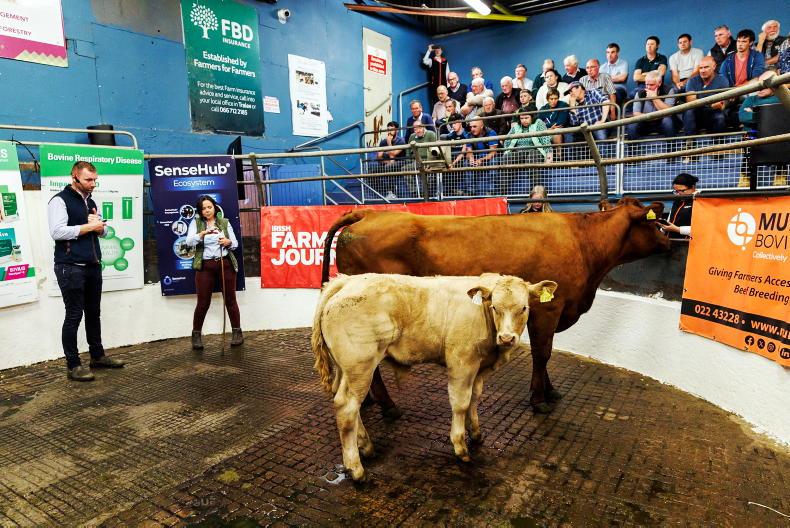
The Irish Farmers Journal held two autumn mart series events in Ballinasloe Mart and Castleisland Mart last week, supported by MSD Animal Health, Munster Bovine, XL Vets and FBD Insurance. Almost 300 farmers attended the events and it was clear that optimism in suckler farming is being buoyed by the sharp upward trajectory in prices since the end of 2025.
While it is unlikely to trigger a reversal of the recent decline in suckler cow numbers, the hope is that it will help stem the decline and steady numbers at current levels. Both Eilish Curley, mart manager in Ballinasloe, and Nelius McAuliffe, mart manager in Castleisland, report renewed interest in suckler breeding sales and for heifers suitable for breeding.
Castleisland held a special suckler sale a couple of days in advance of the event. Prices for in-calf heifers averaged in excess of €3,500. Some heifers with dairy breeding in their background sold under the €3,000 mark, but a significant number of heifers with beef breeding in their background sold in excess of €4,000, with a handful topping €5,000 and reaching a top of €5,800.
Nelius said that the combination of a positive cull cow value and higher weanling value is giving farmers looking to source sucklers extra purchasing power.
Focus on quality
The Irish Farmers Journal’s Martin Merrick and Rose Goulding, beef program manager at the National Cattle Breeding Centre, conducted entertaining livestock demos with farmers presenting excellent-quality cattle at both events.
Martin commented that many farmers who have reduced numbers are focusing more on the quality of progeny being produced, with an increase in specialist in-calf heifer producers also very evident in the last two years.
This ties in with a vibrant show scene, with top-end heifers grabbing the headlines due to high prices being paid.
Rose cautioned farmers that the high prices can look very appealing, but explained that many operators are very specialised at this production system.
She said the key to profitable suckler farming for the majority of farmers is ensuring cows produce a live cow every year.
This does not mean that quality has to take a back seat, rather that breeding decisions are taken to enhance quality, while still ensuring that calving ease is kept within an acceptable level.
Farmer experience
This is where farmer experience comes in to play. Rose said that farmers are in a good position to make informed breeding decisions, but advised them to avail of valuable assistance available.
AI technicians were highlighted as possessing a huge level of knowledge of how different sires are performing and are happy to work with farmers. She added that the Irish Cattle Breeding Federation (ICBF) suckler reports are a valuable tool highlighting the genetic report available to HerdPlus members, as a good starting point when using sires which carry myostatin genes and when coupled with female carriers may result in harder calving’s.
In terms of calving difficulty, there is a calving difficulty index for heifers and for cows. Where the calving ability of an animal is unknown then it is important to air on the side of caution and select an easy calving sire with a high reliability figure.
This is especially important for heifers and can range from 3% to 5% for some herds and breed types (eg. dairy crosses) to 7% with high reliability where heifers or first calvers are well grown / matured.
New sires with low reliability figures can be used to good effect on cows with a few calvings under their belt. It was also pointed out that hard calvings do not necessarily mean increased quality progeny with AI stations, such as Munster Bovine, working hard in sourcing sires with good beef production characteristics and calving ease.
There is also a trend emerging of polled bulls becoming more popular and this is a trend that is predicted to continue with demand said to be growing. This is similar with sexed semen although its use is to a much greater degree in dairy herds but growing from a low base in sucklers.
Review stock values
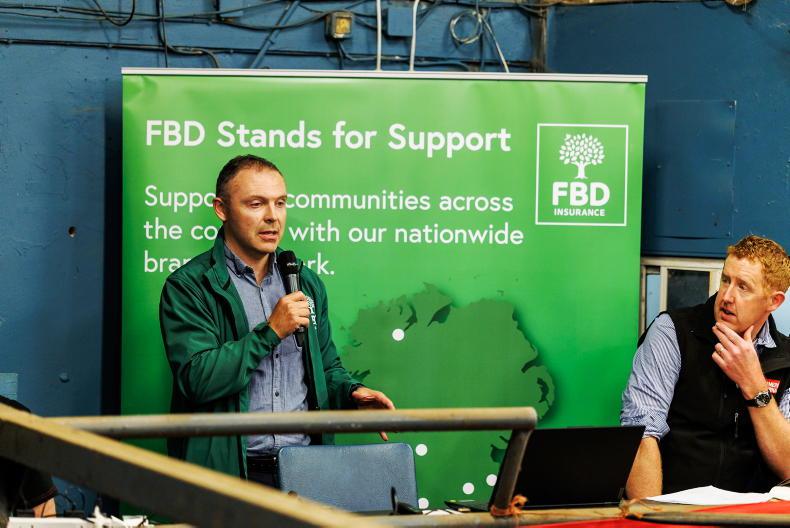
John McGlynn, FBD Insurance, told farmers in Castleisland Mart that it is important to ensure that their level of insurance accurately reflects current stock values.
In some cases, the value of stock has increased by in excess of 50% and John says it is too late to make adjustments when the horse has bolted in the case of insurance being called upon.
He advised farmers renewing their insurance to carefully look at their renewal, with the value of buildings and machinery also increasing significantly in recent years.
He said that an hour’s work in reviewing the contents of the insurance protection is time well spent.
Where farmers feel that the level of protection is not reflective of the actual value then they do not need to wait until the renewal date and can review it at any time.
He added that in most cases, the cost to increase to level of protection will not be high relative to the increase in level of protection attained.



SHARING OPTIONS