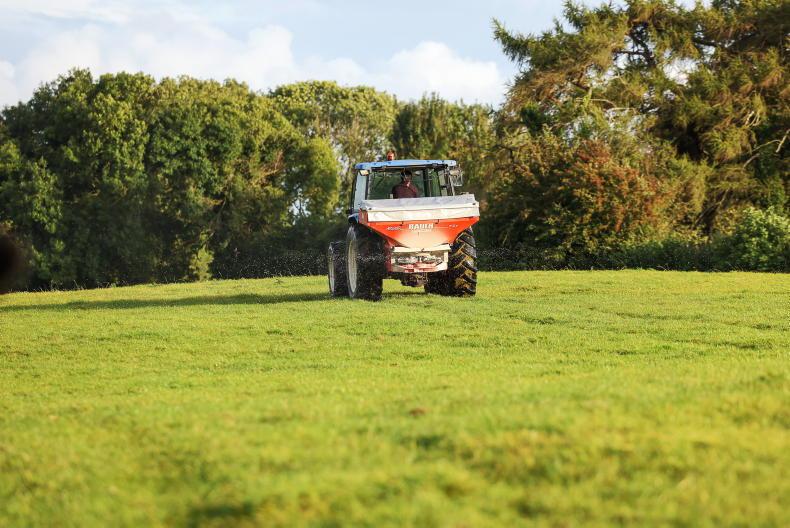
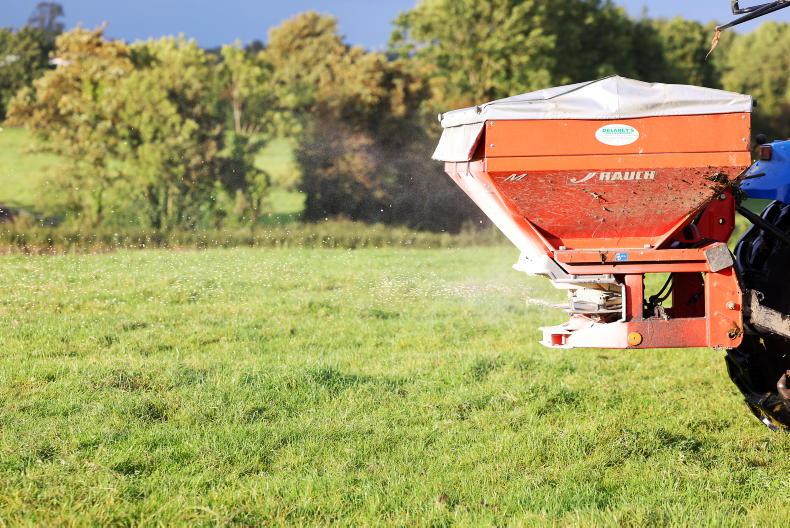
Nitrogen fertiliser can provide a boost to spring grass growth, allowing for more cattle to be turned out earlier. Soil temperature needs to be at least 5°C before there is an adequate response to it and the date at which this occurs can differ from year to year.
In good growing conditions, 1kg of N has the ability to grow 10kg to 15kg of grass dry matter (DM) during February, while in other years, there can be little or no grass growth response to the N due to prolonged cold weather into March. The general recommendation has been to apply nitrogen fertiliser six weeks before your expected turnout date. With farms that are moving towards turning out smaller groups of cattle at intervals and starting with an earlier turnout date, this recommendation no longer applies and a more targeted approach is needed.
Paddocks or fields that have heavy covers of grass built up on them (10cm+) from the previous autumn and over the winter should be grazed before applying N. Paddocks with little or no grass covers should receive cattle slurry first and N at a later date. These will be the last to be grazed in the first rotation.
Target your earliest N applications on the paddocks and fields that have the greatest production potential –predominately ryegrass swards – with 5cm to 8cm of grass that have good fertility (P, K and lime)
Apply no more than 23 units N per acre for the first application.
Wait until soil temperatures are at least 5°C and rising.
Urea is cheaper per kg N than CAN and should be used in spring applications wherever possible to reduce costs.
ADVERTISEMENT
The amount of N that should be spread for first cut silage will depend on a number of factors:
Where slurry is applied first, the requirement can be reduced by nine units N per 1,000 gallons spread per acre, eg 24 units N less when 2,500 to 3,000 gallons are spread.
The amount of ryegrass in the sward to respond to N. Old pastures with low levels of perennial ryegrass should receive a maximum of 80 units (from both slurry and N fertiliser).
New reseeds will give a response up to 100 units per acre.
Most fields should be targeted to receive 90 units in total.
Where fields have received N in the weeks coming up to closing for first cut silage, one-third of this N is still assumed to be available and this should also be taken off the requirement.
This article is an excerpt from Grazing Guide which was published jointly by Irish Farmers Journal and Teagasc.
Read more
To read the more of the ‘Grazing Guide’ click
Register for free to read this story and our free stories.
This content is available to digital subscribers and loyalty code users only. Sign in to your account, use the code or subscribe to get unlimited access.
The reader loyalty code gives you full access to the site from when you enter it until the following Wednesday at 9pm. Find your unique code on the back page of Irish Country Living every week.
CODE ACCEPTED
You have full access to the site until next Wednesday at 9pm.
CODE NOT VALID
Please try again or contact support.
Nitrogen fertiliser can provide a boost to spring grass growth, allowing for more cattle to be turned out earlier. Soil temperature needs to be at least 5°C before there is an adequate response to it and the date at which this occurs can differ from year to year.
In good growing conditions, 1kg of N has the ability to grow 10kg to 15kg of grass dry matter (DM) during February, while in other years, there can be little or no grass growth response to the N due to prolonged cold weather into March. The general recommendation has been to apply nitrogen fertiliser six weeks before your expected turnout date. With farms that are moving towards turning out smaller groups of cattle at intervals and starting with an earlier turnout date, this recommendation no longer applies and a more targeted approach is needed.
Paddocks or fields that have heavy covers of grass built up on them (10cm+) from the previous autumn and over the winter should be grazed before applying N. Paddocks with little or no grass covers should receive cattle slurry first and N at a later date. These will be the last to be grazed in the first rotation.
Target your earliest N applications on the paddocks and fields that have the greatest production potential –predominately ryegrass swards – with 5cm to 8cm of grass that have good fertility (P, K and lime)
Apply no more than 23 units N per acre for the first application.
Wait until soil temperatures are at least 5°C and rising.
Urea is cheaper per kg N than CAN and should be used in spring applications wherever possible to reduce costs.
The amount of N that should be spread for first cut silage will depend on a number of factors:
Where slurry is applied first, the requirement can be reduced by nine units N per 1,000 gallons spread per acre, eg 24 units N less when 2,500 to 3,000 gallons are spread.
The amount of ryegrass in the sward to respond to N. Old pastures with low levels of perennial ryegrass should receive a maximum of 80 units (from both slurry and N fertiliser).
New reseeds will give a response up to 100 units per acre.
Most fields should be targeted to receive 90 units in total.
Where fields have received N in the weeks coming up to closing for first cut silage, one-third of this N is still assumed to be available and this should also be taken off the requirement.
This article is an excerpt from Grazing Guide which was published jointly by Irish Farmers Journal and Teagasc.
If you would like to speak to a member of our team, please call us on 01-4199525.
Link sent to your email address
We have sent an email to your address. Please click on the link in this email to reset your password. If you can't find it in your inbox, please check your spam folder. If you can't find the email, please call us on 01-4199525.
ENTER YOUR LOYALTY CODE:
The reader loyalty code gives you full access to the site from when you enter it until the following Wednesday at 9pm. Find your unique code on the back page of Irish Country Living every week.
SHARING OPTIONS