Mid-December is a good time to take soil samples on grazing and silage ground. On most farms, cattle will have been housed around six to eight weeks ago.
This means grassland will be well rested and samples taken over the next fortnight will not give a false reading from livestock manure, or slurry applied before the closed period.
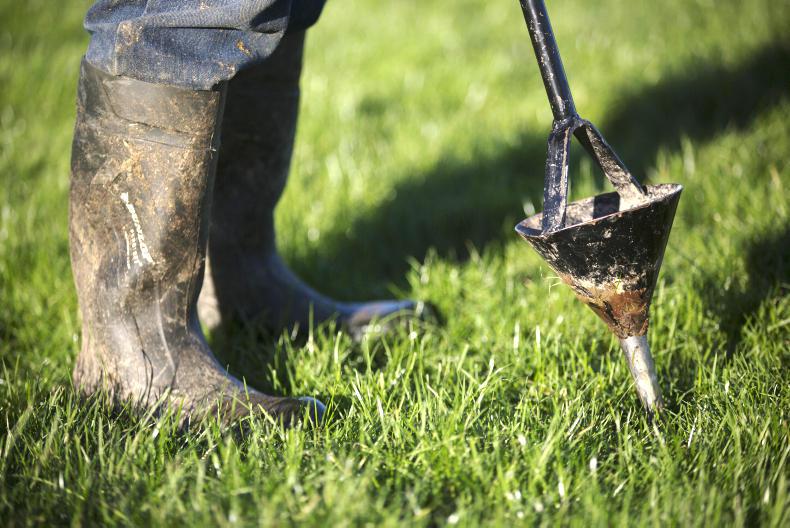
When taking soil samples, take cores every 10 to 15 steps as you walk across a field. Walking in a zig zag, or random direction, will give a better reflection of the field compared to a straight line.
If you do not have a soil corer, use a spade to take a sample from the top two to three inches of clay. Place all soil cores in a bucket as you walk the field.
When finished, mix the soil cores up and fill a plastic bag that can be properly sealed, then label it with the field name.
As a rule, the maximum sample area should be 10ac. So for larger fields, you will need to take multiple samples from the same field.
For smaller fields of one to two acres, you can double these up as a single sample, provided soils are similar and the swards get the same fertiliser treatments each year.
Once you get soil results back, you can target slurry, along with P and K, to the less fertile swards in early spring to kick start grass growth.
Soil sampling will also indicate if pH levels are low and lime is required in spring.
Read more
In pictures: bullocks the main attraction in Kilmallock
BDGP payments roll out to farmers
Mid-December is a good time to take soil samples on grazing and silage ground. On most farms, cattle will have been housed around six to eight weeks ago.
This means grassland will be well rested and samples taken over the next fortnight will not give a false reading from livestock manure, or slurry applied before the closed period.
When taking soil samples, take cores every 10 to 15 steps as you walk across a field. Walking in a zig zag, or random direction, will give a better reflection of the field compared to a straight line.
If you do not have a soil corer, use a spade to take a sample from the top two to three inches of clay. Place all soil cores in a bucket as you walk the field.
When finished, mix the soil cores up and fill a plastic bag that can be properly sealed, then label it with the field name.
As a rule, the maximum sample area should be 10ac. So for larger fields, you will need to take multiple samples from the same field.
For smaller fields of one to two acres, you can double these up as a single sample, provided soils are similar and the swards get the same fertiliser treatments each year.
Once you get soil results back, you can target slurry, along with P and K, to the less fertile swards in early spring to kick start grass growth.
Soil sampling will also indicate if pH levels are low and lime is required in spring.
Read more
In pictures: bullocks the main attraction in Kilmallock
BDGP payments roll out to farmers






SHARING OPTIONS