



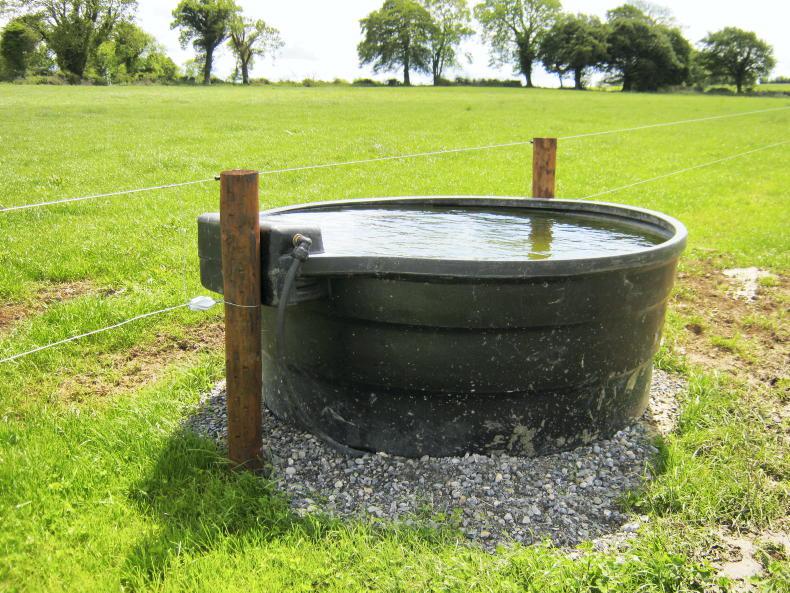
Water supply: The recent warm weather can have serious negative effects on stock where there is insufficient shade and water available.
Regarding water, (other than dairy cows), a good rule of thumb is that for every 100kg of liveweight, an animal will drink approximately 15 litres water/day.
For lactating ewes with lambs, this will result in a water intake of 9-10 litres.
For drystock, a reduced rate of 7 litres/LU can be used to calculate trough requirements eg, for 25 suckler cows and 25 calves:
25 cows @ 1.0 LU= 175 litres
+
25 calves @ 0.4 LU = 70 litres
Total: 245 litres/53.89 gallons.
Wells should not be in any danger of drying out due to the recent rainfall and short nature of this current heat wave, but narrow bore wells with a reduced reservoir of water should be monitored at peak water usage times all the same.
Where any issue has been observed above regarding insufficient pressure, trough size, pipe diameter etc, it is unlikely that this can be rectified quickly. In this instance, setting up a second trough fed off of IBC tanks will go some way towards helping to ease the pressure on the system.
Summer mastitis: The warmer weather of late has increased fly activity which consequently increases summer mastitis risk. Summer mastitis is less common in spring-calving cows as the calf is sucking the cow regularly, but it can occur in late-calving cows where calves are unable to suck all four quarters and mastitis develops, while weaned autumn calving cows and maiden heifers are most affected. Particularly high-risk areas are those with trees, close to water or that have plenty of shelter from hedges, as this will attract flies. Prevention is better than cure and a variety of preventative steps can be taken. Treating cows with a pour on insecticide can help prevent fly activity, but the cover period varies with different products so frequent re application may be required. Applying tar to the teats and udders can work, but that’s less practical as it needs to be reapplied every three to four days. Some farmers have success with garlic licks and fly repellent tags, or a combination of the above can work well.
Managing reseeds: May reseeds will have been grazed of late or are now fit to graze. Pre emergence spray should ideally have been applied to reseeds six weeks post-sowing, though this may have proved difficult with June weather. A general recommendation is to allow cover to creep up to circa 1,300kg DM/ha for the first grazing to ensure there is sufficient root structure, dropping to 1,100kg DM/ha for subsequent grazings to promote tillering and clover establishment.
A good way to test to ensure sufficient root structure is in place is simply gripping a fistful of grass and pulling, replicating a cow’s tongue wrapping around it. The base of the plant should remain in situ. Grazing with lighter stock is preferred, ideally sheep, with swards grazed tightly.




SHARING OPTIONS