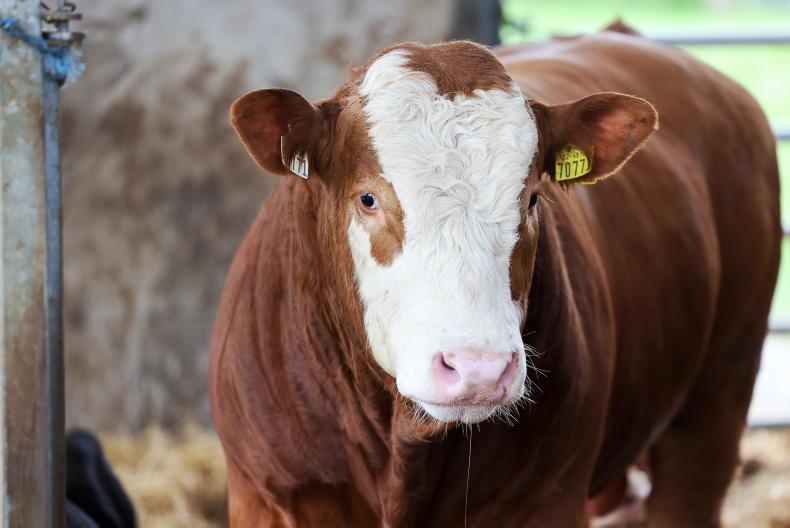
It is decision time on how best to bring the 2026-born batch of young bulls on Tullamore Farm to market.
The farm has traditionally finished young bulls in an under-16-month finishing system, with this route selected for all bar 2024-born bulls, when the 20 heaviest bulls were sold live in November of that year.
Ironically, this was one of only a couple of years since the project started in which there would have been a significant benefit in bringing bulls through to finish, given an unforeseen sharp increase in beef price – and herein lies the problem.
Finishers are at the mercy of the market, and while costs in the system can, generally, be predicted, the risk has never been higher, with increased animal values and rising input costs tying up a big investment, for no guarantee of a return.
Recent decisions
There was a split decision for the 2025-born batch of bulls, with the 20 heaviest bulls finished. A batch of eight lighter bulls, which would have accumulated greater costs in finishing, sold live in spring.
The decision was justified, with the heavier bulls covering their costs and leaving a small margin over finishing costs.
It is for the reasons outlined above that the production system on the farm has veered more towards the use of sexed semen, with the finances of selling in-calf heifers infinitely better than finishing bulls. Sexed semen has also allowed farm manager Shaun Diver to concentrate on using maternal sires through the use of sexed semen, as well as sires with better terminal traits outside of this, with a view to having progeny more suitable to be marketed as weanlings or forward bulls. This is an area that will be further explored in 2027.
The use of sexed semen has reduced the number of bulls available for sale: from 35 to 40 plus bulls in the early years of the project, to 28 bulls sold from the 2025 calf crop and 26 bulls present in 2026. Table 1 details the current position of bulls.
Finishing options
Shaun is weighing up options for the 18 to 20 heaviest bulls. A decision has already been made to retain the remaining six lighter bulls. The option to castrate these and sell as bullocks for grass next spring – with the exception of the lightest bull on the batch – is also available. That outlier is a bull who has failed to thrive due to pneumonia as a calf.
The 20 heaviest bulls are averaging 375kg. Looking at MartBids analysis for last week, the average price for bulls weighing 400kg to 450kg was €4.27/kg, with the top third averaging €4.89/kg.
The few heavier bulls in the batch are, probably, veering towards the top third average, and €4.70/kg can be taken as a good ball-park figure.
The average price for bulls weighing from 300kg to 400kg was€4.59/kg, with the top third averaging €5.40/kg.
The bulls are of good quality, but their colour may go against a few of them, and an average price of €4.90/kg could be closer to the mark in their case.
Starting value
Therefore – for the purposes of doing a budget to inform a decision on whether to finish or sell – an average price of €4.80/kg has been taken.
That leaves the value of bulls, at the outset, at €1,800 per head.
The feeding period taken for the calculations is approximately six months or 180 days, giving an average finishing date of 20 May.
That has typically been the case in recent years, with bulls slaughtered as they approach the 16-month age limit cut-off. The typical finishing system practised in recent years has seen bulls retained on ad-lib, high-quality silage until 1 February, along with 5kg concentrates fed daily, on average, over that period.
Bulls are currently receiving 3.5kg concentrates daily, and this will be stepped up over the next month to about 5kg, with bulls built up to 6kg before transitioning onto ad-lib concentrates from February onwards.
Concentrates being fed, currently, are costing in the region of €360/t, but a price of €380/t has been factored in to allow for a predicted increase in concentrate price in the coming months.
The total volume of concentrates fed is in the region of 1.65t, which is also, broadly, in line with recent years for this feeding period.
A €20/t shift in concentrates adds or deducts about €34 from the bottom line and, on a 390kg carcase, adds almost 9c/kg more to the breakeven finishing price required. Silage intake will average in the region of 2t to 2.2t during this period.
Once on ad-lib concentrates, silage will be phased out of the diet and replaced with straw. The budget allows an average of almost one bale of straw for each animal.
Health and slaughter costs
At this stage, bulls have received a comprehensive health programme, including vaccination for pneumonia, worm treatment etc.
The only real cost to add is treatment for lice and possibly another worm dose based on the results of faecal egg counts, but it is likely that there will be a bull which gets hurt or requires veterinary treatment, and as such a cost of €8/head is built into the system.
There is no mortality figure built into the system. The farm has been lucky enough in recent years to lose no animals, and while bulls have been hurt from time to time, they have been brought to slaughter, albeit at a later date than comrades.
Haulage costs have increased on the back of higher fuel prices, and a charge of €40/bull is factored in for haulage and slaughter fees. Fixed costs of €100 are built in to the budget. Some may argue that is high, but there is also no labour cost or margin included.
The bulls finished in the last couple of cycles have averaged in the region of 385kg to 390kg carcase weight. Shaun believes that the current crop of bulls is probably slightly ahead in terms of quality.
Carcase weight
Four different scenarios for carcase weight are taken into account, and this exercise is also valuable in underlining the importance of achieving high levels of performance. Bulls have, generally, gained in the region of 1.4kg to 1.5kg over the entire finishing phase in recent years. This varies from 1.2kg to 1.3kg earlier in the feeding period; to some bulls hitting 1.7kg to 2kg once transferred on to ad-lib concentrates, with performance tailing back to 1.5kg to 1.6kg daily as bulls approach the end of the finishing phase.
Beef price prospects
The breakeven beef prices displayed in Table 2 reflect the scale of the challenge facing winter finishers.
A 100kg increase in the margin required at 390kg carcase weight would add another 26c/kg to the breakeven price, reducing to 24c/kg at 410kg carcase weight.
The May/June period has, traditionally, been a high point of the year for beef price, with numbers coming on stream being lower. However, in recent years, upward movement in price at that stage of the year has been variable.
With under-16-month bulls currently trading on a base price ranging from €6.50/kg to €6.70/kg, depending on bargaining power, there is a significant distance for beef prices to rise to deliver a return on investment. A decision on what route the farm settles on for its bulls will be detailed on these pages in the coming weeks.