


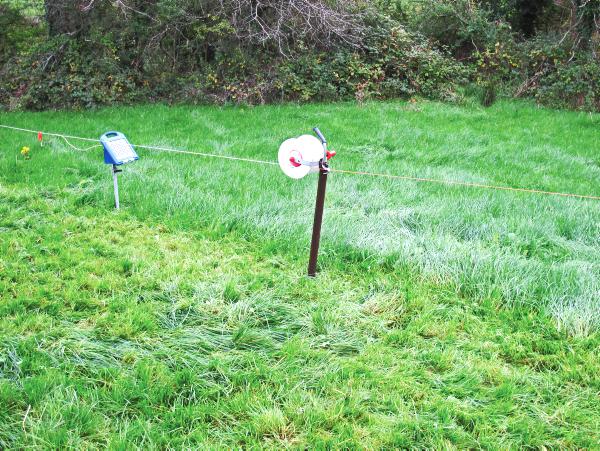
As part of the BETTER Farm programme, measuring grass growth on a weekly basis is part and parcel of improving grassland management. Grass is a crop and it is the cheapest feed resource that any Irish suckler herd has.
Growing more grass and having higher quality grazing available will result in two things at the end of the season – heavier cattle and less concentrates fed during the year.
Just like cattle performance should be monitored to determine which cows are producing the fastest growing calves, grass should also be monitored to determine which paddocks are responsive to fertilizer and which are not. These poor performing fields may need to be reseeded to improve growth.
Sean Coughlan has been measuring grass on his farm over the past four years after encouragement from his local adviser Alan Nolan. For Sean, walking the farm every Monday serves three purposes:
To record the grass growth in the past seven days.
To assess how much grass is available for livestock to graze.
To assess ground conditions across the whole farm.
Farm details
The herd calves from December to April and this year, the calving interval was 354 in 2013 compared with 381 days in 2012.
The herd is bred through AI with a mix of Limousin, Blue and Charolais sires predominantly used.
Calves have previously been sold as weanlings in the autumn, but this year, Sean is considering a different market option by finishing some of the bulls and overwintering heifers for sale in the spring. The main reasons for changing the marketing policy are:
The farm has an abundance of silage in store.
10 cull cows will be sold so there is additional housing space available to carry weanlings over winter.
Increasing the sale value of calves by finishing or selling at a heavier weight.
Grass measurement
The grazing block on the farm consists of 23ha to carry 45 suckler cows. Grass is measured weekly using a plate meter and the figures are then fed into the computer to determine the grass growth.
Simpler methods can also be used, such as having the ideal grass height marked on a welly boot to indicate when cattle should be entering and leaving a field.
Regardless of the method used, the main purpose of getting out and walking the farm on a weekly basis will quickly focus farmers into being much more critical of their grassland.
Pulling up to a field entry or driving through fields that cattle are grazing will do nothing to help you gauge how much grass is present on farm.
For Sean, measuring grass allows him to budget how many days ahead of stock there is at the start of every week.
This means that every Monday lunchtime, Sean will know whether he needs to sow more fertilizer, whether he can skip and close paddocks for silage or whether he will have to reduce the size of a stock group if there is a potential grazing shortage ahead.
In the past week, grass growth on Sean’s farm was 34kgDM/ha/day. The farm has an average grass cover of 1,216kg DM/ha and 33 days ahead of stock.
What these figures basically mean is:
1. Grass growth
This is the amount of grass produced daily. It should be matched to the stock’s grazing demand to determine whether or not there is enough grass growing to feed cattle. For example, Sean currently has grazing 22 cows and 43 weanlings on 23ha.
The cows weigh on average 650kg liveweight and weanlings weigh 350kg, therefore he is carrying 29,350kg of liveweight on 23ha, or 1,276kg of liveweight/ha.
At grass, cattle will eat approximately 2% of their body weight every day. At Sean’s stocking rate, cattle will have a demand for 25kgDM/ha of grass every day (1,279kg X 0.02 = 25kg).
In general, if grass growth is higher than demand, then a surplus will develop. Figures 1 and 2 show the grass growth and stock demand on Sean’s farm over the past two years.
2. Average farm cover (AFC)
This is the average amount of grass available for cattle to graze. The ideal grass height for cattle to start grazing at is 10cm to 12cm (1,600kgDM/ha).
They should then be grazed down to 4cm to 5cm. As grass is measured in kg DM/ha, 4cm is a residual (the remaining grass that was not grazed off) cover of approximately 400kgDM/ha.
With an AFC on Sean’s farm of 1,216kg DM/ha, this means there is 816kg DM/ha of grass available for grazing.
This means that with a daily stock demand of 25kg DM/ha of grass, there are 33 days of grazing available if there was to be no further grass growth this year.
3. Days Ahead
Put simply, if cattle entered a new paddock today and there was no further grass growth, then there should be 33 days before the cattle re-enter this paddock at the stated stocking rate.
Grass utilisation
There is no point in trying to grow more grass if it is not being properly utilised. With heavy grass covers so late into the year, Sean has weaned his cows to avoid damaging swards as ground conditions start to deteriorate.
Weanlings will be used to graze off all paddocks using a strip grazing method. The reason for strip grazing is that Sean does not want weanlings to spoil the grass quality by having free access to roam over a paddock.
In the first half of this year when fodder was tight, cows and calves were on/off grazing using a similar practice.
Cows would be let out to graze for a period of three hours before re-housing. They were allowed out twice daily to graze, but if they became unsettled, they were re-housed immediately.
While to some this may seem labour intensive, it is no different to dairy cow management.
It had the desired effect as Sean was not forced to spend excessive sums of money buying forage and cow fertility did not suffer. Scanning results indicate 92% of cows served are settled in-calf.
Grass performance
Being stocked at over 2LU/ha requires a high level of management. On many farms, stocking rate has increased but little has changed in terms of grassland management. Soil fertility is crucial to supporting a high stocking rate, especially on heavier farms.
In 2013, there has been 60 tonnes of lime spread on Sean’s farm, while 40 tonnes was spread last year. Fertilizer has changed to 10-10-20 and 18-6-12 as well as CAN.
Around 120 units/acre was applied on grazing ground this year which, at an average cost of €360/tonne between compounds and CAN, is approximately €90 worth of nitrogen spread over the season.
The fertilizer bill on the grazing land was approximately €5,112. A total of 78 bales were made from surplus grass this year which are worth €20, minus €10 to make.
The average weaning weight of 26 bull calves was 370kg two weeks ago, while 20 heifers weighed 312kg on the same day.
With a total of 15,860kg of liveweight produced from 23ha and subtracting the value of the bales from the fertilizer costs, Sean’s grazing land produced 690kg/ha of liveweight at a cost of €0.27/kg.
The 23ha of grazing land produced nine tonnes DM/ha this year from 5 April to 22 October.
Reseeding is also a big part of maintaining a high stocking rate and growing more grass each year.
For Sean, the benefits of reseeding is having an earlier start for grass growth in spring and, conversely, having higher growth rates in autumn.
This is helping to shorten winter on his farm which would previously have lasted six months before he started taking grassland management seriously.
Adviser comment
“Using weanlings to good effect can help to manage heavy covers of grass late this autumn. Prioritise groups so that the more efficient cattle utilize grass. Making sure that the soil fertility is being addressed and grass is being reseeded will grow more grass annually, especially at the start and end of the season.” - Shane McHugh.



SHARING OPTIONS