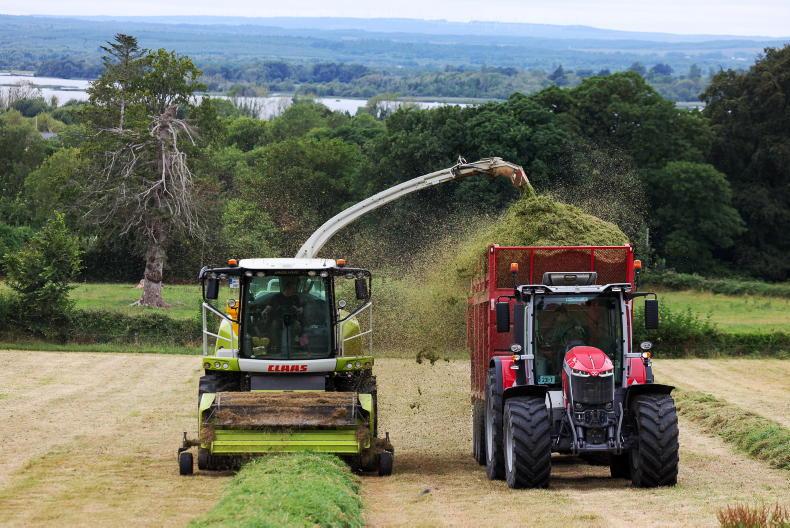
Dairy farmer Gerry Brennan opens up his silage pit a day before bringing his stock inside for the winter feeding season on his farm at Iniskeen, Co Monaghan.
As part of this week’s indoor management focus, William Conlon looks at vermin control. It becomes an issue every year on farms as housing begins and animal feed is stored in sheds around the yard. Typical signs of rodent infestation include rat or mouse droppings around feed stores, gnawing and chewing of materials in sheds, footprints in soft material, eg clay, or holes or burrows in soil around the yard. Infestation with rodents poses both an animal health risk and also more importantly a human health risk. Always wear gloves when handling poison bait and working in areas where rodents are present. If you are not using purpose-built bait boxes, bait should be covered in pipes, etc, to stop other animals from ingesting the bait. Remove dead rodents and replenish bait on a regular basis. Remember to record its usage in your Bord Bia Quality assurance plan.
Carbon Navigator/BDGP deadlines
ADVERTISEMENT
One of the requirements of the BDGP is that a carbon navigator is completed by 31 October 2017. The carbon navigator allows you to look at changes which can be made on the farm in areas such as the length of the grazing season or the average calving rate. The navigator then translates what these changes would mean in terms of reduced greenhouse gases (GHG) emissions from your herd and the increased profitability associated with such a change. The farmer is expected to complete the navigator online through the submission of key data such as grazing dates, etc. They are not required to complete with an adviser for this year 2017 (2016 data).The navigator can be completed by logging on to www.icbf.com and entering the data using your Herdplus account. All BDGP genomic tags must be returned by 7 December 2017 to ensure payment is received in December 2017. Over 30,000 samples have yet to be returned. Make sure you have the sufficient number of tags returned.
FYM Deadline
The last day for spreading farmyard manure is 31 October in accordance with nitrates regulations. Ground conditions are not trafficable on many farms and some have chosen to store this in the yard until spreading can resume. Make sure that the runoff from this material is being collected in a tank and that you have taken account of rain falling on this material as part of your storage calculations. The spreading ban lasts from 1 November to mid-January in zone A and B and 31 January in Zone C.
Rationing Silage
On farms where silage is scarce, body condition-scoring cows and restricting those in very good condition could stretch fodder supplies further. Cows with a condition score of four or five can afford to lose some condition over winter months and can be restricted feed and fed straw if available. Make sure that there is adequate feeding space for cows if you are restricting feed. If buying silage, be careful around the quality and size of bales. Buying a simple ration may present better value in some cases.
Register for free to read this story and our free stories.
This content is available to digital subscribers and loyalty code users only. Sign in to your account, use the code or subscribe to get unlimited access.
The reader loyalty code gives you full access to the site from when you enter it until the following Wednesday at 9pm. Find your unique code on the back page of Irish Country Living every week.
CODE ACCEPTED
You have full access to the site until next Wednesday at 9pm.
CODE NOT VALID
Please try again or contact support.
Vermin Control
As part of this week’s indoor management focus, William Conlon looks at vermin control. It becomes an issue every year on farms as housing begins and animal feed is stored in sheds around the yard. Typical signs of rodent infestation include rat or mouse droppings around feed stores, gnawing and chewing of materials in sheds, footprints in soft material, eg clay, or holes or burrows in soil around the yard. Infestation with rodents poses both an animal health risk and also more importantly a human health risk. Always wear gloves when handling poison bait and working in areas where rodents are present. If you are not using purpose-built bait boxes, bait should be covered in pipes, etc, to stop other animals from ingesting the bait. Remove dead rodents and replenish bait on a regular basis. Remember to record its usage in your Bord Bia Quality assurance plan.
Carbon Navigator/BDGP deadlines
One of the requirements of the BDGP is that a carbon navigator is completed by 31 October 2017. The carbon navigator allows you to look at changes which can be made on the farm in areas such as the length of the grazing season or the average calving rate. The navigator then translates what these changes would mean in terms of reduced greenhouse gases (GHG) emissions from your herd and the increased profitability associated with such a change. The farmer is expected to complete the navigator online through the submission of key data such as grazing dates, etc. They are not required to complete with an adviser for this year 2017 (2016 data).The navigator can be completed by logging on to www.icbf.com and entering the data using your Herdplus account. All BDGP genomic tags must be returned by 7 December 2017 to ensure payment is received in December 2017. Over 30,000 samples have yet to be returned. Make sure you have the sufficient number of tags returned.
FYM Deadline
The last day for spreading farmyard manure is 31 October in accordance with nitrates regulations. Ground conditions are not trafficable on many farms and some have chosen to store this in the yard until spreading can resume. Make sure that the runoff from this material is being collected in a tank and that you have taken account of rain falling on this material as part of your storage calculations. The spreading ban lasts from 1 November to mid-January in zone A and B and 31 January in Zone C.
Rationing Silage
On farms where silage is scarce, body condition-scoring cows and restricting those in very good condition could stretch fodder supplies further. Cows with a condition score of four or five can afford to lose some condition over winter months and can be restricted feed and fed straw if available. Make sure that there is adequate feeding space for cows if you are restricting feed. If buying silage, be careful around the quality and size of bales. Buying a simple ration may present better value in some cases.
If you would like to speak to a member of our team, please call us on 01-4199525.
Link sent to your email address
We have sent an email to your address. Please click on the link in this email to reset your password. If you can't find it in your inbox, please check your spam folder. If you can't find the email, please call us on 01-4199525.
ENTER YOUR LOYALTY CODE:
The reader loyalty code gives you full access to the site from when you enter it until the following Wednesday at 9pm. Find your unique code on the back page of Irish Country Living every week.
SHARING OPTIONS