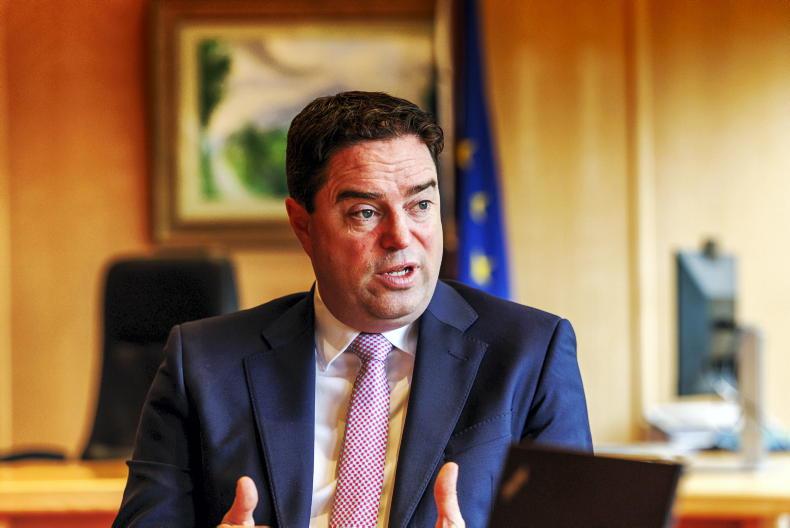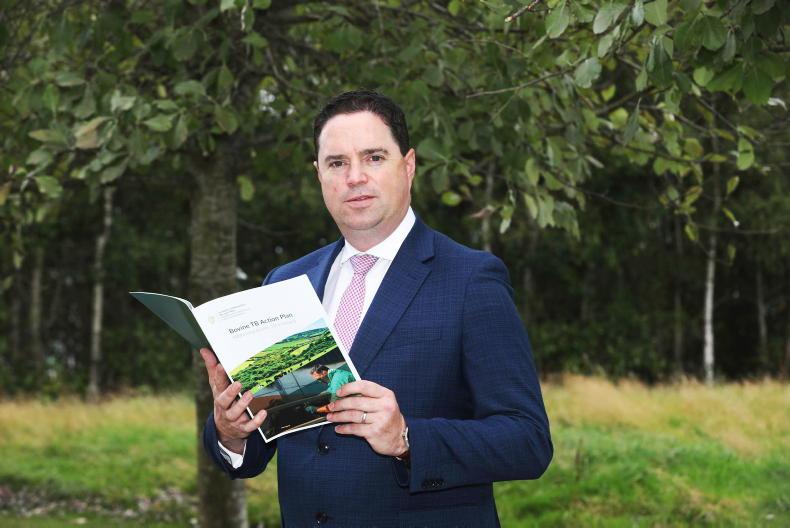
Minister for Agriculture Martin Heydon has said that the State's finances are stretched too tight to have allowed him bring forward an increase to the compensation available to farmers experiencing a bovine TB breakdown.
The focus of the TB eradication programme reset announced on Tuesday must instead lie with spending new funds on measures that will reduce the incidence of the disease, Minister Heydon told the Irish Farmers Journal.
Speaking at the launch of the revamped TB controls, the Minister said that raising TB spending levels over the next two years will prove to be an investment in both farmers and the public purse, as the 30 new actions are anticipated to lower incidence of the disease into the future.
This will, in turn, save farmers from income forgone and will save the Department of Agriculture from opportunity costs associated with spending funding on the disease, rather than other investment areas, he said.
“In 2018, the entirety of the TB programme for this country cost €35m. Last year it cost €101m and to the end of July this year, we spent €61m so far, so last year’s €101m would be surpassed without any additional action,” Minister Heydon commented.
“This is growing exponentially. Last year’s €101m was €101m out of the Department of Agriculture budget that we could spend in a variety of different ways supporting farmers.
“That is why, ultimately here, we need to make the investment now to save the cost that there is on farmers and the Exchequer.”
Compensation plans
The plan itself states that farm-specific risk mitigation plans are to be drawn up outlining biosecurity and cattle trading measures a farmer must follow if they seek compensation after having three or more reactors identified during a single breakdown.
However, Minister Heydon played down the possibility of future links between farmer supports and adherence to these plans when pushed by the Irish Farmers Journal.
“In terms of the risk mitigation plans, in the original proposals and options put forward, it was an option to link risk behaviour with compensation, withdrawing compensation,” he responded when asked on that area of the programme.
“In terms of this approach, it is very much a partnership approach that recognises the cost and huge financial and emotional toll there is on farmers here.
“I took that away because I thought that that was something very difficult to have there in the mix. Farmers don’t want to be in this position.
“This is, as far as possible, trying to incentivise farmers, making them aware, giving them their own information, making them aware of what risk looks like.”
Expected impact of measures
The new measures contained in the updated TB eradication programme have not been modelled individually, rather they are based on previous studies assessing TB trends, the Department’s chief veterinary officer June Fanning said in response to a question from the Irish Farmers Journal.
“While specifically the individual measures haven’t been modelled, it is based on modelling that has been done around the broad measures and based on measures that have been effective in the likes of New Zealand or Australia where they have been successful in moving towards eradication,” the official stated.
The drive to weed out residual infection in cattle that previously tested clear on skin tests in herds that have went down with the disease is likely to see reactor numbers for a year or two after the changes take effect, she continued.
“We do expect there will be an initial increase in the number of reactors because it is with the benefit to, in the future, we will have found that infection earlier and therefore it is not having the chance to spread on and to cause problems.”