



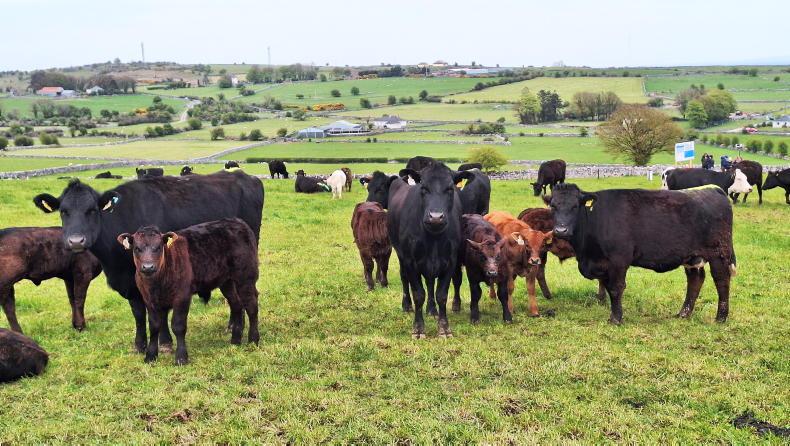
Newford Farm, the 90-cow suckler-to-beef demonstration farm located in Scrine, Co Roscommon, generated a net profit including payments in the Suckler Carbon Efficiency Programme (SCEP) and the National Beef Welfare Scheme (NBWS) of €103,054 in 2025.
The sharp jump in financial performance was underpinned by a combination of higher farmgate beef price and more kilos of beef to sell, with bullocks and heifers killing at significantly higher carcase weights.
The farm, operated by Dawn Meats and Teagasc, with support from McDonald’s, held an open day to showcase the production system on Wednesday afternoon this week.
The farm moved from lands on Teagasc Mellows Campus, Athenry, to Scrine in Roscommon in 2024 and quickly bedded in to the new location.
Discussing the positive financial performance, Teagasc's Padraig French said a key aspect of the farm being in a position to capitalise on higher beef prices in 2025 was keeping variable costs in check and operating at a high level of physical performance to drive output.
Table 1 compares performance in 2023, the final year the farm was located in Atherny, to 2025 and also gives a breakdown on a per-cow basis.
Gross output
Gross output increased by over €1,000/ha and with variable costs remaining similar at €1,554/ha, this lifted the gross margin from €1,202/ha to €2,261/ha.
Fixed costs crept upwards from €725/ha to €1,095/ha through a combination of an increase in hired labour costs and higher costs stemming from a change in farm location.
This breakdown in costs is displayed in Table 2, which shows a detailed breakdown in variable and fixed costs.
Padraig noted that labour sticks out as the most expensive fixed cost, explaining that this covers labour costs for weekend relief, holidays and peak labour periods such as calving.
He said that this is a focal point that will be honed in on in the future, with the farm taking steps to try to reduce the overall labour requirement in the system.
Typical farm return
The financial performance does not include the cost of the farm manager or land rent.
If a farmer was operating a similar system on owned lands, then the system would have potentially generated income of over €100,000 in 2025.
This excludes the Basic Income Support for Sustainability, Complementary Redistributive Income Support for Sustainability, Eco Scheme and Areas of Natural Constraint payments.
It highlights the importance of higher beef prices in contributing to family farm income.
Padraig stated that the farm required a total labour input of 2,800 hours in 2025, which breaks down to about 33 hours per cow. The financial performance generated a return per hour worked of €39/hour in 2025 compared with €15/hour in 2023.
Padraig said that there is scope to reduce the labour requirement, with labour on dairy farms coming in at about 19 hours per cow and that includes milking time.
He said that this is a critical aim to solve, with more suckler farms being operated on a part-time system and labour constraints putting pressure on part-time and full-time systems.



SHARING OPTIONS